Thursday, March 31, 2011
A Different World by Bucky Covington
So I am in a country music mood... I do live in a Country music free zone in NJ. This is a good one from Bucky! It actually reminds me of growing up... more or less! Keep smiling and enjoy the memories!


Pope urges revival of prayer and confession, in era of "lost conscience"

In our era, marked by “signs of loss of conscience and morality and in which there is an obvious lack of esteem for the sacrament of confession", the shepherd of souls and the confessor must have "fidelity to Catholic moral teaching "and" a charitable understanding, and gentle attitude ", so penitents may "feel guided, supported and encouraged in their journey of faith and Christian life”.
This is the teaching of "Doctor of the Church", Saint Alphonsus Liguori, described by Benedict XVI to 20 thousand faithful gathered in St. Peter's Square for the general audience. During the gathering, the Pope also appealed for reconciliation in Côte d'Ivoire, where he announced the dispatch of Ghanaian Cardinal Peter Kodwo Turkson, ,president of the Pontifical Council for Justice and Peace "to express my solidarity and that of the universal Church to victims of the conflict and encourage reconciliation and peace. "
Returning to St. Alphonsus, the Pope described him as a "great moralist Monk," to whom we are "highly indebted" for his work especially for simple people, and author of the words and music of one of the best-loved Italian Christmas carols "You come down from the stars".
Benedict XVI stressed the relevance of the Neapolitan saint’s teachings on moral issues and in particular with regard to the tasks of the confessor. In his day, he explained, " a very strict interpretation of the moral life had spread, partly because of the Jansenist mentality that instead of nourishing trust and hope in the mercy of God, fomented fear that depicted a severe and grim God far from the image revealed in Jesus". St. Alphonsus "offers a balanced and convincing synthesis between the needs of God's law and the dynamics of conscience and freedom of man in adherence to truth and goodness allowing maturation and personal fulfilment. He recommended pastors of souls and confessors, to be faithful to Catholic moral teaching, having a charitable, understanding and gentle attitude, so penitents may feel guided, supported and encouraged in their journey of faith and Christian life. "
Alfonso was born in Naples in 1696. A gifted young man, at only 16 years of age he was awarded a degree in civil and canon law and became the most brilliant lawyer of the Court of Naples, winning all his cases for eight years. However, in 1723 "outraged by the corruption and injustice in the forensic sphere" he decided to leave the profession to become a priest despite the opposition of his father. He had "great teachers" and in 1726 was ordained a priest. In the Diocesan Congregation of the missions he began his apostolic mission of evangelization and catechesis among the most humble strata of the population of Naples.
"Quite a few of these people, poor and simple, whom he was addressing, were often in the grips of vices and performed criminal acts. He patiently taught them to pray, encouraging them to improve their way of life. Alfonso obtained excellent results: in the poorest neighbourhoods of the city groups of people multiplied who, in the evening, met in private homes and shops, to pray and meditate on the Word of God under the guidance of some catechists trained by Alfonso and other priests, who regularly visited these groups of believers. When, at the behest of the archbishop of Naples, these meetings were held in the chapels of the city, they took on the name of 'Evening Chapels'. They were a real source of moral education, social rehabilitation, mutual support among the poor: theft, duels, prostitution almost disappeared. "
"Although the social and religious context of the time of St. Alphonsus was very different from ours, the 'Evening Chapels' appear a model of missionary activity that can inspire us today for a new evangelization, especially among the poorest, and to build a more human, just and fraternal solidarity in society. Priests were given the task of spiritual ministry, and well-formed lay Christian leaders can be effective, authentic Gospel leaven in society. "
At 35 St. Alphonsus came into contact with farmers and shepherds of the inner regions of the kingdom, who were spiritually and materially poor. In 1732 he founded the Religious Congregation of the Most Holy Redeemer. "These men, led by Alfonso, were true itinerant missionaries, reaching even the most remote villages exhorting to conversion and perseverance in the Christian life, especially through prayer. Even today, the Redemptorists, scattered in many countries around the world with new forms of apostolate continue this mission of evangelization. I think of them with gratitude, urging them to always be faithful to the example of their holy founder. " In 1762 he was appointed bishop of St. Agatha of the Goths, which he left in 1765 due to illness. "He was a saint exclaimed Pope Pius VI at the news of his death in 1787. And he was not wrong. " He was beatified in 1816 and canonized in 1787 and in 1817 Pope Pius IX proclaimed him a Doctor of the Church and Pope Pius XII in 1950, wanted him patron saint of confessors and moralists
Finally, Benedict XVI underlined his insistence "on the need for prayer" and recalled the motto of the saint, "he who prays is saved," and the exhortation of John Paul II: "Our Christian communities must become schools of prayer. It is therefore essential that education in prayer becomes a priority of all pastoral planning”.
This is the teaching of "Doctor of the Church", Saint Alphonsus Liguori, described by Benedict XVI to 20 thousand faithful gathered in St. Peter's Square for the general audience. During the gathering, the Pope also appealed for reconciliation in Côte d'Ivoire, where he announced the dispatch of Ghanaian Cardinal Peter Kodwo Turkson, ,president of the Pontifical Council for Justice and Peace "to express my solidarity and that of the universal Church to victims of the conflict and encourage reconciliation and peace. "
Returning to St. Alphonsus, the Pope described him as a "great moralist Monk," to whom we are "highly indebted" for his work especially for simple people, and author of the words and music of one of the best-loved Italian Christmas carols "You come down from the stars".
Benedict XVI stressed the relevance of the Neapolitan saint’s teachings on moral issues and in particular with regard to the tasks of the confessor. In his day, he explained, " a very strict interpretation of the moral life had spread, partly because of the Jansenist mentality that instead of nourishing trust and hope in the mercy of God, fomented fear that depicted a severe and grim God far from the image revealed in Jesus". St. Alphonsus "offers a balanced and convincing synthesis between the needs of God's law and the dynamics of conscience and freedom of man in adherence to truth and goodness allowing maturation and personal fulfilment. He recommended pastors of souls and confessors, to be faithful to Catholic moral teaching, having a charitable, understanding and gentle attitude, so penitents may feel guided, supported and encouraged in their journey of faith and Christian life. "
Alfonso was born in Naples in 1696. A gifted young man, at only 16 years of age he was awarded a degree in civil and canon law and became the most brilliant lawyer of the Court of Naples, winning all his cases for eight years. However, in 1723 "outraged by the corruption and injustice in the forensic sphere" he decided to leave the profession to become a priest despite the opposition of his father. He had "great teachers" and in 1726 was ordained a priest. In the Diocesan Congregation of the missions he began his apostolic mission of evangelization and catechesis among the most humble strata of the population of Naples.
"Quite a few of these people, poor and simple, whom he was addressing, were often in the grips of vices and performed criminal acts. He patiently taught them to pray, encouraging them to improve their way of life. Alfonso obtained excellent results: in the poorest neighbourhoods of the city groups of people multiplied who, in the evening, met in private homes and shops, to pray and meditate on the Word of God under the guidance of some catechists trained by Alfonso and other priests, who regularly visited these groups of believers. When, at the behest of the archbishop of Naples, these meetings were held in the chapels of the city, they took on the name of 'Evening Chapels'. They were a real source of moral education, social rehabilitation, mutual support among the poor: theft, duels, prostitution almost disappeared. "
"Although the social and religious context of the time of St. Alphonsus was very different from ours, the 'Evening Chapels' appear a model of missionary activity that can inspire us today for a new evangelization, especially among the poorest, and to build a more human, just and fraternal solidarity in society. Priests were given the task of spiritual ministry, and well-formed lay Christian leaders can be effective, authentic Gospel leaven in society. "
At 35 St. Alphonsus came into contact with farmers and shepherds of the inner regions of the kingdom, who were spiritually and materially poor. In 1732 he founded the Religious Congregation of the Most Holy Redeemer. "These men, led by Alfonso, were true itinerant missionaries, reaching even the most remote villages exhorting to conversion and perseverance in the Christian life, especially through prayer. Even today, the Redemptorists, scattered in many countries around the world with new forms of apostolate continue this mission of evangelization. I think of them with gratitude, urging them to always be faithful to the example of their holy founder. " In 1762 he was appointed bishop of St. Agatha of the Goths, which he left in 1765 due to illness. "He was a saint exclaimed Pope Pius VI at the news of his death in 1787. And he was not wrong. " He was beatified in 1816 and canonized in 1787 and in 1817 Pope Pius IX proclaimed him a Doctor of the Church and Pope Pius XII in 1950, wanted him patron saint of confessors and moralists
Finally, Benedict XVI underlined his insistence "on the need for prayer" and recalled the motto of the saint, "he who prays is saved," and the exhortation of John Paul II: "Our Christian communities must become schools of prayer. It is therefore essential that education in prayer becomes a priority of all pastoral planning”.
Pope John Paul II's Methodist Pilot Recalls the "Pope of All People"

The following comes from the Catholic Key:
Pope John Paul II, fresh from a rain-soaked Mass on the Boston Commons, gave the baby-faced pilot of Shepherd I a bear hug. Then held he held him at arm’s length for a good look, and proclaimed, “You are so young!”
The 32-year-old Nelson Krueger, stunned to be unexpectedly face-to-face with the pontiff in the airliner’s cockpit, replied with the first words that came to his mind: “You are so wet!”
The pope let out a big laugh and looked Krueger straight in the eyes.
“The guy was so warm and friendly,” Kreuger told The Catholic Key. “There I was face-to-face with the Holy Father. Our eyes met, and those millions of bits of information that happen in such a moment were exchanged.”
It was the start of a relationship that would last a week, and, to this day nearly 32 years later, one that the pilot would remember in minute detail for the rest of his life.
Krueger was already one of the top international pilots for Trans World Airlines when he was hand-selected by Capt. Sal Fallucco, the airline’s director of flight operations, to sit in the left seat for Pope John Paul’s first pastoral and state visit to the United States from Oct. 1-7, 1979.
Krueger, now retired and living in Lawrence, was on a layover in St. Louis in mid-September when he got the call from TWA’s chief scheduler to get back to headquarters in Kansas City right away.
For the rest of the story please click here!
Wednesday, March 30, 2011
Time-Lapse Auroras Over Norway
The Aurora from Terje Sorgjerd on Vimeo.
God is good! Check this out on a bigger screen here.As beatification nears, memories of Pope John Paul II surface

The following comes from the CNA:
With the May 1 beatification of Pope John Paul II fast approaching, those who knew and loved the late pontiff are speaking out about the imprint he left on the Church and the world.
Archbishop Piero Marini remembered the “almost father-son relationship” he enjoyed with the Pope while serving as his master of liturgical ceremonies. In a Vatican Radio broadcast on March 28, he said that the beatification is a way for all people to once again “re-encounter this friend of humanity” by getting to know him, his love for evangelization and his strong witness.
Archbishop Marini remembered that the "greatest gift" the Pope ever gave him was in reminding him of the everyday quality of holiness. "Each of us ... must build sanctity responding to the vocation that the Lord has given us in our life with humility and simplicity as John Paul II did. He spent his entire life announcing the Gospel to create unity."
By going out to meet the people where they were, proclaiming God's Word and celebrating the Eucharist and sacraments, the Pope was able "to create around himself, around the person of the Pope, truly the unity of the Church," said the archbishop.
Cardinal Roberto Tucci, who planned the Pope's lengthy and frequent trips to international destinations, remembered the Pope for his "spontaneity."
He was present at a press conference last week to launch Italian journalist Angela Ambrogetti's new book, "Travel Companions," examining previously unedited comments and conversations the Pope had with reporters on his trips abroad.
Cardinal Tucci called the book a "rare and efficient testimony of the personality and the ideas of Pope Wojtyla which comes across with great freshness – as it was – with his extraordinary spontaneity and freedom of expression, with his kindness and bluntness before others, also to that special kind of humanity that are journalists."
Vatican spokesman Fr. Federico Lombardi, and veteran Vatican analysts Gian Franco Svidercoschi and Paloma Gomez Borrero recounted anecdotes of their personal experiences with the pontiff on the numerous papal flights.
Beautiful accounts of the Pope’s spirituality have come to light.
Cardinal Angelo Comastri said Pope John Paul "restored Mary to her place in the Church alongside Jesus."
In an article written for the Diocese of Rome's website, the archpriest of St. Peter's Basilica and Marian scholar recalled that in the 1960s and 1970s many sought to marginalize the Madonna.
Into this "Marian winter," Pope John Paul led the Church to rediscover Mary, said the cardinal.
"It is beginning from Jesus, in fact, that one discovers Mary, and beginning from Jesus that one notes the presence of the Mother and her interminible mission ... that of leading us to him!"
Cardinal Comastri remembered the great faith of John Paul II and his untiring devotion to the Blessed Mother.
"Every time we touch the crown of the Holy Rosary and recite the Holy Mary, may a spontaneous exclamation come out of our hearts, "Totus tuus, Maria!" (Totally yours, Mary!). It is the Marian inheritance that John Paul II left us."
Initiatives to remember the Pope are also popping up all over the city. On March 31 at the Pontifical University of the Holy Cross, Cardinal Angelo Amato of the Vatican's department for saints' causes and the late-Pope's spokesman, Joaquin Navarro-Valls, will be joined by journalists and experts in examining public opinion and "sensus fidei" (sense of the faithful) ahead of the beatification.
A pub in downtown Rome called the GP2 (Italian abbreviation for JPII) has announced that it will be hosting a series of encounters for the month of April in the countdown to the beatification. The Diocese of Rome-sponsored establishment has scheduled the likes of Fr. Slawomir Oder, the priest in charge of John Paul II's cause for sainthood, and former vicar general of Rome, Cardinal Camillo Ruini, as speakers at the gatherings.
Pontifical universities and religious communties are organizing events, lectures, conferences and prayer memorials for the late Pope ahead of this occasion, which could prove to be the largest since his funeral on April 8, 2005.
Vatican officials are hesitant to make estimates as to possible attendance. Expectations will certainly be become more clear during an April 5 press conference at the Vatican's Press Office. Cardinal Agostino Vallini, current vicar general of Rome, and other Church officials will host the press event.
At a March 29 press conference, Vatican-affiliated pilgrimage and travel agency Opera Romana Pelligrinagi (ORP) set the bar low, saying they are expecting a minimum of 300,000 people to attend.
The pilgrimage agency has set up reliable information hub at www.jpiibeatus.org, offering information on the beatification, lodging and travel for anyone interested in making the trip.
The organization is even offering a multilingual telephone hotline for direct inquiries and a discounted three-day tour pass for the weekend. They emphasize that no ticket is needed for the ceremony.
The agency announced that structures are being built around St. Peter's Square for the huge influx of people. Reception points will serve pilgrims around the Square with bathrooms and refreshment stands, while young adults are encouraged to "spend the night safely" in a village set up outside the city.
They announced that the city of Rome awaits all who come "with open arms."
The Living Scripture Blog

Tuesday, March 29, 2011
China: Don Bosco has come to get to know the young people of China

The following comes from the Salesian News Agency:
On Thursday 17 March, slightly ahead of schedule, the casket with the relic of Don Bosco arrived in the Special Administrative Region of Hong Kong of the Chinese Peoples’ Republic.
“Saint John Bosco has come!” Fr Simon Lam, Superior of the “Mary Help of Christians Province of China” declared during the welcoming ceremony. Among those with the Provincial at the “Ex Skylimo International airport” was Cardinal Joseph Zen Ze-Kiun, SDB, former Bishop of Hong Kong, and over 200 members of the local Salesian Family.
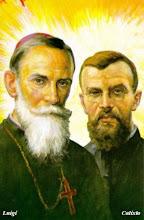
During the ceremony the Provincial recalled Don Bosco’s wish to send his spiritual sons to China and Don Rua eventually sending Fr Luigi Versiglia, who became a martyr saint for God and for China. Cardinal Zen Ze-Kiun spoke about the importance of the visit of the casket: “It is important to treasure these days that we can stay with Don Bosco, to pray for those who are in need especially abandoned young people. For Don Bosco`s confreres this is a chance for us to review our religious vocation and apostolic life.”
Then a Guard of Honour from Salesian Yip Hon Primary School and Salesian Yip Hon Millennium Primary School performed Giu’ Dai Colli to escort the Casket, while Cardinal Zen officiated at the ceremony.
On Friday 25 March the casket was welcomed at the Tang King Po Institute, in a ceremony at which the School Band and Choir performed. Also on this occasion Cardinal Zen Ze-Kiun and the Provincial both spoke. Referring to the relic of Don Bosco’s right hand said that Jesus used human’s hands to do his work and uses our heart to love others. Addressing the young people Fr Lam said that Don Bosco present among them through his relic was interested in them and would like to know about them and what their daily life was like so that he could lead them to Jesus.
Student representatives then expressed their wishes and prayed in front of the relic of Don Bosco with the intentions that temptations might be kept away from them, they might use their time well and spread the Gospel among their companions
The following day Saturday 26, in the church of Mary Help of Christians about 1500 young people gathered around the casket. With traditional dances, musical and theatrical performances they demonstrated the quality and breadth of their Salesian education and at the same time the characteristics of the Salesian Youth Movement: joy, cheerfulness, hard work, serving God enthusiastically, caring and serving others.
Among the young people present were 9 from Mongolia, accompanied by Fr Paul Leung, who with a video showed the Salesian mission in Mongolia.
Pope Benedict: God sent Jesus to quench man’s thirst for eternal life

Before the thousands of faithful gathered in St. Peter’s Square for the Sunday Angelus, Pope Benedict XVI said that God’s all-powerful love respects the freedom of every person and therefore touches man’s heart and “waits patiently for his answer.”
“God the Father sent Christ to satisfy our thirst for eternal life by giving us his love, but Jesus asks of us the gift of our faith,” the Pope stated before the Angelus.
He discussed the gospel reading about Jesus’ encounter with the Samaritan woman at the well, explaining that his fatigue is “a sign of his true humanity” which can be seen as a prelude of his Passion.
His encounter with the woman at the well raises the theme of thirst and foreshadows his cry on the Cross: “I have thirst.”
While this thirst and fatigue had a physical aspect, the Pope explained, Jesus “thirsted” for the woman’s faith and for the faith of all mankind.
The water in the gospel story “clearly” refers to the sacrament of baptism, “the source of new life for the faith in the grace of God.” The water represents the Holy Spirit, the gift “par excellence” that Jesus brings to man from God the Father.
“Each one of us can take the place of the Samaritan woman,” the Pope continued. “Jesus waits for us, especially in this time of Lent, to speak with us. Let us pause for a moment in silence in our room, or in a church or in a secluded place.”
“Listen to his voice that tells us ‘If you knew the gift of God…’,” he said as he finished his remarks.
He closed with the prayer: “May the Virgin Mary help us not to miss this event, on which depends our true happiness.”
After the Angelus, Pope Benedict offered a “warm greeting” to English-speaking visitors.
“In today’s Gospel Jesus speaks to the Samaritan women of the gift of the Holy Spirit, the water which wells up to eternal life in those who believe. Through our Lenten observance may all of us be renewed in the grace of our baptism and prepare with hearts renewed to celebrate the gift of new life at Easter. Upon you and your families I invoke God’s blessings of joy and peace!”
Monday, March 28, 2011
Pope Benedict: Take a moment to listen this Lent

The following comes from Zenit.org:
Benedict XVI is inviting the faithful to pause a moment in silence this Lent to listen to God speaking to their hearts.
The Pope reflected today on the Gospel story of the Samaritan women, whom Jesus spoke to at Jacob's well, before praying the midday Angelus together with those gathered in St. Peter's Square.
"The woman goes every day to get water from an ancient well put there by the patriarch Jacob, and that day Jesus was sitting there, 'tired from the journey,'" the Pontiff explained.
"Jesus' weariness, sign of his true humanity, can be seen as a prelude to the passion, with which he brought the work of our redemption to completion," he said.
The Holy Father that Christ was also thirsty, and that the "theme of 'thirst' emerges in particular in the meeting with the Samaritan woman at the well."
"This thirst, like the weariness, has a physical basis," the Pontiff explained. "But Jesus, as Augustine continues, 'had thirst of the woman's faith,' as he has for the faith of all of us.
"God the Father sent him to quench our thirst for eternal life, giving us his love, but asks our faith for bestowing this gift. Love's omnipotence always respects man's freedom; it knocks at his heart and awaits his answer with patience."
Baptism
Benedict XVI noted in particular the prominence of water in the encounter between Christ and the Samaritan woman: "It clearly alludes to the sacrament of baptism, the source of new life through faith in the grace of God."
"This water represents the Holy Spirit," he explained, "the 'gift' par excellence that Jesus has come to bring us from God the Father. Whoever is reborn by the water of the Holy Spirit, that is, baptism, enters into a real relation with God, a filial relation, and can worship 'in spirit and truth,' as Jesus discloses to the Samaritan woman.
"Thanks to the encounter with Jesus Christ and the gift of the Holy Spirit, man's faith comes to its fulfillment, as an answer to God's revelation."
"Each one of us can identify ourselves with the Samaritan woman," the Holy Father affirmed. "Jesus awaits us, especially during this season of Lent, to speak to our hearts, to my heart.
"Let us pause a moment in silence, in our room, or in a church, or in a place apart. Let us listen to the voice that says: 'If you knew the gift of God.'"
Sunday, March 27, 2011
Saturday, March 26, 2011
POPE BENEDICT: CONFESSIONAL ALSO A PLACE TO LEARN SOMETHING
 The following comes from Zenit.org:
There is a pedagogical value to the sacrament of confession, according to Benedict XVI.
The Pope affirmed this today when he addressed participants in a five-day course on the internal forum. The seminar, sponsored by the Apostolic Penitentiary, concluded today.
The Holy Father said that the teaching-learning aspect of confession is not sufficiently considered, despite its spiritual and pastoral importance.
"In what way does the sacrament of penance educate?" he asked. "In what sense does its celebration have a pedagogical value, first of all, for the ministers?"
The Holy Father said that the teaching-learning aspect of confession is not sufficiently considered, despite its spiritual and pastoral importance.
"In what way does the sacrament of penance educate?" he asked. "In what sense does its celebration have a pedagogical value, first of all, for the ministers?"
To respond to these questions, he suggested starting with the recognition "that the priestly ministry constitutes a unique and privileged observation post, from which, daily, we are enabled to contemplate the splendor of divine mercy."
"Fundamentally," the Holy Father said, "to confess means to assist in as many 'professiones fidei' as there are penitents, and to contemplate the action of the merciful God in history, to touch the salvific effects of the cross and resurrection of Christ, at all times and for every man."
The Pontiff reflected how in the confessional, the priest in a sense visits the "abyss of the human heart, also in the dark aspects." And this, he said, also tests the "humanity and the faith of the priest himself."
"On the other hand," he continued, "it nourishes in him the certainty that the last word on the evil of man and of history is God's, it is his mercy, able to make all things new."
The Pontiff reflected how in the confessional, the priest in a sense visits the "abyss of the human heart, also in the dark aspects." And this, he said, also tests the "humanity and the faith of the priest himself."
"On the other hand," he continued, "it nourishes in him the certainty that the last word on the evil of man and of history is God's, it is his mercy, able to make all things new."
From confession, in fact, the priest can learn much, the Pope said, above all "from exemplary penitents by their spiritual life, by the seriousness with which they conduct their examinations of conscience, by the transparency in recognizing their sin and by their docility to the teaching of the Church and the indications of the confessor."
"From the administration of the sacrament of penance we can receive profound lessons of humility and faith," he assured. Confession is "a very strong call for each priest to the awareness of his own identity."
"Never, in the strength of our humanity alone, would we be able to hear the confessions of brothers," continued the Pope. "If they approach us, it is only because we are priests, configured to Christ, High and Eternal Priest, and made capable of acting in his name and in his person, of rendering really present God who forgives, renews and transforms."
Penitents, too
In regard to the pedagogical value for penitents, the Holy Father said that it depends "first of all, on the action of grace and on the objective effects of the sacrament in the soul of the faithful."
"Sacramental reconciliation is one of the moments in which personal liberty and self-awareness are called to express themselves in a particularly evident way," the Pontiff observed. "It is perhaps also because of this that, in an age of relativism and of consequent attenuated awareness of one's being, the sacramental practice is also weakened."
In this context, the examination of conscience has "an important pedagogical value" as it "educates to look with sincerity at one's own existence, to confront it with the truth of the Gospel, and to evaluate it not just with human parameters, but changed by divine revelation," he said. "The comparison with the Commandments, with the Beatitudes and, above all, with the precept of love, constitutes the first great 'penitential school.'"
Furthermore, Benedict XVI proposed, an integral confession of sins "educates the penitent in humility, in recognition of his own fragility and, at the same time, in awareness of the need for God's forgiveness and trust that divine grace can transform life."
Furthermore, Benedict XVI proposed, an integral confession of sins "educates the penitent in humility, in recognition of his own fragility and, at the same time, in awareness of the need for God's forgiveness and trust that divine grace can transform life."
In an age characterized "by noise, distraction and loneliness," said the Pope, "the penitent's conversation with the confessor can be one of the few, if not the only occasion to be truly heard and in profundity."
For this reason, the Bishop of Rome asked priests to "give appropriate space to the exercise of the ministry of penance in the confessional."
"To be received and heard is also a human sign of the acceptance and goodness of God to his children," he said.
Health of souls
In his greeting to the Pope, Cardinal Fortunato Baldelli, major penitentiary, reminded that "every confessor, to carry out his ministry well and faithfully, must have the necessary learning and prudence for this purpose."
"To be received and heard is also a human sign of the acceptance and goodness of God to his children," he said.
Health of souls
In his greeting to the Pope, Cardinal Fortunato Baldelli, major penitentiary, reminded that "every confessor, to carry out his ministry well and faithfully, must have the necessary learning and prudence for this purpose."
The cardinal introduced to the Pope the priests of 242 dioceses of 68 nations who are participating in the annual course on the internal forum, and he confirmed that "the doctrinal preparation of the confessor is absolutely indispensable."
Following in the footsteps of Pope Pius V -- who said, give me good confessors and I will renew the whole Church from her foundations -- the penitentiary promotes every year these days of study on the sacrament, the cardinal noted.
"With intense satisfaction," he said, "we note that the fruits of these annual meetings have a concrete confirmation in the daily activity of our dicastery, which is approached with increasing interest and known for its essential mission in the Church, which is the 'salus animarum.'"
Friday, March 25, 2011
Do Beautiful Churches Produce Vocations?

This is a very good question and Fr. Dwight Longenecker offers an insightful answer:
I know a young priest who was brought up as a Baptist. He went into a beautiful old Catholic Church during the liturgy. This was a classic neo-Gothic church with stained glass windows and a beautiful liturgy. He fell to his knees and said that he knew then and there that he not only needed to be a Catholic, but that he was called to be a Catholic priest. He's not the only one. I know two other guys who eventually made the same decision for the same reason, and numerous other converts who were drawn by the beauty and reverence of worship including the reverence evoked by the beautiful church.
The unknown architect of Glastonbury Abbey in England wrote, "I want to create a church so beautiful that it will move even the hardest heart to prayer." Can a beautiful church produce vocations to the priesthood? Perhaps we should reverse the question and say, "Does an ugly church discourage priestly vocations?" To answer the question we must think through, and come up with a theory of aesthetics and think through the reasons for both ugly churches and beautiful churches. Once we understand the mentality behind both we will be able to answer the question of whether a beautiful church can help produce new vocations to the priesthood.
The modern churches we deem 'ugly' are usually designed from a utilitarian point of view. Modern architecture has taken as it's creed Frank Lloyd Wright's dictum, "Form follows function." Therefore most modern architechts, when considering the building of a church will ask, "Where will everyone sit. What kind of an artificial sound system should we install? Where will the heating, air conditioning and toilets go? Where will the Sunday School rooms go? What about disabled access? Do we need elevators?" All these practical and utilitarian questions must, of course, be answered, but if they are the only considerations you will end up with a practical, inexpensive and ugly building. You'll end up with a building that is simply an auditorium.
Then, of course, Catholics will want their church to be 'pretty' so they'll spend lots of money adding a layer of gloss. They'll throw in some marble. They'll buy some second hand stained glass windows from an old church in Ohio or somewhere. They'll add a nice tabernacle or some statues. That's all well and good, but the building itself is still probably an ugly, utilitarian, cheaply built structure.
We then have to ask what these churches say about the faith, for the church building is a sacramental. It states what we believe. A building, whether we like it or not, is a statement of our values, our faith and our world view. A cheap building with no inner integrity of beauty--a cheap building that is 'dressed up' to look Catholic or 'pretty' with decorations is superficial and shallow and only skin deep....just like our faith too often I'm afraid! In our superficial, face lift world we build churches that are superficial where the 'beauty' is really on 'pretty' and skin deep.
What about the liturgy that goes on in such buildings? Too often it also is superficial, sweet and comfortable and skin deep. Does such liturgy and do such buildings inspire vocations? Do they say to our young people, "Look what sacrifices we have made to worship God?" Do they say, "We have given all to build something beautiful for God"? or do they actually say, "It's okay to give God second best. It's okay to give him what's left over."? Do they come out of the building yawning and wondering what next for Sunday or do they come out full of awe and thankfulness for the beautiful worship of God?
A beautiful church, that required great sacrifice to build, on the other hand--combined with beautiful liturgy and an awesome and reverent worship of God is more likely to inspire the reverence and awe and sacrifice required of our young people who are thinking about a vocation.
This is my theory: sacrifice much to build a beautiful church and you will find that your children will sacrifice much to become the priests, brothers and sisters to fill that church for a next generation.
The unknown architect of Glastonbury Abbey in England wrote, "I want to create a church so beautiful that it will move even the hardest heart to prayer." Can a beautiful church produce vocations to the priesthood? Perhaps we should reverse the question and say, "Does an ugly church discourage priestly vocations?" To answer the question we must think through, and come up with a theory of aesthetics and think through the reasons for both ugly churches and beautiful churches. Once we understand the mentality behind both we will be able to answer the question of whether a beautiful church can help produce new vocations to the priesthood.
The modern churches we deem 'ugly' are usually designed from a utilitarian point of view. Modern architecture has taken as it's creed Frank Lloyd Wright's dictum, "Form follows function." Therefore most modern architechts, when considering the building of a church will ask, "Where will everyone sit. What kind of an artificial sound system should we install? Where will the heating, air conditioning and toilets go? Where will the Sunday School rooms go? What about disabled access? Do we need elevators?" All these practical and utilitarian questions must, of course, be answered, but if they are the only considerations you will end up with a practical, inexpensive and ugly building. You'll end up with a building that is simply an auditorium.
Then, of course, Catholics will want their church to be 'pretty' so they'll spend lots of money adding a layer of gloss. They'll throw in some marble. They'll buy some second hand stained glass windows from an old church in Ohio or somewhere. They'll add a nice tabernacle or some statues. That's all well and good, but the building itself is still probably an ugly, utilitarian, cheaply built structure.
We then have to ask what these churches say about the faith, for the church building is a sacramental. It states what we believe. A building, whether we like it or not, is a statement of our values, our faith and our world view. A cheap building with no inner integrity of beauty--a cheap building that is 'dressed up' to look Catholic or 'pretty' with decorations is superficial and shallow and only skin deep....just like our faith too often I'm afraid! In our superficial, face lift world we build churches that are superficial where the 'beauty' is really on 'pretty' and skin deep.
What about the liturgy that goes on in such buildings? Too often it also is superficial, sweet and comfortable and skin deep. Does such liturgy and do such buildings inspire vocations? Do they say to our young people, "Look what sacrifices we have made to worship God?" Do they say, "We have given all to build something beautiful for God"? or do they actually say, "It's okay to give God second best. It's okay to give him what's left over."? Do they come out of the building yawning and wondering what next for Sunday or do they come out full of awe and thankfulness for the beautiful worship of God?
A beautiful church, that required great sacrifice to build, on the other hand--combined with beautiful liturgy and an awesome and reverent worship of God is more likely to inspire the reverence and awe and sacrifice required of our young people who are thinking about a vocation.
This is my theory: sacrifice much to build a beautiful church and you will find that your children will sacrifice much to become the priests, brothers and sisters to fill that church for a next generation.
Thursday, March 24, 2011
Pope Benedict: The Church needs courageous apostles to fight religious indifference
 The following comes from the CNA:
Pope Benedict said at his Wednesday general audience that the modern world needs “zealous” disciples of Christ, who will fight religious indifference with the “light and beauty” of the Gospel.
The Pope dedicated his teaching at the Vatican on March 23 to St. Lawrence of Brindisi, who was born in Italy in 1559 and was named one of the Doctors of the Church for his expertise in preaching Catholic doctrine and Sacred Scripture.
St. Lawrence is known for his “clear and tranquil” explanations of the Christian faith to his surrounding culture, the pontiff noted, particularly to those who had left the Church in the wake of the Reformation.
“Even today, the new evangelization needs well-trained, zealous and courageous apostles, so that the light and beauty of the Gospel may prevail over the cultural trends of ethical relativism and religious indifference,” he said. This effort will help transform the various ways people think about life and help them act with an “authentic Christian humanism.”
St. Lawrence, who lost his father at the age of seven, was entrusted by his mother to the care of the Franciscan Friars Minor Conventuals. He later entered the Order of Capuchins and was ordained a priest in 1582.
The saint acquired a deep knowledge of ancient and modern languages, which enabled him to “undertake an intense apostolate among various categories of people,” the Pope explained.
He was also an effective preacher, who was so well versed in the Bible and rabbinic literature “that rabbis themselves were amazed and showed him esteem and respect.”
“The success enjoyed by St. Lawrence helps us to understand that even today, as the hope-filled journey of ecumenical dialogue continues, the reference to Sacred Scripture, read in the Tradition of the Church, is an indispensable element of fundamental importance,” Pope Benedict said.
He added that even “the lowliest members of the faithful” benefited “from the convincing words of St. Lawrence, who addressed the humble in order to call everyone to live a life coherent with the faith they professed.”
The Pope then noted another prominent aspect of St. Lawrence's life, which was his tireless work to promote political and religious peace.
Popes and Catholic princes “repeatedly entrusted him with important diplomatic missions to placate controversies and favor harmony between European States, which at the time were threatened by the Ottoman Empire,” he said.
“Today, as in St. Lawrence's time, the world has great need of peace, it needs peace-loving and peace-building men and women,” Pope Benedict said. “Everyone who believes in God must always be a source of peace and work for peace.”
St. Lawrence was canonized in 1881 and declared a Doctor of the Church in 1959 by Blessed John XXIII, who recognized not only the saint's personal sanctity, but his numerous contributions to biblical scholarship.
“St. Lawrence of Brindisi,” Pope Benedict said, “teaches us to love Sacred Scripture, to become increasingly familiar with it, daily to cultivate our relationship with the Lord in prayer, so that our every action, our every activity, finds its beginning and its fulfillment in Him.”
Wednesday, March 23, 2011
Tuesday, March 22, 2011
Monday, March 21, 2011
'Jesus of Nazareth' by Pope Benedict is instant bestseller
 The following comes from the Spero News site:
Pope Benedict XVI’s second volume on Christ’s life debuts on the March 27 New York Times Bestseller List. Released March 10 worldwide, the new volume covers the last week of Jesus’ earthly life – from his entrance into Jerusalem to his resurrection and appearances to his apostles and other followers. “We’re delighted that Jesus of Nazareth: Holy Week is an instant New York Times bestseller. It means that many people across the country are discovering Pope Benedict’s insights into the life of Jesus Christ,” said Mark Brumley, President of Ignatius Press reacting to the announcement. “In this way, more and more people will encounter the real Jesus, which was the Holy Father’s goal in writing the book. It would be great if Jesus of Nazareth: Holy Week became the number one book in America!”
Global reaction to the book makes it clear that Benedict XVI has contributed a work on Jesus that is as important and historically significant as it is well-written and thorough.
“It’s a remarkable achievement,” said Protestant scholar Dr. Craig A. Evans of Acadia Divinity College, Acadia University, in Wolfville, N.S., Canada. “It’s the best book I’ve read on Jesus in years. This is a book that I think all Christians should read, be they Protestant or Catholic.”
“(The Pope) asked for the union of theology and critical history, a response to the failure of critical historical scholarship during the last century,” said Dr. Jacob Neusner, Rabbi and Distinguished Research Professor of Religion and Theology at Bard College in Annandale-on-Hudson, N.Y. “And he’s accomplished something that no one else has achieved in the modern study of Scripture.”
“This book fulfills Pope Benedict’s ardent desire – that it would ‘be helpful to all readers who seek to encounter Jesus and to believe in him,’” said Capuchin Fr. Thomas G. Weinandy (O.F.M., Cap.), Executive director of the U.S. Conference of Catholic Bishops Secretariat for Doctrine.
Sunday, March 20, 2011
Good Stuff about Salesians!
The young men of my community made a great video on the works of our Salesian Province! I hope you enjoy it!
Saturday, March 19, 2011
The Spirituality of St. Joseph
 The following comes from Fides Service:
"Humility, generosity, unconditional devotion, enlivened by a genuine spirit of service, living in poverty, absolute obedience and chastity, all these virtues that distinguish St. Joseph, which the Church celebrates on March 19, are so relevant for men today." This is how a Beijing priest encouraged his flock during the Lenten retreat that started today, on the eve of the Solemnity of the Patron Saint of the Universal Church and Patron of the Mission in China.
According to information received by Fides, across China, especially in parishes dedicated to the Saint, the faithful are living the month of March intensely, focusing on St. Joseph, in the spirit of Lent. These include, for example, the Parish of St. Joseph in downtown Beijing, dating back to the church built by the two Jesuit missionaries, successors of Fr. Matteo Ricci: Fr. Louis Buglio and Fr. Gabriel de Magallanes. To mark the 400th anniversary of the death of Fr. Ricci, the parish has tried to unite the many spiritual aspects of the circumstance with the figure of St. Joseph. The diocesan religious congregation in Beijing that is dedicated to St. Joseph is preparing the final vows of the sisters to be held tomorrow, the day of the festival.
Since St. Joseph is also patron of workers, the priests also wanted to highlight the reality of Chinese immigrant workers, inviting them to celebrate it tomorrow with the Chinese community with this invitation: "Dear brothers and sisters, workers, the Church is your home, where you are received and where you breathe spiritual oxygen not only in the days of the Feast of St. Joseph, but all year."
In the Chinese Catholic world, fervent devotion to the Spouse of Mary and the guardian of the Child Jesus has a long tradition and history. Each year, the Solemnity of St. Joseph is a moment of great celebration, with prayers, novenas, Eucharistic Adoration, give great honor to the most humble Saint. For this reason, the Chinese faithful harbor a special affection for him, as evidenced by the many churches and ecclesial structures (seminaries and national and diocesan congregations), charitable institutions (orphanages, homes for the elderly), and Catholic schools that are dedicated to him and bear his name. Also, St. Joseph is also patron of a "good death", and this is resonant with the great Chinese tradition, which is very attentive to the spiritual aspects that affect life and death.
Hat tip to Spirit Daily on this one!
Thursday, March 17, 2011
Wednesday, March 16, 2011
VATICAN TAPS TECHNOLOGY TO PROMOTE JPII BEATIFICATION
The following comes from Zenit.org:
The Vatican is giving Pope John Paul II's beatification this May a high profile, tapping technology and vast archives to give as "great an exposure and as wide a coverage as possible."
A note today from the Vatican press office announced official YouTube and Facebook pages -- coming from Vatican Radio and the Vatican Television Center with the agreement of the Pontifical Council for Social Communications.
The pages present video clips on the pontificate year by year, as well as video clips with the Pope's voice in various languages and situations, on trips and in the Vatican.
"The general objective is to accompany the course of the beatification using the instruments technology makes available, making full use of the resources at our disposal and, at least in part, of the vast documentary archives held by Vatican Radio and the Vatican Television Center," the statement affirmed.
The new sites are in addition to the Vatican's already existing YouTube channel. The John Paul II channel will also be supplied with video clips of current events and information concerning the days of the beatification, the Vatican reported.
The same video clips are available at the Facebook page, where the number of fans is in the thousands and literally growing by the second.
Monday, March 14, 2011

Sunday, March 13, 2011
Saturday, March 12, 2011
Friday, March 11, 2011
Thursday, March 10, 2011
Tuesday, March 8, 2011
Monday, March 7, 2011
Sunday, March 6, 2011
Vatican synod aims to rediscover 'original enthusiasm' of following Christ
The following comes from the CNA:
The newly-released outline for 2012's Synod on the New Evangelization speaks of the Church's need to rediscover its “original enthusiasm” – by emphasizing society's need for God, and the possibility of a personal encounter with Christ.
On March 4, Archbishop Nikola Eterovic, Secretary General of the Synod of Bishops, presented Pope Benedict XVI with a preparatory document for next year's synod. During the meeting, which will take place from Oct. 7-28, 2011, bishops and other participants from around the world will discuss the late Pope John Paul II's vision of proposing the Christian faith in new ways.
One goal of the new evangelization, according to the synod's new guidelines, is to revive an enthusiasm for the Christian faith among historically Catholic populations.
“The new evangelization,” the drafters wrote, “should aim to revive the original enthusiasm in Christians, a new mission that should involve all members of God's community.”
“The Gospel,” they explained, “is to be understood not as a book or a doctrine, but rather as a person: Jesus Christ, the definitive Word of God, who made himself a man.”
Archbishop Eterovic noted that the outline for the synod also draws an important distinction between two types of contemporary missionary activity.
On the one hand, there is the “regular activity of the Church,” intended for “those who do not yet know Jesus Christ.” But this mission, he explained, differs from “the new evangelization – which is directed toward those who have moved away from the Church, those who have been baptized but not sufficiently evangelized.”
In order to draw these people back, synod organizers believe that the Church must come to grips with a number of challenges posed to the Christian faith by today's “social and cultural context.”
In the document presented to the Pope, they listed a number of these challenges which will be discussed at the 2012 synod – including the secularization of society, the changing global economy, developments in science and technology, and the realm of politics.
The upcoming synod's work is closely connected with Pope Benedict XVI's recent creation of a Pontifical Council for Promoting New Evangelization, which will develop ways of re-proposing the Christian faith in places where it has been weakened.
In the October 2010 letter that established the new council, Pope Benedict said he hopes “that the entire Church, allowing herself to be regenerated by the power of the Holy Spirit, may present herself to the contemporary world with a missionary impulse in order to promote the new evangelization."
Pope John Paul II's Prayer for Life
 O Mary, bright dawn of the new world, Mother of the living, to you do we entrust the cause of life.
 Look down, O Mother upon the vast numbers of babies not allowed to be born, of the poor whose lives are made difficult, of men and women who are victims of brutal violence, of the elderly and the sick killed by indifference or out of misguided mercy.
Grant that all who believe in Your Son may proclaim the Gospel of life with honesty and love to the people of our time. Obtain for them the grace to accept that Gospel as a gift ever new, the joy of celebrating it with gratitude throughout their lives and the courage to bear witness to it resolutely, in order to build, together with all people of good will, the civilization of truth and love, to the praise and glory of God, the Creator and lover of life.
Saturday, March 5, 2011
Pope Benedict on St. Francis de Sales

Some of the protagonists of modern spirituality and the teachings of the Second Vatican Council can be traced to the contribution of a 16th century bishop and doctor of the Church.
Benedict XVI made this observation today when he focused the general audience on the figure of St. Francis de Sales (1567-1622).
Francis developed a conviction about the love of God early in his life, the Pope explained, when the 20-year-old youth overcame a period of extreme anguish about his eternal salvation and predestination, a theme much under discussion in the Calvinist epoch.
The future saint came to peace "in the radical and liberating reality of the love of God," the Holy Father said, "to love him without asking anything in return and to trust in his divine love; not to ask any longer what God will do with me: I will simply love him, regardless of what he does or does not give me."
Francis "no longer sought what he could have from God; he simply loved him, abandoned himself to his goodness. And this would be the secret of his life, which would shine in his principal work, 'Treatise on the Love of God,'" the Pope continued.
Leading figure
Francis de Sales would eventually become the bishop of Geneva, "at that time a stronghold of Calvinism," the Holy Father noted. "His fine education, his personal gifts of charity, serenity and openness to dialogue, together with his brilliance as a spiritual guide, made Francis a leading figure of his age."
Benedict XVI pointed out how Francis' spirituality proposed an appeal to the laity, a "care to consecrate temporal things and sanctify the every day, on which the Second Vatican Council and the spirituality of our time insist."
"His spiritual writings include the celebrated 'Introduction to the Devout Life,' which insists that all Christians are called to perfection in their proper state of life, foreshadowing the insistence of the Second Vatican Council on the universal call to holiness," the Pontiff observed. "His 'Treatise on the Love of God' develops this teaching, stressing that we find ourselves and our true freedom in the love of God."
"[A]t the origin of many paths of pedagogy and spirituality of our time we rediscover the stamp of this teacher, without whom there would be no St. John Bosco or the heroic 'little way' of St. Thérèse of Lisieux," Benedict XVI asserted.
The Pope emphasized Francis' relevance for today, particularly in his Christian humanism and teaching on freedom.
"[I]n an age such as ours that seeks liberty, even with violence and disturbance," the Pope said, "the timelines of this great teacher of spirituality and peace should not be missed, a teacher who gave to his disciples the 'spirit of liberty,' the true one, as the culmination of his fascinating and complete teaching on the reality of love. St. Francis de Sales is an exemplary witness of Christian humanism; with his accessible style, with words that at times have the touch of poetry, he reminds that man bears inscribed in his deepest self nostalgia for God and that only in him is found his true joy and most complete fulfillment."
Archbishop Chaput: Weak faith cannot compete with modern 'idolatry'

Addressing a gathering of European church officials on March 4, Archbishop Charles J. Chaput of Denver warned that many contemporary Christians have reduced their faith to a convenient “form of paganism,” which cannot compete with the widespread “idolatry” of modern consumer culture.
Archbishop Chaput offered his observations at a conference in Paris honoring the late Cardinal Archbishop Jean-Marie Lustiger, a Jewish convert to Catholicism who was the Archbishop of Paris from 1981 to 2005.
The Denver archbishop described Cardinal Lustiger as “an unsentimental realist” who dared to speak about disturbing trends in the Church and society – including a lack of faith among professed Christians, leaving a vacuum that would be filled by other “gods” such as sex and money.
“Lustiger named lukewarm Christians and superficial Christianity for what they are: a congenial form of paganism,” said Archbishop Chaput. “The Church needs a great deal more of his medicine.”
He recalled Cardinal Lustiger's prophetic warnings against “creating alibis and escaping the implications of our faith.” In a passage cited by Archbishop Chaput, the cardinal wrote that “many Christians,” through evasions and misunderstandings, had “reduced the God of the Covenant to a mere idol.”
“The main crisis of modern Christianity is not one of resources, or personnel, or marketing,” Archbishop Chaput asserted. “It is a crisis of faith. Millions of people claim to be Christian, but they don't really believe.”
“They don't study Scripture. They don't love the Church as a mother and teacher. And they settle for an inoffensive, vanilla Christianity that amounts to a system of decent social ethics.”
“This is self-delusion,” he warned, “the worst kind of phony Christianity that has no power to create hope out of suffering, to resist persecution, or to lead anyone else to God.”
Archbishop Chaput said that these weakened forms of Christian faith would not be able to compete with the many modern cults of instant gratification and success.
Cardinal Lustiger, he recalled, had “warned that one of the deepest and oldest instincts of man is idolatry.” The Denver archbishop said he sees that instinct taking on several forms today.
“There are no real atheists in America – quite the opposite,” he said. “We have a thriving free market of little gods to worship. Sex and technology have very large congregations.”
“I was especially struck,” he noted, “by Lustiger's description of the modern state 'as one of the strongest forms of idolatry that exists; it has become the most absolute substitute for God that men have been able to give themselves . . . and it is a tyrant god, feeding itself on its victims.'”
But the Archbishop of Denver said that these human tendencies, leading to the worship of objects and of oneself, could not be driven out by the mere exercise of authority.
“The Christian remedy to these idolatries,” he explained, “can never simply be coerced from the outside, by stronger statements from stronger bishops.” He quoted Cardinal Lustiger's insight that these forms of idolatry “must be exorcised from the inside … To uproot them, we must be converted in depth.”
He also indicated that Cardinal Lustiger's unique perspective was just as important for U.S. Catholics today as it was for European Catholics during his lifetime. The cardinal's work, Archbishop Chaput noted, “continues to influence our seminary formation” at Denver's St. John Vianney seminary.
“He is a Jew who discovers Jesus Christ … His mother is murdered at Auschwitz. He survives the most horrific war in history, but he refuses to hate and despair. Instead, he turns to God more deeply and gives himself to the priesthood.”
“Most of the young men I meet hunger for examples of manliness, confidence, courage and faith,” Archbishop Chaput noted. “Cardinal Lustiger's personal story is itself a catechesis – an invitation to pursue God heroically.”
Friday, March 4, 2011
Pope Benedict and How To Read the Bible

The following comes from Fr. Robert Barron of Word on Fire:
The second volume of Pope Benedict’s masterful study of the Lord Jesus has just been published. The first volume, issued three years ago, dealt with the public life and preaching of Jesus, while this second installment concentrates on the events of Lord’s passion, death, and resurrection. As was the case with volume one, this book is introduced by a short but penetrating introduction, wherein the Pope makes some remarks about the method he has chosen to employ. What I found particularly fascinating was how Joseph Ratzinger develops a motif that has preoccupied him for the past thirty years, namely, how biblical scholarship has to move beyond an exclusive use of the historical-critical method.
The roots of this method stretch back to the seventeenth and eighteenth centuries, to the work of Baruch Spinoza, Hermann Samuel Reimarus, and D.F. Strauss. The approach was adapted and developed largely in Protestant circles in the nineteenth and early twentieth centuires by such figures as Julius Wellhausen, Albert Schweitzer, Rudolf Bultmann, and Gerhard von Rad. Upon the publication of Pius XII’s encyclical Divino Afflante Spiritu in 1943, Catholic scholars were given permission to use the historical-critical method in the analysis of the Bible, and a whole generation of gifted Catholic historical critics subsequently emerged: Joseph Fitzmeyer, Roland Murphy, Raymond E. Brown, John Meier, and many others.
At the risk of over-simplifying a rather complex and multivalent method, I would say that historical criticism seeks primarily to discover the intentions of the human authors of the Bible as they addressed their original audiences. It endeavors to know, for instance, what the author of the book of the prophet Isaiah wanted to communicate to those for whom he was originally writing his text. It wants to understand what, say, an Israelite community in 5th century B.C. Palestine expected, hoped for, or was able to hear; or it seeks to grasp, for example, the theological intentions of Matthew or John as they composed their Gospels. Accordingly, historical criticism is extremely sensitive to the cultural, political, and religious setting in which a given biblical author operated as well as to the particular literary forms that he chose to utilize.
Now it would be foolish to deny the value of the historical-critical method. When employed by responsible and faithful scholars, it has yielded tremendous fruit. One of its principal advantages is that it grounds our interpretation of the Bible in the rich soil of history. The Hebrew and Christian Scriptures are not predominantly mythological in form. By this I mean that they do not trade in timeless, ahistorical truths; rather, they convey how God has interacted with very real people across many centuries. Relatedly, the historical-critical method has allowed us to see through some of the distorting layers of interpretation that have been imposed on the Bible throughout the tradition and to return to the bracing truth of the texts themselves as they were originally meant to be read. Again and again, in both his pre-Papal and Papal writings, Joseph Ratzinger has affirmed the permanent value of this approach to the Scriptures. (By Rev. Robert Barron)
Thursday, March 3, 2011
Pope Benedict's Volume 2 of Jesus of Nazareth to Be Released March 10

Benedict XVI's new book, "Jesus of Nazareth: Holy Week -- From the Entrance into Jerusalem to the Resurrection," will be presented in the Vatican on March 10.
The Pope's book is being released in Italian by the Vatican Publishing House, and in English by Ignatius Press. It will also be published in German, Spanish, French, Portuguese and Polish.
A press conference will be held for the presentation of the book, with the participation of Cardinal Marc Ouellet, prefect of the Congregation for Bishops, and Claudio Magris, a writer and German scholar.
The book has nine chapters and an epilogue. Chapter One is titled "The Entrance into Jerusalem and the Cleansing of the Temple."
Chapter Two, which focuses on "Jesus' Eschatological Discourse," is subdivided into three sections: "The End of the Temple," "The Times of the Gentiles," and "Prophecy and Apocalyptics in the Eschatological Discourse."
Chapter Three has as its subject "The Washing of the Feet" and contains the following six subheadings: "The Hour of Jesus," "You Are Clean," "Sacramentum and Exemplum -- Gift and Task: The 'New Commandment,'" "The Mystery of the Betrayer," "Two Conversations with Peter" and "Washing of Feet and Confession of Sin."
The title of Chapter Four is "Jesus' High-Priestly Prayer," and the subdivisions are: "The Jewish Feast of Atonement as Biblical Background to the High-Priestly Prayer," and "Four Major Themes of the Prayer."
Chapter Five is entirely dedicated to "The Last Supper," which is analyzed under the headings: "The Dating of the Last Supper," "The Institution of the Eucharist," "The Theology of the Words of Institution," and "From the Last Supper to the Sunday Morning Eucharist."
"Gethsemane," the subject of Chapter Six, includes sections titled: "On the Way to the Mount of Olives," "The Prayer of Jesus," "Jesus' Will and the Will of the Father," and "Jesus' Prayer on the Mount of Olives in the Letter to the Hebrews."
Chapter Seven, "The Trial of Jesus," includes sections on "Preliminary Discussion in the Sanhedrin," "Jesus Before the Sanhedrin" and "Jesus before Pilate."
Chapter Eight, on the "Crucifixion and Burial of Jesus," begins with a reflection on "Word and Event in the Passion Narrative," and continues with "Jesus on the Cross," concluding with "Jesus' Death as Reconciliation (Atonement) and Salvation."
The ninth and final chapter is titled "Jesus' Resurrection from the Dead" and is subdivided as follows: "What Is the Resurrection of Jesus?" "The Two Different Types of Resurrection Testimony," "The Confessional Tradition," "The Narrative Tradition," and "Summary: The Nature of Jesus' Resurrection and Its Historical Significance."
The Holy Father's book concludes with an epilogue titled: "He Ascended into Heaven -- He Is Seated at the Right Hand of the Father, and He Will Come Again in Glory."
Wednesday, March 2, 2011
Archbishop Dolan questions motive behind removal of NYC pro-life ad

After the removal of a billboard in New York City which charged that abortion makes a mother’s womb the most dangerous place for African Americans, Archbishop Timothy M. Dolan condemned the move as an intolerant “gag order.”
Likening the ad to anti-smoking campaigns that show the graphic affects of nicotine addiction or world hunger organizations that show pictures of starving children, the New York archbishop said that being “confronted by the truth can often be unpleasant.”
In a Feb. 25 post on his blog, The Gospel in the Digital Age, Archbishop Dolan said that the removed ad is so upsetting because its “message is somberly true.”
The billboard, sponsored by the group Life Always, measured 29 feet high and 16 feet wide and was erected on the night of Feb. 22. It depicted a young black girl beneath the phrase “The most dangerous place for an African American is in the womb.”
Pete Costanza, the general manager for Lamar Advertising, said the billboard was being taken down because an objector to the billboard harassed the waiters and waitresses in the Mexican restaurant below the sign.
The restaurant has no affiliation with the billboard company or the pro-life group.
“I don’t want any violence to happen around the buildings there,” Costanza told the New York Times. His decision was not about politics, but safety, he remarked. He said he was not inundated by requests for the ad’s removal.
Lamar Advertising spokesman Hal Kilshaw told the New York Times that Costanza was worried about the safety of the restaurant staff and also about reports of a protest against the billboard.
In his recent blog post, Archbishop Dolan cited New York City's Department of Health and Mental Hygiene, which reported last year that 59.8 percent of African American pregnancies in the city ended in abortion.
“That’s even higher than the chilling city-wide average of 41 percent of pregnancies ending in abortion,” he said.
The archbishop then asked what it was “that moved many of our elected officials to condemn this ad and call for the gag order?”
“Are they claiming that free speech is a right enjoyed only by those who favor abortion or their pet causes? Do they believe that unpleasant and disturbing truths should not be spoken?”
“Or,” he added, “are they afraid that when people are finally confronted with the reality of the horror of abortion, and with the toll that it is taking in our city, particularly in our African-American community, that they will be moved to defend innocent, unborn, human life?”
Subscribe to:
Posts (Atom)