Thursday, July 15, 2010


Wednesday, July 14, 2010
500 year-old monstrance to be used at 2011 World Youth Day
 The followinc comes from the CNA:
Pilgrims attending World Youth Day in Madrid next year will see a monstrance from the 15th century that is known as “the finest example of Spanish silverwork of all time.” The Monstrance of Arfe will used during a time of Eucharist adoration led by Pope Benedict XVI at the international youth gathering.
According to a press release, the monstrance “is popularly known for being used during the Corpus Christi procession each year in Toledo. It measures almost 9 feet tall and is made of gold and silver.”
Francisco Portela, professor of Art History at the Compultense University of Madrid, said the monstrance “is the finest example of Spanish silverwork of all time” and underscored that WYD would be a worthy occasion to bring the masterpiece to Madrid.
Juan Sanchez, the dean of the Cathedral of Toledo, where the monstrance is kept, said, “We were pleased to allow the monstrance to be used for WYD, knowing that it will be used for such a great purpose.”
The origin of Eucharistic monstrances dates back to the 13th century with the establishment of the feast of Corpus Christi. They were developed primarily in Flanders and Germany, where the Arfe family had its origins.
The famous Monstrance of Arfe is the masterpiece of German silversmith Henry of Arfe, who finished it in 1524 after nine years of work.
The Eucharistic adoration led by the Holy Father will take place on August 20 at the Cuatro Vientos Airfield, where the vigil will be held on Saturday night. Young people will be able to “contemplate and admire a work of art that is unique in the world and is being used as its creators imagined, and they will rediscover the value of art in the liturgy,” organizers said.
Don Bosco, patron Saint of Soccer? Why not!
 The following comes from the Salesian News Agency:
The journalist Albert Christian Sellner in the pages of the Austrian daily “Der Standard” has proposed Don Bosco as the patron of football and suggested to the Pope that he should promote this recognition.
In the weekend edition of 3-4 July, Sellner notes that many footballers pray and look up to heaven as they are playing and yet there is no official patron for the profession. In spite of the fact that FIFA had forbidden the use of religious symbols and gestures most of the players don’t seem to take any notice and openly express their religious faith. Maradona, for example, during the World Cup has been seen with some rosary beads as the matches are played.
In fact many professional and social settings have their holy protector; St Isidor of Seville is the patron of the Internet, St Clare of Assisi of the television, St Joseph of Copertino of space travel , the Archangel Gabriel of telecommunications. Although some sports have patrons such as St Sebastian for athletics, football still lacks its holy protector.
National Teams could turn to saints from their own country such as England and St George, France and St Joan of Arc, Italy and the meek St Francis of Assisi, Slovakia and St Martin.
And who could be the patron of football? The reply of Sellner, and others involved is unequivocal: Don Bosco. The reason? The characteristics of football: youth, friendship, artistic skill and celebration are all associated with Don Bosco.
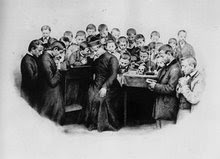
In his article Sellner gives a short biographical sketch of the saint from Turin mentioning how he roamed the streets of the city looking for boys and a suitable place to gather them together, demonstrating all his own personal skills in games, artistry and creativity which helped him in his mission of education. “At his death over 200 thousand youngsters had enjoyed the benefits of his friendship”.
Sellner gets to the point. As John Paul II declared Don Bosco “Father and Teacher of Youth,” “Benedict XVI would have the chance of making a mark in the world of football by proclaiming Don Bosco patron of football.”
It was a Salesian who brought to the attention of the ANS Office the article in the Austrian daily with a liberal slant – Fr Bernahard Maier chaplain to the Austrian Olympic and Para-olympic squads. Sellner’s suggestion recognises the great contribution Don Bosco and his Salesians have made to games and sport as occasions for education and human development, emphasising their value in bringing people together over the competitive.
We hope to see further developments …
Tuesday, July 13, 2010
Today Is the 93rd Anniversary of the July 13 Secret of Fatima
 It has been 93 years since the Fatima secrets were given to the three young seers. The following comes from Inside the Vatican:
Ninety-three years ago today, on July 13, 1917 -- precisely when Lenin was beginning to foment the Russian revolution in Petrograd (see http://en.wikipedia.org/wiki/July_Days) -- three shepherd children in Fatima, Portugal, for the third time in three months on the 13th of the month (May 13, June 13, July 13), saw a Lady appear before them in the air, an apparition, and heard her speak a message.
It was about noon.
Such was the origin of the "secret" of Fatima -- of three secrets, to be precise.
At that moment, in mid-1917, Europe was, for all intents and purposes, committing a type of suicide. World War I was three years old. Hundred of thousands of young men were lined up in trenches on the Western front, and in some battles, like Verdun, hundreds of thousands were killed in a matter of hours, as lines of human flesh surged forward, were mowed down, and surged forward again -- in vain.
In the West, there was stalemate.
In the East, the Russians changed their government, pulled out of the war, and the Germans, essentially, won.
In those months in the middle of 1917, the civilization that had once been called "Christendom" energetically sculpted its own tombstone. (We are putting the finishing touches on that work in our own time.)
Wherever there had been a Christian government, a Christian legislation, a Christian ethos, a Christian world, it was being dismantled.
In central Europe, the Catholic Hapsburg government of Austria-Hungary, heir of the Holy Roman Empire with roots deep in the middle ages, was overthrown. The Emperor Karl and his wife were exiled to the island of Madeira, and the modern, secular states of Austria and Hungary were born.
In Russia, once called "Holy Russia," the Romanovs were overthrown by Lenin, and communism became the official religion of the state, dogmatically atheistic, and the Russian Orthodox Church went into eclipse, fiercely persecuted. The new rulers turned churches into latrines.
In Germany, after the war, the Weimar Republic replaced the rule of the Protestant Hohenzollern Kaiser, and shortly thereafter the National Socialists came on the scene, while in England, the Anglican monarchs, heads of the Church, increasingly gave way to Parliament as Britain too grew ever more secularized.
The three children of Fatima must have dimly conceived of these events, as their elders and parish pastors must have spoken of the terrible war, and of the overthrow of traditional values which was occurring everywhere, and even all around them, in Portugal.
Read more here!
Ministering in a Nation Without God
 The following comes from the Zenit.org site:
Mosques and churches were forcibly closed in Albania in 1967; religious practice wasn't allowed again for almost a quarter of a century. In fact, Albania is known as the world's first atheist state.
Today in post-Communist Albania, it's hard to estimate how many Catholics are among the nation's 3.6 million people -- perhaps around 10%, with another 20% being Orthodox.
To this scenario journeys Dr. Anna Maria Doro, a member of the Catholic lay Community of Sant'Egidio. She's been helping in Albania for 10 years.
In this interview given to the television program "Where God Weeps" of the Catholic Radio and Television Network (CRTN) in cooperation with Aid to the Church in Need, Doro gives an inside look at Albania and how it's changed and continues changing.
Q: What struck you the most when you first went to Albania? What touched you personally?
Doro: What touched me was the difference between the two countries [Italy and Albania]. It is very near Italy and only 60 kilometers (37 miles) from the Port of Brindisi to the port in Vlore in Albania.
Albania had not changed -- it was something like a hundred years ago: very few cars on the streets, bad streets and shortages of electricity. The life of the people is linked to a very archaic agricultural system and many shepherds. But what touched me was the warmth of the people. The Albanians are very welcoming toward foreigners. Hospitality is highly valued and even if they are in a difficult situation, they share what they have with their guests.
Q: If I read correctly, there was an electric fence that went around the country?
Doro: There was a kind of a fence, for example along the border with Yugoslavia surrounding the lake. There are no trees on the border to this day. The trees were all cut in order to prevent the people from leaving the country. To leave the country was forbidden and the people who were caught were executed and their family prosecuted. I met people who could not finish their studies because a distant cousin tried to escape.
Even movement within the country was forbidden so people in the mountains, who were economically deprived, were forbidden from migrating to the urban areas because it was a privilege to live in the city, which was accorded to the loyal members of the regime. There was a total cultural isolation and the people were forbidden from listening to foreign news and music and as a consequence, the people were unaware of events in the outside world during that period and they were fed with a distorted view of the outside world.
Q: The attack on the Church was terrible; persecution was hard. What examples can you give us of how this attack on the Church occurred?
Doro: They started with the killing of about 60 priests and many nuns and arresting all of the priests. There was a suppression of religious orders and the closure of Catholic schools. I met a Stigmatine sister in Shkoder. Their convent was closed. There were about 90 of them. They went back to their homes and continued to be nuns and people brought children to them to be baptized in secret. Some of these sisters were novices and they waited and could only wear their religious habits again in 1991 when they were in their 70s.
Q: You are a medical doctor. You've been working in Albania since 1995 and you are going as a volunteer that is, you go on your holidays to Albania, you give 15 days and in fact you are going to be leaving very soon? What medical challenges do you see? You are working with children. What challenges do you see in the medical structure and infrastructure in Albania?
Doro: The Sant'Egidio Community helps particularly in the health and educational sectors. The health sector is ill-equipped like most of the public sectors in Albania. So we assist with donations for medicine and health equipment for hospitals. And particularly in the north, which is the poorest part of the country, we are supporting 14 pediatric clinics especially to help in the fight against childhood malnutrition. Since 1991 the economic situation in Albania has improved of course, but there are still plenty of needs in the health sector and people are still suffering. The infrastructure is lacking and there are still shortages in electricity and this is very difficult for the people.
Q: There somehow seems to be silence about the country from the international community. Do you feel this and why?
Doro: For 40 years it was impossible to know anything about Albania. Now, the situation surely is different. From a general point of view, I would say, that Albanians are very interested about other countries and languages but there is no reciprocity among the Western Europeans and the U.S.. The Italians, for example are misinformed about Albania. Their perception is based on the first Albanians they encountered in 1991: poor refugees. Now the situation is different. The Albanian emigrates overseas should assist in changing the perception by the international community and through tourism. There are many wonderful sites in Albania.
Q: How does the Church work in this reconstruction effort?
Doro: The Church has done very important work in Albania. It aided in the reconstruction of the society in terms of human development and in the communication of the Gospel. This started initially in the beginning especially with the aid of the universal Church. Many missionaries -- priest and nuns -- came from Italy, Kosovo, Croatia, India, the Philippines and Germany. They help to rebuild the churches, schools and clinics. In the beginning the Church was forced to become a proxy administrator because the state was non-existent or ineffective. I think that the Church is a very important point of reference not just for Catholics but for everyone including those without a clear religious identity because the Church is a witness of Christian love which is free of charge -- compassion and love, which is uncommon in that society.
Q: Is the Church highly trusted by the people because it lived with the people during their difficult times, perhaps more than the state?
Doro: Yes, it is very trusted and respected not only by the state but by the other religions because the Church helps everyone without distinction and the people recognize this.
Q: How is the relationship between the Muslims and Catholics in Albania? It seems to be quite harmonious?
Doro: Yes it is up to now. Catholics and Muslims co-exist. Catholics would visit the Muslims during their feasts and vice versa. Now there are some signs of fraying in the relationships because of the events internationally that are reflected as well in Albania, but generally the relationship is quite good and there are a lot of intermarriages.
* * *
This interview was conducted by Mark Riedemann for “Where God Weeps," a weekly TV & radio show produced by Catholic Radio & Television Network in conjunction with the international Catholic charity Aid to the Church in Need.
Subscribe to:
Posts (Atom)