Sunday, December 7, 2014


Saturday, December 6, 2014
Saint of the day: Nicholas of Myra
 Today is the Feast of St. Nicholas! Here is the info from the Patron Saints Index:
Priest. Abbot. Bishop of Myra, Lycia (modern Turkey). Generous to the poor, and special protector of the innocent and wronged. Many stories grew up around him prior to his becoming associated with Santa Claus. Some examples
Upon hearing that a local man had fallen on such hard times that he was planning to sell his daughters into prostitution, Nicholas went by night to the house and threw three bags of gold in through the window, saving the girls from an evil life. These three bags, gold generously given in time of trouble, became the three golden balls that indicate a pawn broker’s shop.
He raised to life three young boys who had been murdered and pickled in a barrel of brine to hide the crime. These stories led to his patronage of children in general, and of barrel-makers besides.
Induced some thieves to return their plunder. This explains his protection against theft and robbery, and his patronage of them - he’s not helping them steal, but to repent and change. In the past, thieves have been known as Saint Nicholas’ clerks or Knights of Saint Nicholas.
During a voyage to the Holy Lands, a fierce storm blew up, threatening the ship. He prayed about it, and the storm calmed - hence the patronage of sailors and those like dockworkers who work on the sea
Friday, December 5, 2014
Dostoevsky on Love

F. Dostoevsky (h/t Living Scripture)
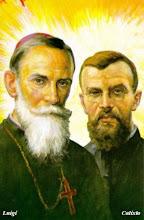
Remembering Blessed Philip Rinaldi
 Today the Salesians of Don Bosco remember Blessed Philip Rinaldi. Blessed Philip was born on May 28, 1856 at Lu Monferrato (Alessandria). Philip met Don Bosco when he was very young, and was won over by Don Bosco at the age of twenty-two.
As a priest, he was entrusted with the formation of the aspirants and novices. In 1899 Fr. Rua sent him as Director of the community of Sarriá, Spain and later as provincial leader. In this role he contributed greatly to the development of the Salesians in Spain.
Nominated Vicar General of the Congregation, his gifts as father and the wealth of his initiatives became even more evident. He set up formation centres to offer spiritual and social assistance to young working women, planned printing works and guided and supported the Salesian Sisters through a particularly sensitive period in their history. He gave great encouragement to the Cooperators, and set up the World Federations of Past-Pupils (male and female).
Working with the Zelatrici di Maria Ausiliatrice, he saw the possibilities for a new form of consecrated life in the world and made it a reality. This group would later become the "Volunteers of Don Bosco". He was elected Rector Major in 1922. "All that is lacking to Fr. Rinaldi is Don Bosco's voice: he has everything else" said Fr. Francesia.
He used all his energies in adapting Don Bosco's spirit to the times. He did much to develop Salesian studies and was a master of spiritual life. He worked to renew the spiritual life of the Salesians, had absolute confidence in God and unlimited trust in Mary Our Help. He asked Pius XI to grant the "indulgence for sanctified work". He took great interest in the missions, sending many young Salesians to learn languages and customs so that evangelisation might be more effective.
He died on December 5, 1931. His remains are venerated in the crypt of the Basilica of Mary Our Help. His memorial is celebrated on December 5. He was beatified on 29 April 1990 by Pope John Paul II.
Thursday, December 4, 2014
St. John of Damascus: The Last Church Father

The following comes from Jimmy Akin at the NCR:
On December 4th we celebrate St. John of Damascus.
He was a priest, a religious, and he is a doctor of the Church.
He’s also the last Church Father.
Here are 7 things to know and share . . .
1) Why is he the last of the Church Fathers?
We need to divide history into different periods. The age of the Church Fathers was not the same as the ages that came before it or the ages that followed it.
But to do this, we have to divide history at somewhat arbitrary points.
Thus, it is customary to regard the age of the Church Fathers as ending in the East with the life of St. John of Damascus (also known as St. John Damascene), who died around A.D. 749.
(In the West, the age of the Church Fathers is commonly reckoned as ending with St. Isidore of Seville, who died in A.D. 636.)
2) Who was St. John of Damascus?
As his name implies, he was born in the city of Damascus, in the modern state of Syria, which is just north of Israel.
It’s the same city that St. Paul was travelling to when he experienced his conversion on “the Damascus Road.” (In fact, it’s quite close by modern standards; Damascus is about 135 miles north of Jerusalem.)
John was born in A.D. 675 or 676, and he lived to around 75 years of age, dying around A.D. 749.
He spent most of his life in the Mar Saba monastery, near Jerusalem.
He is also known by the Greek nickname Chrysorrhoas, which means “Streaming with Gold” or “Gold-Pouring,” indicating the quality of his writings.
3) Why is he significant?
Pope Benedict XVI explained:
Above all he was an eyewitness of the passage from the Greek and Syrian Christian cultures shared by the Eastern part of the Byzantine Empire, to the Islamic culture, which spread through its military conquests in the territory commonly known as the Middle or Near East.
4) What happened in his early life?
Pope Benedict XVI explained:
John, born into a wealthy Christian family, at an early age assumed the role, perhaps already held by his father, of Treasurer of the Caliphate.
Very soon, however, dissatisfied with life at court, he decided on a monastic life, and entered the monastery of Mar Saba, near Jerusalem. This was around the year 700.
He never again left the monastery, but dedicated all his energy to ascesis and literary work, not disdaining a certain amount of pastoral activity, as is shown by his numerous homilies.
5) What theological controversy made him important?
It was the eighth-century controversy over whether images should be venereated—the so-called “iconoclast controversy.”
Pope Benedict XVI explained:
In the East, his best remembered works are the three Discourses against those who calumniate the Holy Images, which were condemned after his death by the iconoclastic Council of Hieria (754).
These discourses, however, were also the fundamental grounds for his rehabilitation and canonization on the part of the Orthodox Fathers summoned to the Council of Nicaea (787), the Seventh Ecumenical Council.
In these texts it is possible to trace the first important theological attempts to legitimize the veneration of sacred images, relating them to the mystery of the Incarnation of the Son of God in the womb of the Virgin Mary.
6) How did St. John Damascene contribute to the discussion?
Pope Benedict XVI explained:
John Damascene was also among the first to distinguish, in the cult, both public and private, of the Christians, between worship (latreia), and veneration (proskynesis):
The first can only be offered to God, spiritual above all else, the second, on the other hand, can make use of an image to address the one whom the image represents.
Obviously the Saint can in no way be identified with the material of which the icon is composed.
This distinction was immediately seen to be very important in finding an answer in Christian terms to those who considered universal and eternal the strict Old Testament prohibition against the use of cult images.
This was also a matter of great debate in the Islamic world, which accepts the Jewish tradition of the total exclusion of cult images.
Christians, on the other hand, in this context, have discussed the problem and found a justification for the veneration of images.
7) What did St. John Damascene write about this?
As Pope Benedict XVI explained, John Damascene wrote:
In other ages God had not been represented in images, being incorporate and faceless.
But since God has now been seen in the flesh, and lived among men, I represent that part of God which is visible.
I do not venerate matter, but the Creator of matter, who became matter for my sake and deigned to live in matter and bring about my salvation through matter.
I will not cease therefore to venerate that matter through which my salvation was achieved.
But I do not venerate it in absolute terms as God! How could that which, from non-existence, has been given existence, be God?…
But I also venerate and respect all the rest of matter which has brought me salvation, since it is full of energy and Holy graces.
Is not the wood of the Cross, three times blessed, matter?... And the ink, and the most Holy Book of the Gospels, are they not matter? The redeeming altar which dispenses the Bread of life, is it not matter?... And, before all else, are not the flesh and blood of Our Lord matter?
Either we must suppress the sacred nature of all these things, or we must concede to the tradition of the Church the veneration of the images of God and that of the friends of God who are sanctified by the name they bear, and for this reason are possessed by the grace of the Holy Spirit.
Do not, therefore, offend matter: it is not contemptible, because nothing that God has made is contemptible [cf. Contra imaginum calumniatores, I, 16, ed. Kotter, pp. 89-90].
Subscribe to:
Posts (Atom)