Showing posts with label Men's Spirituality. Show all posts

Wednesday, February 17, 2016

Catholic Men Preparing for Spiritual Battle

The following comes from Fr. Longenecker at Crux:
Catholic men are arming themselves for battle.
Spiritual battle.
Behind the headlines and beneath the radar, a grassroots movement is growing among Catholic men in the United States. Spurred on by the culture wars, they are rallying to conferences, retreats, seminars, and parish study groups that aim to support them in their faith, encourage fellowship, and motivate Christian action in support of charity, social justice, pro-life causes, and the traditional family. Catholic men’s events have become phenomenally successful, gathering Catholic men from a wide spectrum of age ranges to hear motivational speakers, inspiring converts, and spiritual leaders.
In an interview with Tim Drake at Catholic Pulse, Dan Spencer, executive director of the National Fellowship of Catholic Men, said that at the beginning of the century there were just 16 Catholic men’s conferences. Now a quick check of the Web discovers more than 100 nationwide. In addition to the keynote speakers, the conferences feature workshops and breakout sessions focused on topics such as battling pornography, being a better husband and father, successful stewardship, and how to develop a stronger spirituality.
In our own state of South Carolina — a state where less than 5 percent of the population is Catholic — the first annual men’s conference was standing-room-only with more than 500 registrants. The second year the attendance nearly doubled. The same story is told at men’s conferences across the country.
The renewal of men’s ministry is also taking place at the parish level. Pastors and laymen are starting their own groups, while the National Fellowship of Catholic Men, That Man is You!, and The King’s Men offer guidance and content for local groups.

Saturday, January 9, 2016

“As Iron Sharpens Iron”

The following comes from the NCR:

There is a crisis in our society — a crisis in masculinity. Men need to man-up and save their families and themselves from destruction of not just the physical but the spiritual kind — their very souls.

So emphasizes a wake-up call for men in a new short, challenging and inspiring film called “A Call to Battle — a short film on ‘Society’s Crisis in Masculinity.’” This film on YouTube is another clarion call, like a bugler signaling men to charge into the fray, from the Diocese of Phoenix.

It directly grows out of Phoenix Bishop Thomas Olmsted’s apostolic exhortation to Catholic men released last Sept. 29. He gave it the perfect title: Into the Breach.

In a no-nonsense way, Bishop Olmsted stirringly calls men to become the men God calls them to be. In the exhortation, he says: “Men, do not hesitate to engage in the battle that is raging around you, the battle that is wounding our children and families, the battle that is distorting the dignity of both women and men. This battle is often hidden, but the battle is real. It is primarily spiritual…”
He stresses: “Herein lies the fullness of masculinity; each Catholic man must be prepared to give himself completely, to charge into the breach, to engage in spiritual combat, to defend women, children and others against the wickedness and snares of the devil!”

Film Accents the Message
This new short film brings that message home in images and insights from others that should move men’s hearts and minds, and challenge them to courage, to step into the breach at this critical time. And that means ALL men.
We’ve always been called to be soldiers of Christ. Now, as the spiritual battle rages in every quarter, the film and the exhortation from which it grew wants to gather the troops to step into the breach. It’s a manly call to arms.

Read the rest here.

Wednesday, November 26, 2014

Why Orthodox Men Love Church


The following comes from Provoslavie:

In a time when churches of every description are faced with Vanishing Male Syndrome, men are showing up at Eastern Orthodox churches in numbers that, if not numerically impressive, are proportionately intriguing. This may be the only church which attracts and holds men in numbers equal to women. As Leon Podles wrote in his 1999 book, "The Church Impotent: The Feminization of Christianity," "The Orthodox are the only Christians who write basso profundo church music, or need to." 
Rather than guess why this is, I emailed a hundred Orthodox men, most of whom joined the Church as adults. What do they think makes this church particularly attractive to men? Their responses, below, may spark some ideas for leaders in other churches, who are looking for ways to keep guys in the church.
Challenges. The term most commonly cited by these men was "challenging." Orthodoxy is "active and not passive." "It's the only church where you are required to adapt to it, rather than it adapting to you." "The longer you are in it, the more you realize it demands of you."
The "sheer physicality of Orthodox worship" is part of the appeal. Regular days of fasting from meat and dairy, "standing for hours on end, performing prostrations, going without food and water [before communion]...When you get to the end you feel that you've faced down a challenge." "Orthodoxy appeals to a man's desire for self-mastery through discipline."
"In Orthodoxy, the theme of spiritual warfare is ubiquitous; saints, including female saints, are warriors. Warfare requires courage, fortitude, and heroism. We are called to be 'strugglers' against sin, to be 'athletes' as St. Paul says. And the prize is given to the victor. The fact that you must 'struggle' during worship by standing up throughout long services is itself a challenge men are willing to take up."       
A recent convert summed up, "Orthodoxy is serious. It is difficult. It is demanding. It is about mercy, but it's also about overcoming oneself. I am challenged in a deep way, not to 'feel good about myself' but to become holy. It is rigorous, and in that rigor I find liberation. And you know, so does my wife."
Clear Disciplines. Several mentioned that they really appreciated having clarity about the content of these challenges and what they were supposed to do. "Most guys feel a lot more comfortable when they know what's expected of them." "Orthodoxy presents a reasonable set of boundaries."  "It's easier for guys to express themselves in worship if there are guidelines about how it's supposed to work—especially when those guidelines are so simple and down-to-earth that you can just set out and start doing something."
Male choir, seminarians.
"The prayers the Church provides for us — morning prayers, evening prayers, prayers before and after meals, and so on — give men a way to engage in spirituality without feeling put on the spot, or worrying about looking stupid because they don't know what to say."
They appreciate learning clear-cut physical actions that are expected to form character and understanding. "People begin learning immediately through ritual and symbolism, for example, by making the sign of the cross. This regimen of discipline makes one mindful of one's relation to the Trinity, to the Church, and to everyone he meets."
A Goal. Men also appreciate that this challenge has a goal: union with God. One said that in a previous church "I didn't feel I was getting anywhere in my spiritual life (or that there was anywhere to get to — I was already there, right?) But something, who knew what, was missing. Isn't there SOMETHING I should be doing, Lord?"
Orthodoxy preserves and transmits ancient Christian wisdom about how to progress toward this union, which is called "theosis." Every sacrament or spiritual exercise is designed to bring the person, body and soul, further into continual awareness of the presence of Christ within, and also within every other human being. As a cloth becomes saturated with dye by osmosis, we are saturated with God by theosis.
A catechumen wrote that he was finding icons helpful in resisting unwanted thoughts. "If you just close your eyes to some visual temptation, there are plenty of stored images to cause problems. But if you surround yourself with icons, you have a choice of whether to look at something tempting or something holy."
A priest writes, "Men need a challenge, a goal, perhaps an adventure — in primitive terms, a hunt. Western Christianity has lost the ascetic, that is, the athletic aspect of Christian life. This was the purpose of monasticism, which arose in the East largely as a men's movement. Women entered monastic life as well, and our ancient hymns still speak of women martyrs as showing 'manly courage.'"
"Orthodoxy emphasizes DOING. …. Guys are ACTIVITY oriented."
No Sentimentality. In "The Church Impotent," cited above (and recommended by several of these men), Leon Podles offers a theory about how Western Christian piety became feminized. In the 12th-13th centuries a particularly tender, even erotic, strain of devotion arose, one which invited the individual believer to picture himself or herself (rather than the Church as a whole) as the Bride of Christ. "Bridal Mysticism" was enthusiastically adopted by devout women, and left an enduring stamp on Western Christianity. It understandably had less appeal for guys. For centuries in the West, men who chose the ministry have been stereotyped as effeminate. A life-long Orthodox layman says that, from the outside, Western Christianity strikes him as "a love story written for women by women." 
The Eastern Church escaped Bridal Mysticism because the great split between East and West had already taken place. The men who wrote me expressed hearty dislike for what they perceive as a soft Western Jesus. "American Christianity in the last two hundred years has been feminized. It presents Jesus as a friend, a lover, someone who 'walks with me and talks with me.' This is fine rapturous imagery for women who need a social life. Or it depicts Jesus whipped, dead on the cross. Neither is the type of Christ the typical male wants much to do with."
During worship, "men don't want to pray in the Western fashion with hands clasped, lips pressed together, and a facial expression of forced serenity." "It's guys holding hands with other guys and singing campfire songs." "Lines about 'reaching out for His embrace,' 'wanting to touch His face,' while being 'overwhelmed by the power of His love'—those are difficult songs for one man to sing to another Man."
"A friend of mine told me that the first thing he does when he walks into a church is to look at the curtains. That tells him who is making the decisions in that church, and the type of Christian they want to attract."
"Guys either want to be challenged to fight for a glorious and honorable cause, and get filthy dirty in the process, or to loaf in our recliners with plenty of beer, pizza, and football. But most churches want us to behave like orderly gentlemen, keeping our hands and mouths nice and clean."
One man said that worship at his Pentecostal church had been "largely an emotional experience. Feelings. Tears. Repeated rededication of one's life to Christ, in large emotional group settings. Singing emotional songs, swaying hands aloft. Even Scripture reading was supposed to produce an emotional experience. I am basically a do-er, I want to do things, and not talk about or emote my way through them! As a business person I knew that nothing in business comes without effort, energy, and investment. Why would the spiritual life be any different?"
Another, who visited Catholic churches, says, "They were conventional, easy, and modern, when my wife and I were looking for something traditional, hard, and counter-cultural, something ancient and martial." A catechumen says that at his non-denominational church "worship was shallow, haphazard, cobbled together from whatever was most current; sometimes we'd stand, sometimes we'd sit, without much rhyme or reason to it. I got to thinking about how a stronger grounding in tradition would help."
"It infuriated me on my last Ash Wednesday that the priest delivered a homily about how the real meaning of Lent is to learn to love ourselves more. It forced me to realize how completely sick I was of bourgeois, feel-good American Christianity."
A convert priest says that men are drawn to the dangerous element of Orthodoxy, which involves "the self-denial of a warrior, the terrifying risk of loving one's enemies, the unknown frontiers to which a commitment to humility might call us. Lose any of those dangerous qualities and we become the 'JoAnn Fabric Store' of churches: nice colors and a very subdued clientele."
"Men get pretty cynical when they sense someone's attempting to manipulate their emotions, especially when it's in the name of religion. They appreciate the objectivity of Orthodox worship. It's not aimed at prompting religious feelings but at performing an objective duty."
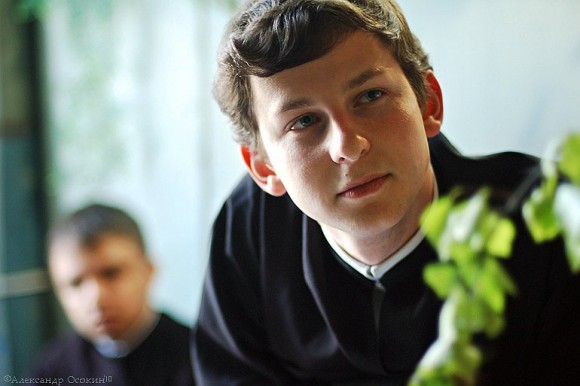
Photo by Alexander Osokin.
Yet there is something in Orthodoxy that offers "a deep masculine romance. Do you understand what I mean by that? Most romance in our age is pink, but this is a romance of swords and gallantry."
From a deacon: "Evangelical churches call men to be passive and nice (think 'Mr. Rogers'). Orthodox churches call men to be courageous and act (think 'Braveheart').
Jesus Christ. What draws men to Orthodoxy is not simply that it's challenging or mysterious. What draws them is the Lord Jesus Christ. He is the center of everything the Church does or says.
In contrast to some other churches, "Orthodoxy offers a robust Jesus" (and even a robust Virgin Mary, for that matter, hailed in one hymn as "our Captain, Queen of War"). Several used the term "martial" or referred to Orthodoxy as the "Marine Corps" of Christianity. (The warfare is against self-destructive sin and the unseen spiritual powers, not other people, of course.)
One contrasted this "robust" quality with "the feminized pictures of Jesus I grew up with. I've never had a male friend who would not have expended serious effort to avoid meeting someone who looked like that." Though drawn to Jesus Christ as a teen, "I felt ashamed of this attraction, as if it were something a red-blooded American boy shouldn't take that seriously, almost akin to playing with dolls."
A priest writes: "Christ in Orthodoxy is a militant, Jesus takes Hell captive. Orthodox Jesus came to cast fire on the earth. (Males can relate to this.) In Holy Baptism we pray for the newly-enlisted warriors of Christ, male and female, that they may 'be kept ever warriors invincible.'"
After several years in Orthodoxy, one man found a service of Christmas carols in a Protestant church "shocking, even appalling." Compared to the Orthodox hymns of Christ's Nativity, "'the little Lord Jesus asleep on the hay' has almost nothing to do with the Eternal Logos entering inexorably, silently yet heroically, into the fabric of created reality."

Read the rest here.

Wednesday, November 12, 2014

Men, Remember Who You Are


The Following comes from Msgr. Pope:

This is a post that Satan apparently did not like. When I posted it last Thursday, the Server of the Archdiocese (literally) burnt up within an hour or two of posting. And while things are slowly coming back online, the post you are about to read could not be found in the archive file, anywhere. Thanks be to God some intrepid readers (at dclatinmass.com) had saved the post which I had not had time to back up. So here is a post that I suspect Satan did not want you to read. But the devil is a liar and God is able. :-)
When I was growing up, my father would often exhort me to “be a man.”He would summon me to courage and responsibility and to discover the heroic capacity that was in me. St. Paul summoned forth a spiritual manhood with these words: We [must] all attain to the unity of faith and knowledge of the Son of God, to mature manhood, to the extent of the full stature of Christ, so that we may no longer be infants, tossed by waves and swept along by every wind of teaching arising from human trickery, from their cunning in the interests of deceitful scheming. Rather, living the truth in love, we should grow in every way into him who is the head, Christ (Eph 4:13ff).
If the ladies will pardon me (for women have their own sort of strength), I want to issue a special summons to men,especially fathers, husbands, and priests. The summons is simple: be a man. We need men in these dark days, men who will heroically speak and act, men who will announce the truth and insist upon it wherever they have authority, men who will stop being passive fathers and husbands, priests who will stop “playing it safe” by remaining silent in the moral storm. Yes, be a man.
It has often been observed that men are rather disengaged from the practice of the faith and attendance at the Sacred Liturgy. Frankly, there is a reason—not a politically correct one, but a reason nonetheless. Most of the men I talk to find the Church rather feminized. There is much talk in the Church about forgiveness and love, about receptivity and about being “nicer.” These are fine virtues, all of them necessary. But men also want to be engaged, to be sent into battle, to go forth and make a difference.
After years of radical feminism, men are shamed for seeking to take up leadership and authority in their families and in the Church. It starts early.  Any normal boy is full of spit and vinegar, is aggressive, competitive, and anxious to test his wings. But many boys are scolded, punished, and even medicated for these normal tendencies. They are told to behave more like girls and to learn to be nicer and to get along, etc. It will be granted that limits are necessary, but the tendency for boys to roughhouse is normal. The scolding and “socializing” to more feminine traits continues apace into early adulthood. And then there are other cultural phenomena such as the slew of “Men are stupid” commercials, etc.
Though many in past decades have sought to describe the Church as “male-dominated,” nothing could be further from the truth. Most parish leadership structures are dominated by women. And women do fine work. But the Church has done a very poor job of engaging men as men and equipping them to be strong husbands, fathers, and priests. Virtues related to bold leadership and the effective use of authority are in short supply whereas other virtues such as collaboration, listening, empathy, and understanding are overemphasized.

Wednesday, June 11, 2014

Lose Yourself: Finding Freedom in Mary’s Risky Yes

The following comes from The Catholic Exchange

Did she really say that? Did she really mean it? I keep turning back to Luke 1:38, “And Mary said, ‘Behold, I am the handmaid of the Lord; let it be to me according to your word.’” I take a few minutes to present myself before God in silence. When my mind wanders, I return to the spirit of Mary’s words. How can my heart prepare him room?
Then it hits me.
Only as God’s handmaiden did Mary became the God-bearer.
I want to ask you: when did the New Covenant start? Where was the special place where God became man, “not by conversion of the Godhead into flesh, but by the taking of manhood up into God”? It all started in the womb of the virgin Mary. She is the genesis, the cradle, the fountainhead of Christ’s humanity. She is the place where, as John 1:14 says, “The Word became flesh and tabernacle among us, and we beheld his glory.” Mary gave herself—body and soul—to God: and as God’s handmaiden, Mary became the God-bearer.
Now, the incarnation is not like a game of Monopoly. We can’t pull out the board and arrange the pieces and do it all over again. But gentlemen, I want to suggest to you that Mary was just the beginning of what God wants to do in all of us—make us God’s handmaidens. You and me. People who, like Mary, can hear Christ and then say Yes to Christ. So it is that Jesus says in Luke 8:20, “My mother and brothers are those whohear the word of God and do it.”
St. Paul puts it in more muscular terms. He says he is “a slave for Christ” (Rom. 1:1). The way of manliness, for Paul, is “not by way of eye service, as men-pleasers, but as slaves of Christ, doing the will of God from the heart” (Eph. 6:6).
Brothers, if we do not become God’s “handmaidens,” God’s slaves, our lives will be barren, childless, Godless. But if we imitate Our Lady, the ever Virgin Mary, and we hold nothing back—if we say only Yes! to God—we would “conceive” Christ within us, and show his New Covenant to the world.
How can we hear God’s word? He tells us: “The Lord revealed himself to Samuel at Shiloh by the word of the Lord” (1 Sam. 3:21). God reveals himself by his word. If you want him, you begin with his word. God also reveals himself through his Church. “But when they believed Philip as he proclaimed the good news of the kingdom of God and the name of Jesus Christ, they were baptized, both men and women” (Acts 8:12). When they believed Philip they were baptized. God reveals himself through his Church. To hear God’s word, we must start by seeking him in Scripture and the Church.
How can we, as men of Christ, say Yes to God’s word? When we think only of how we might get hurt, or have been hurt, we do not risk saying Yes to God. We grasp for the wrong things (like control) and come up empty. We do not risk the Gospel, and so we never really know the Gospel. We only know our fears. But gentleman, our Blessed Mother reminds us that we were made for more than worry. Sometimes the manliest thing to do is let go.
Let go. 

Read the rest here.


Sunday, March 16, 2014

The Hard Way

The following comes from The Art of Manliness:


“The essential thing “in heaven and earth” is…that there should be a long obedience in the same direction; there thereby results, and has always resulted in the long run, something which has made life worth living.” – Friedrich Nietzche, Beyond Good and Evil
In 1989, Wyoming-native Mark Jenkins set out with three Americans and four Russians to become the first to bicycle all the way across Siberia, starting at the Pacific port town of Vladivostok and ending 7,500 miles later in Leningrad. Battling mud, wind, injuries, and sub-zero temperatures, the 5-month journey took them through hundreds of villages, an 800-mile swamp, the Ural mountains, and a culture permanently hardened by the savage taskmaster of communism. The trip planted the team in the Guinness Book of World Records, but what made it remarkable was not that it was long, but that it was hard – brutally, numbingly, painfully…hard.
We don’t come across that word too often when discussing heroes or success. Everything we long for is easy and instant. Without a shortcut to the end we often conclude that the journey isn’t worth the time and effort. We want everything neatly packaged and ready for immediate consumption – our food, our friends, even our faith. Our lives have come to resemble those of tourists, wanting the experience, but not wanting to stay long enough to risk experiencing the realities that come with permanence and commitment. In fact, “hard” has become more of a scarlet letter rather than a badge of honor. Let’s face it, the idea of spending years busting your butt at the same job or pursuing the same goal has become downright antiquated, a fool’s game.
Abraham Lincoln and Andrew Carnegie are finding their stories of long persistence quickly displaced by those of the flash-in-the-pan celebrity tabloid genre. Teenage phenoms, reality “stars,” 20-something internet billionaires, and people for whom success and its spoils came swift and early are the new cultural heroes and idols. With each new fresh-faced superstar, the idea of success as a secret formula to be unlocked rather than something to be worked for is slowly cemented into our brains.
“He or she is naturally-gifted,” we proclaim, inwardly hoping that we too can find our own hidden talent or skill to make us famous, rich, or at least…noticed. The books and seminars that sell out most quickly are those that promise the easiest steps to a better life – the secrets that have been known for ages by the rich and famous, but somehow managed to escape your radar until this very moment.
This “easy” epidemic has reached every aspect of our culture from health to education to relationships. People don’t want to workout and eat healthy because it’s hard. No problem, according to the creators of 1,000 different diets promising a great body with little to no effort. As for expanding one’s knowledge, why waste time reading a whole book when you can get the gist from the Cliff Notes? And relationships? Well, working through marriages can be difficult, so “experts” have stepped in to hand you a Kleenex and pat your back as they tell you, “You deserve to be with someone who adores you for you, don’t feel bad about ending things and moving on to someone new who will better meet your needs.”
At some point it has become acceptable to avoid things because they’re hard. Success has become some sort of self-help scavenger hunt with all of us desperately wanting to find an easier way than just grinding it out, a magic solution to life’s equation waiting to be uncovered. We cut corners and call it “optimizing.” We take the path of least resistance and dress up our cowardice in the guise of efficiency. And in doing so, we’re killing ourselves, one life-hack at a time.
There’s nothing wrong with working smarter or making things more simple. There’s no reason to make something harder than it has to be. And I’m not suggesting we go back to plowing fields by hand or walking uphill both ways to work. The problem is that many of us have begun to think that if something is hard, it is automatically wrong and must be changed or substituted immediately. In the process we often fail to reach our real goals, substituting in ones that are more “realistic.” And more importantly, we rob our character of some much needed pruning. We’re missing out on a fundamental truth of manhood – doing things that are hard molds boys into men of strength and character.
http://www.sethskim.com/Spartans2jpg.jpg
http://images.rottentomatoes.com/images/movie/trailer/10012339/trailer_27.jpg
In the recent blockbuster smash 300, audiences and critics were shell-shocked by the ripped and chiseled bodies of the actors and stuntmen involved. How did they get so jacked? Surely they were Hollywood-ized, right? Wrong, says Mark Twight, the man behind the regime that molded these actors and stunt men into Spartan warriors. Writing to the critics he responded curtly:
“It appears everyone has an opinion about ’300′ and how the actors and stunt crew achieved the level of fitness €“ and consequentially, appearance €“ for the movie. I have read that it was all CGI, make-up, steroids, etc. However, no one has come right out and said, ‘those guys worked really hard and had the self-discipline to control what they put into their mouths.’”
In short, these guys got their stuff handed to them 10-12 hours a day, five days a week for four months. It wasn’t pretty and they didn’t get the usual, “Way to go buddy!” or “‘Atta boy!” after each set. Instead they were called losers and mocked for being fat. Not the kind of positive, feel-good, self-congratulation you would find most life-coach gurus promoting. It was brutal, it wasn’t fun, but it worked. It was hard, hellishly hard. Lead actor Gerard Butler summed up the experience saying, “Pretty much anything Mark Twight offered up was so difficult in the kind of way where you wish you had never been born – and even more than that, wished he had never been born.”
Absolutely nothing replaces hard work. No shortcuts, no 5-steps to success, no secrets. This may come either as a blessing or a curse depending on how one looks at it. But, what makes the hard way so important for men is not just the end result, but the character built along the way.
It may sound cliche, but the journey we take often matters much more than the destination. How we live our lives each hour, each day determines the type of men we will be in ten years. Knowing this, we should construct our lives to embrace difficult challenges which will mold our character into one of discipline and perseverance. In doing hard things on a daily basis we’re constantly training ourselves so that on other days, in other situations, we can remain solid.
The hard way may be scoffed at as old-fashioned, but it produces integrity and strength far more meaningful and concrete than any gold star along the way. This method of living produces men who remain faithful to their wives and children, decade after decade. Men who refuse to sacrifice their integrity for short-term results or gain. Men who at the end of the day are fulfilled with the fruit of their labor. Men who finish a marathon rather than simply starting a million sprints.
If we can develop in ourselves a certain zeal for the hard things in life we will reap the benefits for years to come. Not only victories won along the way and character developed, but a fulfilled life at the end of the day. As legendary football coach Vince Lombardi once put it:
“But I firmly believe that any man’s finest hour, the greatest fulfillment of all that he holds dear, is that moment when he has worked his heart out in a good cause and lies exhausted on the field of battle – victorious.”

Thursday, January 30, 2014

The Priesthood: A Beacon of Manly Hope

The following comes from Jared Zimmerer at Word on Fire:

Over the last two decades, a sociological problem has jolted apostolates, conferences, even entire communities. This issue pertains to the misunderstanding of authentic masculinity. A recent article brought to light many disturbing trends among young men, including the rising affluence gap between them and their more successful female peers. The article bases much of its premise on the apparent lack of drive young men exhibit as the numbers of educational degrees are swaying more and more in majority to the female population. Joblessness among young men grows while more and more females are taking high up positions at some of the largest companies in the world. This isn’t to say that women should not be in these positions, but it does suggsest we should look at the problem of men who lack the drive necessary to strive for the same position.

Writers such as Christina Hoff Sommers and Helen Smith, author of the article above, claim that the problem lies much deeper than just a simple lack of motivation, instead that the issue might be arising from the way the young male is increasingly programmed to act. The authors posit the educational system now has two maxims:

"Out: structured, competitive, teacher-directed classrooms that best support boys’ learning and outlets for natural rambunctiousness, including conflict-oriented play like ‘Cops and Robbers.’ Last year, 7-year-old Coloradan Alex Smith was suspended for throwing an imaginary grenade at ‘bad guys.’ In: behavior-modifying drugs designed to make boys attentive and controlled."

This type of ‘bury the testosterone’ tactic has been grown over the past few decades and unfortunately has caused a cultural phenomenon where authentic masculinity finds itself marginalized and headed towards non-existence. As a young man myself I often feel the pressure to conceal my masculinity, as well as viewing the masculinity of my peers as ‘something ain’t right here’.

The forced ostracism of masculinity has caused a rift against the confines of the all-embracing arms of the Church as well. The Church teaching on the masculinity of the priesthood, echoed by Pope John Paul II (the man who wrote possibly the most exquisite prose on femininity) when he stated in his 1994 apostolic letter on ordination, that “the church's ban on women priests is definitive and not open to debate among Catholics.” a hardline statement from a man who embodied gentleness and compassion. The steadfast and unwavering teaching of the Church’s role of the priest is a bull’s-eye mark for those who wish to do away with the notions of masculinity and would prefer a hazy, laissez-faire sexuality among the culture. In her wisdom, the Church knows, without a shadow of doubt, that the collar belongs on men and bids them to take that vocation as well as the implications of gender very seriously.

This is one of the primary reasons that the Church is held in such disdain from the cultural elites. Masculinity is blamed for the problems of war, strife, and violence as opposed to its actual source: sin.

So, what do we do now? Is it too late for classic masculinity to find the surface and breathe once again? The article above ends on a hopeful note: “The answer is not to ‘raise boys like we raise girls,’ as Gloria Steinem suggested, but to recognize that, while the sexes are equal, they’re naturally different — and that’s beautiful.”

Without diving too deep into the murky waters of progressive feminism, the article at hand offers a prime example of the problem that comes when feminism focuses on an unrestrained need to bog men down rather than build women up with the dignity they deserve. With all of the nonsensical educational philosophies floating around regarding male rowdiness, it seems what sociologists might need to be aware of is the Church’s teaching on the male-only priesthood. The apostolic tradition of men leading the faith creates a community where masculinity should thrive and excel in the service of others. It's a very different color than the painted picture cultural philosophies spread.

The priesthood very well could be the beacon of hope needed for men like me who want to see a rehashing or renaissance of what it means to be a man. In the priest's role we find what manhood is actually all about, that being service to the Bride. In his collar of strength he gives his life day in and day out to the needs of his fellow man and the desires of his Bride, the Church. If only more men would look to this place of encouragement and follow in the footsteps of the great men who came before them, not fearing their testosterone but embracing it and letting its great fire burn within the heart of the hero we men are called to be!

Even as a married man I find reassurance and inspiration in the lives of these leaders of the spiritual battle. Perhaps instead of reacting in anger towards the collar that only graces the neck of a man, the culture should take a second look at what they represent and realize that that what they exemplify, men willing to give their lives for others, can heal many of society’s wounds and misunderstandings of masculinity. If the cultural elites who want men to become better servants decided to understand and appreciate what the priesthood is, then maybe we would start to hold them up as the exemplars of masculinity they are.

Friday, December 20, 2013

Wednesday, September 25, 2013

Fr. Larry Richards: "Real Men Love Jesus Christ!"

Monday, May 17, 2010

Male spirituality in our contemporary culture