Showing posts with label Youth. Show all posts

Saturday, July 30, 2016

Pope Francis to Youth: God prefers us weak

 The weaker we are, the more God's mercy can transform our lives. Pope Francis made these impromptu remarks on Saturday to crowds of young people gathered outside of Krakow’s St. John Paul II shrine.
“Today, the Lord wants us to feel ever more profoundly his great mercy,” the Pope said in a short, impromptu speech, delivered right after his visit to the Polish city’s Divine Mercy shrine. “May we never turn away from Jesus!”
Pope Francis shared these thoughts to a group of young people who are in Poland for World Youth Day moments before entering the St. John Paul II shrine to pass through its Holy Door, hear confessions, and celebrate Mass for priests and religious men and women. 
We may think that we are the “worst” on account of our sins and weaknesses, the Pope told the youth. However, this is how God prefers us to be, in order that “his mercy may spread.”
“Let us take advantage of these days to receive all of the mercy of Jesus!”
Pope Francis proceeded to lead the young people in praying the Hail Mary before bestowing on them his blessing.
“And please, I ask you to pray for me.”
Before his brief encounter with the young people, the pontiff paid a visit to the shrine of the Divine Mercy where the body of St. Faustina Kowalska are interred.
There, he venerated the relics of the Polish saint and mystic, during a brief ceremony attended by some 300 people, including members of the Congregation of the Sisters of Our Lady of Mercy, St. Faustina’s own order.
While there, Pope Francis signed the sanctuary’s guestbook with the words: “I desire mercy, and not sacrifices.” The words refer to a passage from the Gospel of Matthew which the Pope has often referred to in the past.
Venerated by the Church as the “Apostle of Divine Mercy,” St. Faustina (1905-1938) reported numerous visions of Jesus throughout her life which she recorded in her diary. Many of the devotions relating to the feast of Divine Mercy, established on the first Sunday of Easter by St. John Paul II, were inspired by her writings.
Saturday marks the second to last day of Pope Francis’ July 27-31 apostolic journey to Poland where he is leading World Youth Day celebrations.

Wednesday, April 27, 2016

Chris Stefanick on St. John Paul II and World Youth Day in Denver

Tuesday, April 26, 2016

Pope Francis: Love is the Christian identity card

(Vatican Radio) At the heart of Pope Francis’ message during the Jubilee Mass for Teens celebrated on Sunday was quite simply one word Love.

The Pope told the thousands of 13 to 16 year olds gathered in St Peter’s Square that “love, was the Christian’s identity card, the only valid “document” identifying us as Christians. If this card expires and is not constantly renewed,” he said, “we stop being witnesses of the Master.”

Then he asked the teenagers gathered “Do you want to experience the love of Jesus? Let us learn from him, for his words are a school of life, a school where we learn to love.”

The Holy Father noted, however, that although love is beautiful and it's the path to happiness it is not necessarily and easy path. It is, he said, demanding and it requires effort.

The Lord, Pope Francis stressed, is generous, “he offers us his faithful friendship, which he will never take back. Even if you disappoint him and walk away from him, Jesus continues to want the best for you and to remain close to you; he believes in you even more than you believe in yourself.” This is very important, the Pope noted because, “the biggest threat to growing up well comes from thinking that no one cares about us, from feeling that we are all alone.”

During his homily the Pope also warned the teens present to be on their guard against what he called “an instinctive desire to “have to have” what we find pleasing”, adding, “our consumerist culture reinforces this tendency.”

“Don’t be content with mediocrity, with “simply going with the flow”, with being comfortable and laid back,” the Holy Father said. He also told the teenagers to be sceptical about “people who want to make you believe that you are only important if you act tough like the heroes in films or if you wear the latest fashions.” Your happiness, the Pope continued, has no price. “It cannot be bought: it is not an app that you can download on your phones nor will the latest update bring you freedom and grandeur in love.”

Pope Francis invited those present in St Peter’s Square to be courageous and firm in their decisions because, he said, it is only by doing this you will realize your greatest dreams, adding, “if a person of your age can’t dream they are already in retirement, this serves nothing.”

Love does not happen because we talk about it, the Pope underlined, “but when we live it”. He also said : "In the art of climbing, the important thing is not to remain on the ground when you fall.”

The Holy Father concluded his homily by saying to the teenagers “you will do amazing things if you prepare well, starting now, by living your youth and all its gifts to the fullest and without fear of hard work. Be like sporting champions, he said who attain high goals by quiet daily effort and practice.”The Lord, Pope Francis stressed, is generous, “he offers us his faithful friendship, which he will never take back. Even if you disappoint him and walk away from him, Jesus continues to want the best for you and to remain close to you; he believes in you even more than you believe in yourself.” This is very important, the Pope noted because, “the biggest threat to growing up well comes from thinking that no one cares about us, from feeling that we are all alone.”

During his homily the Pope also warned the teens present to be on their guard against what he called “an instinctive desire to “have to have” what we find pleasing”, adding, “our consumerist culture reinforces this tendency.”

“Don’t be content with mediocrity, with “simply going with the flow”, with being comfortable and laid back,” the Holy Father said. He also told the teenagers to be sceptical about “people who want to make you believe that you are only important if you act tough like the heroes in films or if you wear the latest fashions.” Your happiness, the Pope continued, has no price. “It cannot be bought: it is not an app that you can download on your phones nor will the latest update bring you freedom and grandeur in love.”

Pope Francis invited those present in St Peter’s Square to be courageous and firm in their decisions because, he said, it is only by doing this you will realize your greatest dreams, adding, “if a person of your age can’t dream they are already in retirement, this serves nothing.”

Love does not happen because we talk about it, the Pope underlined, “but when we live it”. He also said : "In the art of climbing, the important thing is not to remain on the ground when you fall.”

The Holy Father concluded his homily by saying to the teenagers “you will do amazing things if you prepare well, starting now, by living your youth and all its gifts to the fullest and without fear of hard work. Be like sporting champions, he said who attain high goals by quiet daily effort and practice.”


Tuesday, February 16, 2016

Pope Francis Speaks to Children in Mexico

Thursday, November 26, 2015

Saint of the day: John Berchmans


Today we remember another youthful saint as we remember John Berchmans.  The following comes from the Patron Saints Index:

Son of a shoemaker, and one of five children, three of whom entered religious life. Great devotion to his position as an altar boy. He spent much of his time caring for his mother, who was in poor health. Jesuit noviate in 1616, deciding to become a Jesuit after reading the life of Saint Aloysius Gonzaga. Student at the Jesuit College at Malines. Studied philosophy in Rome. John had a dream of helping and teaching multi-lingual migrants, and he studied all the chief languages of Europe. He wanted to work in China after ordination. He died of unknown causes following his participation in a public debate defending the faith, and while clutching his rosary, crucifix, and rules of his order; he did not live to be ordained.

John Berchmans was not noted for extraordinary feats of holiness or austerity, nor did he found orders or churches or work flashy 
miracles. He made kindness, courtesy, and constant fidelity an important part of his holiness. The path to holiness can lie in the ordinary rather than the extraordinary.

Friday, October 9, 2015

Don Bosco Song Makes it to the UK Charts!

Saturday, October 3, 2015

Blessed Marcel Callo: The nerd’s alternative to Pier Giorgio!

MarcelsoloThe following comes from the Denver Catholic and Melissa Keating:

Blessed Marcel Callo just needs to be more famous. His story is equal parts Pier Giorgio, Maximilian Kolbe,  Romeo Montague, and something that is uniquely his own. He also totally looks like a French Urkel, which I think we can all agree is amazing. In honor of his feast day on October 4, here is his life in blog form:

That kid at youth group

Marcel as a Boy Scout. Image from the Diocese of Fresuj-Toulon
Marcel was the second of nine children. His family was French and poor, but happy, and raised him in the faith. He started working when he was 13, which is when we get one of my favorite insights into him: He was kind of an obnoxious Christian.
His coworkers would make jokes about women, so Marcel refused to have anything to do with them. He also refused to date, saying, “I am not one to amuse myself with the heart of a lady, since my love is pure and noble,” among other things that kind of make me want to take his lunch money. Most of his (very few) biographers try to pass this off as piety, but I think he was just your typical overzealous young Catholic. He would have been the modern equivalent of the teenager who wears 50 saints medals at once and has the techno remix of “Oceans” as their ringtone. He even spent all of his time with his equivalent of a youth group, the Jeunesse Ouvriere Chretienne (JOC), or Young Christian Workers.
The JOC is where Marcel learned to stop being so obnoxious. They stressed the importance of community and intellectual formation, as well as a robust prayer life. Marcel played sports through them, and began to spend 15 minutes a day in quiet prayer and went to Confession every other week. He still wasn’t perfected, as he was known for losing his temper with people who questioned Church teaching. And yet, as he became a leader within the JOC, he started to lighten up. For example, he shocked many elderly parishioners when he and his friends decided to go see a movie on All Soul’s Day. The older people thought the JOC should spend the day in prayer. However, Marcel and his friends managed to see the movie and still get into the Church before the liturgy started.
A very long engagement
Marcel and Maurgerite. Photo from Blessed Marcel Callo Parish in the Diocese of Arras.
However, the JOC wasn’t just a place for Marcel to sass old ladies. It was also where he met the love of his life, Marguerite Derniaux. He waited to ask her out, because he said, “One must master his heart before he can give it to the one that is chosen for him by Christ”. They were engaged, but World War II and his subsequent martyrdom prevented them from ever getting married.
Rennes was bombed on March 8, 1943. Marcel and his JOC friends volunteered to recover bodies and help the injured. Marcel was sifting through the debris of an office building when he recognized his little sister’s leg and shoe sticking out from a pile of debris. He had to break the news to his family.
A few weeks later, Marcel learned that he was being sent to a forced labor camp in Germany. His family would be arrested if he resisted, which would have been especially horrible since his older brother was about to be ordained a priest.  So he went. He told his family that he was going as a missionary, because there was an urgent apostolate waiting for him in the barracks.
Jesus in the barracks
jeuneMarcelCallo3_ptt
Unfortunately, the reality of forced labor was harder than he had anticipated, but this last round of suffering was what made him a saint. He was sent to a town without a single Catholic Church and forced to help make rockets that were used against his countrymen. He went three months without his family, his fiancee, or the Eucharist, all the while living on starvation rations and recreating the weapons that had killed his own sister. In other words, legalistic lip-service Christianity wasn’t going to work. He developed infected teeth, boils, and headaches from the deplorable conditions.  He sunk into a deep depression.
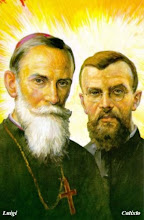
And then, just when everything seemed hopeless, he encountered Christ. Marcel discovered that Sunday Mass was offered in an obscure room of the barracks. He received the Eucharist for the first time in months and appreciated it like never before. He wrote to Marguerite, “Finally Christ reacted. He made me to understand that the depression was not good. I had to keep busy with my friends and then joy and relief would come back to me.”
Marcel the Missionary
And that’s exactly what he did. He rededicated himself to the prayer life he and Marguerite had established before the war. He also began to organize JOC-inspired activities for his friends in the barracks. They would play sports and cards, perform plays, and pray together. He found a French priest to say Mass for them once a month. In short, he stopped looking at his awful life and instead focused on choosing to love his God and his community. His hope and joy came back and spread to his fellow prisoners.
The S.S. also noticed the change in Marcel. They arrested him on April 19, 1944. While the officers search through his belongings, his friends asked for a reason for his arrest.  One of the officers replied, “Monsieur est trop Catholique” (translation: He is too Catholic).
Martyrdom
The Germans interrogated him. He admitted to being a part of the JOC, which the Germans had banned as a clandestine organization. He was sent to the concentration camp at Mathausen. The conditions were even worse than in the forced labor camp, but Marcel knew how to keep his joy. He continued to pray and encourage his fellow prisoners, even as he suffered from bronchitis, malnutrition, dysentary, fever, swellings, and generalized weakness, all in addition to his previous ailments. One prisoner had smuggled in a box of consecrated hosts and was able to give him his final Eucharist, also known as Viatacum.
His joy and hope were present to the end. The latrines at Mathausen were designed so that weaker prisoners would fall into them. Marcel nearly drowned in one, but was pulled out by a Colonel Thibideux. Marcel was too weak to even speak at this point. However, the colonel remembered that even covered in human waste and dying, “there was a holiness in [Marcel’s] eyes. I had never before seen anyone look that way!”
Beatification
Marcel died on the feast of St. Joseph, March 19, 1945. It was exactly two years after he left France.  The last time he had seen Marguerite was at the train station, when she told him he was going to be a martyr. He told her that he would never be good enough for that. St. John Paul II disagreed, and declared him a martyr for the faith on October 4, 1987. The pope said that like Christ, Marcel “loved until the end, and his entire life became the Eucharist.
“Received into the everlasting joy of God, [Marcel] testifies that the Christian faith cannot separate Heaven from Earth. Heaven is prepared on Earth through justice and love,” the pope said.
“Nourished by prayer, the sacraments, and apostolic action….he built the Church with his brothers, the young Christian workers. It is in the Church that we become Christian, and it is with the Church that we build a new humanity.”***
A man for our generation
Marcel
And that’s why I love Marcel. He started off as the kind of Christian so many of us are early in our conversion: overzealous, obsessed with vocation, and more interested in looking Catholic than cultivating a deep relationship with Christ.
But then he was stripped of absolutely everything. His little sister was killed, his vocation was snatched away, and he was forced to take the place of German workers who had killed his family. He couldn’t even maintain the prayer and sacramental schedule of his former life. Yet his response was simply to find Christ already present in those dismal surroundings and dedicate himself to bringing others to the Lord. He offered his sufferings for the sake of his brother’s mission as a priest. Even when he was too weak to speak, he changed something in the colonel just by looking at him.
You don’t get that kind of radiance from simply following the rules. It comes from falling deeply, irrevocably in love with Christ, and knowing that his peace and joy are available no matter what happens to you. That’s the kind of twentysomething our world needs.

Tuesday, September 22, 2015

Pope Francis with the Youth in Havana

Thursday, July 16, 2015

Pope Francis Commemorates Bicentenary of St. John Bosco's Birth

The following comes from Zenit:
In a message on the Bicentenary of St. John Bosco's birth, Pope Francis praised the Salesian founder, saying that the heart of his vision was "love in action, reaching out to those in need."
According to Vatican Radio, the letter was signed on St. John Bosco's feast day, June 24th and sent to the head of Salesian order, Fr. Angel Fernandez Artime.
"Don Bosco teaches us not to stand on the sidelines but rather to work on the frontlines in offering youth an experience of inclusive education that involves the whole human person," he wrote.
The Holy Father highlighted that while Italy and Europe has changed significantly in the last 200 years, today's youth are still "open to life and the encounter with God and with others." However, the Pope also said that youth continue to face "discouragement, spiritual anemia and marginalization."
Don Bosco's example, he continued, stresses the need for "the love of the educator expressed through concrete and efficacious gestures."
The Saint of Turin's complete trust in God, he said, "brought him to go out and make courageous decisions: the choice to dedicate himself to poor youth, with the intention of realizing a vast movement of poor people for the poor."
The 78 year old Pontiff went on to encourage the Salesian order to continue to accompany youth "In the search for a synthesis between faith, culture and life, at times when decisions are difficult, when trying to interpret a complex reality."
Concluding his address, Pope Francis called the Salesians to assume the inheritance left by Don Bosco in speaking and acting "with youth and for youth."

Tuesday, June 23, 2015

Pope Francis to Youth: Go against the flow; be courageous, creative!

(Vatican Radio) At the end of the first day of a two day trip to Turin, Pope Francis met with tens of thousands of young people in the city’s central square, Piazza Vittorio.

Pope Francis spoke to the young people “from the heart” for more than half an hour, laying aside his prepared remarks (which he promised would later be published). The Pope responded to questions from three young people on the topics of love, life, and friendship.

Love, the Pope said, is concrete, and is seen more in actions than in words. Love always communicates itself. Love, he continued, is very respectful of persons, it does not use people, and so it is chaste.

The Holy Father also responded to a question about disappointments in life. There are so many evils in the world. What can we expect of life, for instance, in a world where there are so many wars? Pope Francis referred to ongoing wars in Europe, in Africa, and in the Middle East; and to historical violence such as the great tragedy in Armenia at the beginning of the century, to the Shoah, and to the gulags in Soviet Russia. It is easy to grow disillusioned with life, he said, when even today we live in a “culture of waste.”

In the face of such evils, the Pope asked, how can we live a life that does not disappoint? “We must go forward with our projects of construction, and this life does not disappoint,” he said. We must help one another. And to do this, Pope Francis told the young people, they must go against the current, they must be courageous and creative.

Friday, February 27, 2015

Saint of the day: Gabriel Possenti


The following comes from EWTN:

On a summer day a little over a hundred years ago, a slim figure in a black cassock stood facing a gang of mercenaries in a small town in Piedmont, Italy. He had just disarmed one of the soldiers who was attacking a young girl, had faced the rest of the band fearlessly, then drove them all out of the village at the point of a gun. The young man was Francesco Possenti, whose father was lawyer for the Papal States and who had recently joined the Passionist Order, taking the name of Brother Gabriel.

Francesco Possenti had been the fanciest dresser in town as well as the best dancer. He was a superb horseman and an excellent marksman. Engaged to two girls at the same time and a great partygoer, he had shocked his family by announcing after his graduation that he was going to become a Passionist monk. No one believed him and expected him back within a few weeks. He stayed, and when Garibaldi's mercenaries swept down through Italy ravaging villages, Brother Gabriel showed the kind of man he was by confronting them, astonishing them with his marksmanship, and saving the small village where his monastery was located.

He had become very sick during his school years and had promised that if he got better, he would dedicate his life to God. St. Gabriel Possenti got better and forgot about it. He got sick again and made the same promise, but again got well and forgot his promise. Once, during a church procession in which a great banner of Our Lady, Help of Christians, was being carried, the eyes of Our Lady looked straight at him and he heard the words: "Keep your promise." Shaken, he remembered his promise, changed his life completely, and entered the Passionists.

He hoped to be sent to the missions after his ordination to the priesthood, but at the young age of twenty-four, he died. Canonized in 1920, he is, along with St. Aloysius, one of the patrons of youth. He was very fond of his family and is particularly remembered as a remarkable young man who, at the age of twenty, threw all aside for God, determined to become a saint.

Monday, July 7, 2014

Blessed John Paul II on Vocations


The following comes from Blessed John Paul II's Letter to Youth:

We could speak here of the "life" vocation, which in a way is identical with that plan of life which each of you draws up in the period of your youth... This "plan" is a "vocation" inasmuch as in it there make themselves felt the various factors which call. These factors usually make up a particular order of values (also called a "hierarchy of values"), from which emerges an ideal to be realized, an ideal which is attractive to a young heart. In this process the "vocation" becomes a "plan," and the plan begins to be also a vocation.

...During youth a person puts the question, "What must I do?" not only to himself and to other people from whom he can expect an answer, especially his parents and teachers, but he puts it also to God, as his Creator and Father. He puts it in the context of this particular interior sphere in which he has learned to be in a close relationship with God, above all in prayer. He therefore asks God: "What must I do?", what is your plan for my life? Your creative, fatherly plan? What is your will? I wish to do it.

In this context the "plan" takes on the meaning of a "life vocation," as something which is entrusted by God to an individual as a task. Young people, entering into themselves and at the same time entering into conversation with Christ in prayer, desire as it were to read the eternal thought which God the Creator and Father has in their regard. They then become convinced that the task assigned to them by God is left completely to their own freedom, and at the same time is determined by various circumstances of an interior and exterior nature. Examining these circumstances, the young person, boy or girl, constructs his or her plan of life and at the same time recognizes this plan as the vocation to which God is calling him or her.

Thursday, June 12, 2014

Salesian Polish Martyrs: Young Men of Faith!


The Salesian oratory at Poznań, Poland, has its martyrs: Edward Klinik (23), Francis Kesy (22), Jarogniew Wojciechowski (20), Czesław Józwiak (22), and Edward Kaźmierski (23). Today we celebrate their memorial and thank God for their witness to the faith and to the Salesian Family!The five young men were fully committed to their human and Christian development and were involved in working with their companions, sharing similar interests and their personal and community projects. Arrested within days of each other and imprisoned briefly in different places, they were then put in the same prison and suffered martyrdom the same day and in the same way.
Fr. Vecchi (our Salesian Rector Major at the time of the beatification) spoke about them in this way on the occasion of their beatification: “Each of them had his own particular biography which then became inter-twined with that of the others in the common Salesian setting that prepared them in a human and spiritual way to embrace martyrdom.” These young men give outstanding proof of the strong formative influence of life at the oratory, when there is opportunity for co-responsibility, when the educational approach is personalized and when the Salesians are capable of guiding the youngsters along the path of faith and grace. They were arrested by the Nazis in September 1940 and imprisoned in Fortress VII in Poznań. They were then moved first to the Neukoln prison, and then to Zwickau, where they were questioned and tortured and then condemned to hard labor. Two notes show that we are dealing with giants of the spirit: “God alone knows what we are suffering. Prayer was our only support in the darkest nights and days.” “God has given us this cross, and he is giving us the strength to carry it.” They were condemned to death for treason on August 1, 1942. The verdict was followed by a long silence until one of the five exclaimed: “Thy will be done.” They were condemned simply for belonging to Catholic organizations, which it was suspected might give rise to resistance movements.

Before they died they were able to write to their parents. Reading these lines one is astounded as before the truly great. As an example there are the words written by Francis: “My dearest parents, brothers and sisters, the time has come to say goodbye to you on August 24, the day of Mary Help of Christians … May the Good Lord take me to himself. Don’t have regrets that I am leaving this world so young. I am now in a state of grace. ... I am going to heaven. There I shall pray to God … Pray sometimes for me … I’m going now.” They were taken into the prison yard in Dresden and beheaded. The monthly commemoration of Mary Help of Christians was being celebrated in our communities on that day. For more information on these young martyrs please check out the Salesian site here.

Saturday, April 12, 2014

Monday, March 31, 2014

Pope to Salesians: Working for the souls helps fight spiritual worldliness


The following comes from the NCR Canada:
Pope Francis encouraged the Salesians in their work with young people, saying that religious vocations are the fruit of good pastoral youth ministry.
"Sometimes vocations to consecrated life are confused with choosing to do volunteer work, and this distorted vision does no good" to congregations and religious orders, he told more than 250 religious taking part in the Salesians' general chapter in Rome Feb. 22-April 12.
The full beauty of religious life needs to be shared with young people -- not incomplete or biased points of view, which risk promoting "fragile" vocations that are based on "weak motivations," he told them during a private audience at the Vatican March 31.
Religious vocations are "ordinarily fruit of good pastoral care of youth," he said, and people discerning a religious vocation need prayer and special attention, personalized formation, guidance and support from young people's families.
The pope, who attended a Salesian school in Buenos Aires when he was 13, said he recalls the importance of the order's motto of "Work and Temperance," joking that the school even forbade everyone from having "siesta" or an afternoon nap after lunch.
"Working for the good of souls" helps people focus on the essentials of God and his kingdom, the pope said.
He also encouraged the Salesians to continue their efforts in education and help find answers to today's "educational emergency" through increased cultural awareness and strong educational preparation.
"It's necessary to prepare young people to work in society with the spirit of the Gospel, as workers for justice and peace, and to live as protagonists in the church."
However, the pope said, while it's important to learn "new languages" with the changing times, the most important language still remains speaking "from the heart" in order to reach out and forge friendships with others.
The pope also greeted the Salesians' new rector major, Spanish Father Angel Fernandez Artime, who was elected to a six-year term on the first ballot March 25.
Born Aug. 21, 1960, in Luanco-Gozon, Spain, he was ordained in 1987. He has degrees in pastoral theology, and philosophy and pedagogy.
He served as director of youth ministry in the province of Leon, and he was provincial of Leon from 2000 to 2006.
Father Fernandez was provincial of the South Argentina province between 2009 and 2014, during which time he got to know and work with the future Pope Francis, then-Cardinal Jorge Mario Bergoglio of Buenos Aires.
Father Fernandez had been appointed provincial of the new province of Mary Help of Christians in Spain, but will not carry out that appointment because of his election as rector major.
Addressing his fellow Salesians March 25, Father Fernandez said: "I abandon myself to the Lord. We ask Don Bosco and Mary Help of Christians to accompany us and to accompany me, with my brother Salesians and with the congregation, and I accept with faith."

Thursday, March 13, 2014

A Year with Pope Francis; the "Pro-Salesian Jesuit”

(ANS - Rome) Today, 13 March, marks the first anniversary of the election of Pope Francis. It has been a very full year. Pope Francis has provided many good ideas and good examples that are valid for everyone, but especially for those who spend their lives for the salvation of youth. This "pro-Salesian Jesuit,” as he says he was once described, has been for all of us an excellent source of inspiration.

People who knew him well were already aware that he was a great devotee of Mary Help of Christians, and a fan of San Lorenzo de Almagro - the team founded by Fr Lorenzo Massa, SDB; that in his youth he studied for two years at a Salesian college; and that he had great admiration for the Salesian missionaries in Patagonia ("I see in them the story of a fruitful life") and devotion to Blessed Zephyrinus Namuncurá and Blessed Artemide Zatti. All this became public knowledge shortly after his election as Pope.

What perhaps we did not expect was that, even as Pope, Jorge Mario Bergoglio would continue to show gestures and expressions of esteem towards Don Bosco and his spiritual heirs. Yet he has done so right from the beginning. On 21 March last year - a few days after his election - he welcomed the Rector Major and his Vicar with great cordiality when they paid a private visit. A week later when he had lunch with some Roman priests, he invited two Salesians - Fr Maurizio Verlezza and Fr Antonio Petrosino - out of a total of seven guests.

On the Feast of the Assumption of Mary, as other popes had done traditionally, Pope Francis celebrated Mass at Castel Gandolfo and met the Salesian community that serves the Church of St. Thomas of Villanova. Then on 19 January 2014, the Pope paid a pastoral visit to the Salesian parish of the Sacred Cuore in Rome. Even though it is located in the centre of the city, it is a parish that serves many people who are seriously marginalized. 

Meetings are not the only thing that matters. It is above all in his words and gestures that we can see the Salesian style of Pope Francis. Think, for example, of the expression "fate casino (kick up a racket)“ that he addressed to young people on World Youth Day in Rio de Janeiro, or his constant advice to young people to not let anyone steal their hope, or the affectionate grandfather attitude that he always shows to small children, especially if they happen to be sick.

Words and gestures like these reveal to the world the spirit of Don Bosco: “it is enough that you are young for me to love you very much."

Friday, January 31, 2014

ST. JOHN BOSCO: THE SAINT WHO’S PRAYING FOR YOU

The following comes from the LIFE TEEN site:


John knew what it was like to have a tough childhood. Born to a poor family of farmers in 1815, he lost his father when he was only two. Though very intelligent and quite witty, John was forced to delay his dreams of priesthood while working as a shepherd and farmer, to help support his mother and siblings. At the age of nine, John Bosco had his first vision, one in which a man with a radiant face and flowing robes called him to lead a group of unruly boys behaving like wild animals.
Years later John Bosco would fulfill this prophetic vision, feeling called to the missionary field of youth ministry.
John learned to juggle and to do magic tricks – anything and everything he could think of to catch a child’s attention and earn the right to be heard. He served and guided the poor young boys in the city of Turin, many of whom had turned to crime and other sins in order to survive the difficult urban reality into which they were born. John Bosco offered a Catholic education and safe forms of recreation to thousands. He guided them in the ways of the gospel. He cared for them. He fed them.
In fact, once when he was saying Mass for 360 young people, there were only eight consecrated hosts left as he began to distribute Communion. He began to multiply the hosts and, in the end, there was enough for each person present; no one went without Jesus.
Over time, John recruited fellow priests and other friends to help him in his ministry, many of whom left, unable to take any more of the hardships that came with ministering to such a challenging group; two friends even tried to have John Bosco committed to an insane asylum. He was constantly being attacked verbally, physically, and spiritually, but he was not distracted from his mission.
One night while walking home during a particularly rough part of town, two men attacked John. At that very moment a huge, gray dog appeared out of nowhere, pouncing upon the two men and defending the great saint. Assuming the dog was John’s, the assailants begged him to call the dog off. Seeing their penitence, John asked the men to promise not to do commit crimes again. They agreed as John prayed and the dog relented. When the men ran away, the dog, which John named “Grigio”, stayed at his side. From that night forward, Grigio “showed up” whenever John may have been in danger. For almost thirty years, countless eyewitnesses saw the great Mastiff that would mysteriously show up at John’s side, becoming something like a crime-fighting sidekick. When asked about the dog’s origin and mission, John replied, “It sounds ridiculous to call him an angel, yet he is no ordinary dog.”
The saint’s life was never boring, to say the least. His visions became more detailed and more miraculous as the years went on. Pope Pius IX even asked John to record his visions, believing them to be prophetic and valuable to the Church. Records of them still exist today and you can read, in detail, the visions and truths the Lord entrusted to this great servant of youth.
Saint John Bosco died in 1888 and his great work is carried on by the Salesians, the order he founded, and also by all who reach out and serve the young Church through youth ministry. He refused to look upon young people the same way that society did, believing that a young soul only needed to live a saintly life was love and truth.
If you are a teenager who struggles to believe in your own inherent goodness or an adult struggling with hope for the next generation, ask this great saint to join his prayers to yours. Saint John Bosco saw the good within everyone, which makes it even more ironic that this great saint is one of the famous “incorruptible” saints we hallow today – Saint John Bosco’s outside is a perfect reflection of the beauty he possessed on the inside.

Saturday, January 18, 2014

He'd take a bullet for her!

Tuesday, October 8, 2013

Limit Break BMX


Limit Break is a web series about people who do extraordinary things, and how their faith inspires them. In this episode we meet Mike Stanek, a professional BMX rider and medical student. Mike’s tricks are amazing, but even more so when you realize that he is also a full-time medical student. Yet Mike remains humble. Why? It’s because he realizes that it is his faith that has allowed him to accomplish so much. Mike says that he can’t explain everything that happens when he is pulling off a trick. In the same way, he knows his knowledge of science can’t explain all of the world’s mysteries. He turns to his faith to answer these questions. It is through God that he finds the strength to fulfill on the high expectations he has for himself. It’s what motivates him to get back up after a nasty fall, and it’s whom he thanks when he lands a move. Check out his amazing stunts and listen to him discuss how his faith has helped him achieve great things.

Tuesday, September 24, 2013

Pope to the Youth: A young person without hope is not a young person


September 23, 2013 (Romereports.com) It seemed like another World Youth Day, except this wasn't Rio, but the Italian island of Sardinia. The Pope met with thousands of young people during his apostolic visit. Surrounded by applause, the Pope addressed the crowd directly, and at times mixing his Italian with Spanish.   

POPE FRANCIS 

“Some of your 'preguntas,' or rather questions. I guess I also speak a type of 'dialect' right?"     

The Pope called on the youth to not abandon the Church. He specifically talked about a common trend that needs to stop. 

POPE FRANCIS 
“While reading your questions, I noticed this. The Sacrament of Confirmation. What's the name of this Sacrament? Is it Confirmation? No. The name has changed to the 'farewell' Sacrament. After this, youths leave the Church. Right? This is a failed experience.” 

The Pope then encouraged them to have real hope for the future. 

POPE FRANCIS 
“As young people you can't and shouldn't lose hope. It's simply part of your nature. A young person without hope isn't young. It's someone who has aged too soon.” 

Clearly referencing the use of drugs and alcohol, the Pope warned about the dangers that come when one looks for hope in all the wrong places. 

POPE FRANCIS
“You know, these merchants of death. Those who sell death, offering a new route when you're sad, without hope, without confidence, or strength. Please do not sell your youth to these death dealers. You know what I'm talking about. All of you understand. Don't sell your life.” 

It was 60 years ago that the Pope felt a strong calling to become a priest. He talked about this personal experience during his visit. 

POPE FRANCIS 
“I don't regret it. I do not! You may ask, -why?- Is it because I feel like Tarzan and I'm strong enough to keep going? No. I don't regret it because at all times, even in the darkest moments of sin, of weakness and failure, I looked toward Jesus and I believed in Him. He has never abandoned me.” 

To thank him for his visit, a youth group performed for the Pope, singing and dancing to traditional music of the island of Sardinia.