Showing posts with label Ecuador. Show all posts
Showing posts with label Ecuador. Show all posts
Monday, July 13, 2015


Tuesday, July 7, 2015
Tuesday, March 30, 2010
Ecuador – Salesians and Jesuits effective in protecting children’s rights

The following comes from the Salesian News Agency:
During the presentation of a study on child labour, held on 24 March at the Salesian Polytechnical University in Quito, the effectiveness of some projects by Salesians and Jesuits emerged.
The plague of child labour in Ecuador involves a million children and adolescents working, about 18% of the working population. According to a report of the Fides Agency, in a country where 54% are suffering real poverty, child labour to support families takes different forms: 67% is in the agricultural sector, 15% in commerce and the remaining 18% in the third sector of unskilled domestic work.
This was the issue considered on 24 March at the Salesian Polytechnical University in Quito, when there was the presentation of a study by Cristiano Morsolin, a consultant from the SELVAS Observatory on Latin America, who since 2001 has been working on projects of international cooperation in Ecuador, Perù, Colombia and Brazil.
Among examples quoted in the book was that of the Jesuit Fr John Halligan. In 46 years, at the “Centre for the young worker” he founded, about 25,000 people have been helped. Every year about 1,200 children are educated in vocational training in courses of mechanics, wood-work, and baking, and for the girls, beauty-care, needle-work and cookery, as well as each day the support of about 800 parents with meals and voluntary work on Sundays helping to build houses for the families who come into the city from the Andes. The results are very satisfying: of the 42% of the children who come to the Centre not having completed elementary school, 85% finish elementary or middle school and 64% continue to study after they completed their training at the Centre.
Along the same lines there is a Salesian project helping about 8,000 boys and girls each year. In the countryside around Ambato the Salesian project which has been in operation for 30 years has a large farm, where the parents are also taught not to ill-treat their children. In the industrial city of Guayaquil the project mainly concerns street children, the prevention of drug addiction and the care of the addicts. At Esmeraldas, with the strong support of the Bishop Eugenio Arellano Fernández, there is the work of the rehabilitation of the “pandillas”, youth gangs. In the large cities such as Cuenca, much is done in the area of providing hostels as an alternative to living on the streets and providing work training with the help of the Salesian University, street theatre and demonstrations making society aware of the rights of children and of good working conditions, as recognised by the new Constitution of Bolivia, which in article 61 permits work by boys and girls in the family and in the country-side.
Wednesday, July 9, 2008
La Compania Church in Quito, Ecuador
I have been back from Quito for over a week, but I had wanted to post La Compania Church (Church of the Company of Jesus) since I got home. Here are some photo's of this beautiful church! To find out more about this church please click here.


Friday, June 27, 2008
More Pictures from Quito, Ecuador!
I took this picture walking down the street on a Sunday afternoon in Quito. These street children were pretty good musicians and attracted a crowd!

This picture was taken inside the monastic chapel of Saint Mary Ann de Paredes. She is often called the Lily of Quito. A community of 24 cloistered sisters still carry on the tradition of St. Mary Ann (or St. Mariana).

The following pictures were taken at our Salesian Retreat House in Cumbaya, Ecuador. The retreat house is for silent retreats only and was built in a really beautiful monastic/mission style! Cumbaya is just a 30 minute drive from Quito and was really beautiful. It sits between a couple of other volcanoes as well!


The pictures below were taken in Cumbaya as well and were from one of our Salesian grammar schools. One of the parents painted these fantastic paintings on the walls of the courtyard where the kids play! The paintings depict a young John Bosco during his famous dream at the age of 9. The Blessed Mother shows him the work that God is calling him to: to transform the animals into sheep with loving kindness! Also, you can see the image of Don Bosco with St. Dominic Savio and Blessed Laura Vicuna.


Sunday, June 22, 2008
Our Lady of Good Success

Venerable Mother Mariana de Jesus Torres was a Conceptionist nun from Spain who went to the Quito colony in Ecuador in 1576. Our Lady and Our Lord appeared to her and gave her many revelations, beginning in 1610, that included prophecies, especially relevant for the Church in our time. Those considered the most significant of all the prophecies was that of the crisis in the Church. Another prophecy was that Pope Pius IX would promulgate the dogma of the Immaculate Conception and that this same pope would preside over a Vatican Council which would teach infallibly on the Papacy, including the Pontiff's supremacy and the charism of infallibility in matters of faith and morals! Amazing! Ven. Mother Mariana was also instructed on the details of the life-sized statue to be made, that Our Lady should have a crosier and keys with the Child Jesus in her left hand:
" . . . so that men will understand how powerful I am in placating the Divine Justice and in obtaining mercy and pardon for every sinner who comes to me with a contrite heart, for I am the Mother of Mercy and in me there is only goodness and love. Let them come to me, for I will lead them to Him." The statue, made by a sculptor in Quito, was miraculously completed by the Archangels Michael, Gabriel, and Raphael in the early morning of January 16, 1611.
In 1619 Our Lord invited our Venerable Mariana to share His Cross more deeply, " . . . for at all times I have need of valiant souls to save My Church . . ."
On the Feast of the Purification, 1634, Mother Mariana was before the Blessed Sacrament, when she saw the Sanctuary light go out. There are five meanings of this sign: You can read more about these prophetic messages here.
Images of Our Lady in Ecuador
The following is a sample of the different devotions to Our Lady that are popular here in Quito. There are others as well, but these are the most well known. I will post later on Our Lady of Good Success. That is an interesting story as well! I found the information on Our Lady of Quinche at Catholicmedia.net.
 Our Lady of the Presentation of Quinche is a handsome wood sculpture carved in the 16th century by Don Diego de Robles, an extraordinary artist who is also credited with other popular and venerated images of Mary. History tells us that those who had ordered the image couldn't or wouldn't pay the sculptor for it, and he traded it to the "oyacachi" Indians for some large cedar boards he needed. At a later time, popular fancy enriched the facts with the legend that the Virgin had appeared earlier to the Indians in a cave and had promised to deliver them from the dangerous bears which devoured the children. The Indian chiefs were astonished when they saw Diego Robles arrive carrying the image of the Virgin, whom they recognized as having the same features as the Lady who had appeared to them in the cave and had spoken to them. The statue remained under the care of the Indians fifteen years, when the bishop of the place ordered it moved to the village of Quinche from which it finally took its name in 1604. The image is a fine carving in cedarwood, measuring 62 centimeters in height. The handsome sculpture is hidden by large brocade garments, covered with jewels and embroidered with gold and silver threads, which only allow the serene dark face to be seen. The Virgin holds a scepter in her right hand and with the left hand she holds the Child, who lifts a hand in blessing and in the other hand displays a gold globe crowned with a cross. The pedestal at her feet and the large half moon, both of pure silver, and the heavy crowns made of gold and precious stones which adorn the heads of Jesus and Mary, evidence the generosity of the people of Ecuador who like to see their patroness resplendent, dressed with the best finery. The face of the Child Jesus has features resembling those of the mestizo children of those mountains. Mestizo is also the color of the mother, synthesis of the Inca and Spanish souls. She has a delicate oval face with a slender nose, thin lips and a small mouth; her slanted eyes and her sad gaze with half closed eyelids give her a unique gentleness. This is why she is so popular in Ecuador, specially among the Indians who affectionately refer to their protector in heaven as "La Pequehita" (the little one). There are an amazing number of songs in honor of the Virgin of Quinche, in "Quechua," "Jibaro," and many other dialects of the region as well as in Spanish; many have been sung for 300 and even 400 years. The image was crowned in 1943 and her feast is celebrated each year on November 21. The present shrine was declared a National Sanctuary in 1985.

The Virgin of Quito is a popular cult image venerated throughout the northern Andes; its composition is derived from the biblical description of the "Woman of the Apocalypse." As described by Saint John, the woman was clothed in the sun, with the moon under her feet and a crown of twelve stars on her head. After battling a dragon (Satan, with the apple of original sin in its mouth, missing from this object), she is given wings to escape. This small devotional image is one of a multitude to replicate the famed sculpture in the Church of San Francisco in Quito, attributed to the mestizo sculptor Legarda. This image is also seen overlooking the city of Quito and is beautifully lit at night. You can find out more about El Panacillo here.

The picture of Our Lady of Quito, an image of Our Lady with the seven swords piercing her heart, was first placed in the boarding school of the Jesuit Fathers in Quito. On April 20, 1906, Father Andrew Roesch along with thirty-six boys of the academy witnessed the first miracle of this famous picture of Our Lady of Sorrows; while in the refectory they saw the Blessed Mother slowly open and shut her eyes. The same miracle occurred several times after this, once more in front of the boys at the school, but this time in the chapel, to which the picture had been taken. Subsequently the canonical process of examination was carried out by the ecclesiastical authorities, and the Vicar General ordered the picture to be transferred in procession from the College to the Church of the Jesuit Fathers. At the church the prodigy was repeated several times before the crowds gathered there, and many conversions took place. Again and again, the wonder repeated itself, at one time for three consecutive days. The image was also said to have shed tears on April 29, 1906. You can find out more on this by clicking here.
Friday, June 20, 2008
Ecuador, Volcanoes, and Gas Prices!
 I was able to get this picture of the Chimborazo Volcanoe yesterday. It is not an active volcanoe but here is an interesting fact: The summit of Chimoborazo constitutes the furtest point from the center of the Earth because of the high elevation (20,700 feet), the location of the mountain at the equator and the oblateness of the Earth. It really is a beautiful sight to see!

Yes, that is the actual price of a gallon of gas here in Quito, Ecuador today! And yes that price is in dollars!

Here is yet another volcano here near quito. It is actually about 4 hours suth of Quito. Tungurahua is an active volcano also known as the "The Black Giant." It has a 600 ft. wide crater and is still rather active. The last major eruption was back in 1944, but it still grants frequent tremors to nearby towns on a regular basis!
Tuesday, June 10, 2008
Quito at Night!

The Virgin of Quito (El Panacillo)

Quito at Night!

Church of St. Dominic

The Cathedral of Quito

Church of St. Francis

Church of St. Blase
Monday, June 9, 2008
Pictures from Quito!
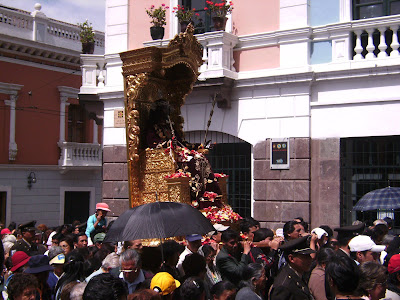
Here are just a few photo's from Quito. I am here for another 3 weeks or so for a class on Salesianity. I will periodically add more shots! I included a procession that I saw yesterday for the Feast of Our Lord, Our Good Hope! The weather here is very mild 62 degrees! God bless!




Subscribe to:
Posts (Atom)