Showing posts with label courage. Show all posts
Showing posts with label courage. Show all posts
Friday, January 12, 2018


Saturday, October 28, 2017
Don’t Give in to Discouragement

Psychologists tell us that one of the chief evils of our age, an evil apparently less evident in earlier ages, is that of easy defeat. Be this as it may, most people who are honest with themselves would probably have to admit to indulging in despondency. They are fortunate if they have nothing worse to confess than despondency; there are many who labor under the weight of near-despair. Whether guilty of surrendering to the temptation or whether burdened with a sense of guilt that in fact is without foundation, a man can reduce his spiritual vitality so as virtually to close his soul to the operation of hope. When hope dies, there is very little chance for faith and charity.
It is a commonplace to observe that the saints were not those who never fell, but those who never gave in to their falls. It is less generally understood that the saints felt just the same longing as we do for the excuse to go on falling. The parable of the wheat and the cockle should show us that the saints were not only as divided against themselves interiorly as we are, but that they had to go on struggling all their lives against the desire to let the cockle have its way.
A mistake we make is to think of the saints as triumphing over temptation by the felt force of ardent love. Some of them, certainly, experienced this fire, but for the most of them it has been a question of grinding out dry, hard acts of faith and hope through clenched teeth. The saints have had to fight every inch of the way against discouragement, defeatism, and even despair.
How could it be otherwise? No virtue can be productive of good unless it comes up against the evil that is its opposite. Courage is not courage until it has experienced fear: courage is not the absence of fear, but the sublimation of fear. In the same way, perseverance has to be tried by the temptation to give up, by the sense of failure, by an inability to feel the support of grace. The reason Christ fell repeatedly — one tradition would have it that He fell seven times — is at least partly because we fall repeatedly and have need of His example in recovering from our falls. The difference between His falls and ours is that, whereas His were because of weakness of the body, ours are because of weakness of the will. The likeness between His and ours lies simply in the use that can be made of them.
Even if we do not reproduce the Passion in any other respect, we have the chance of reproducing it in perseverance under exhaustion. If, as we have seen, the Passion is constantly being renewed in the members of Christ’s Mystical Body, there must always be some aspect of Christ’s suffering to which our own personal sufferings can show an affinity. If we are bearing witness to the same truth, opposing the same evil, moving in the same direction, then the same means must be used by us as those that were used by Christ — namely, patience and endurance in the all-but-defeating experience of life. The effort that we make to regain the position lost by either circumstances or sin will reflect the effort made by Christ to return to the interrupted work of cross-bearing. Nothing of our experience need be wasted, not even our sinfulness.
So it would seem that the truly Christian man transcends discouragement only by accepting it. No man can pass beyond an obstacle except by facing it and rising above it. To go around an obstacle is not to overcome it, but to evade it. Circumvention may be all right when we are traveling along a road, but it will not do when we are advancing toward God by the way of the Cross.
Wednesday, October 4, 2017
Mother Teresa on Loneliness and Love

"There is a terrible hunger for love. We all experience that in our lives, the pain and the loneliness. We must have the courage to recognize it. The poor may be right in your family. Find them and love them!"
Blessed Mother Teresa
Sunday, August 7, 2016
Get Tough With Yourself!
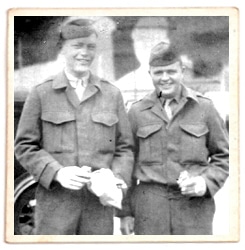
Sid Phillips, left, with W.O. Brown
This is a post from The Art of Manliness, and Men Who Lead Well.
One harmful mindset that can keep a man from fulfilling his calling and potential is self-coddling. This is when he convinces himself he deserves a break, and runs to something that ultimately harms himself.
One harmful mindset that can keep a man from fulfilling his calling and potential is self-coddling. This is when he convinces himself he deserves a break, and runs to something that ultimately harms himself.
The WWII Marines of K/3/5 had been fighting on Guadalcanal for weeks. C-rations had run out, and the men ate twice daily portions of coconuts and wormy rice they’d confiscated from the Japanese.
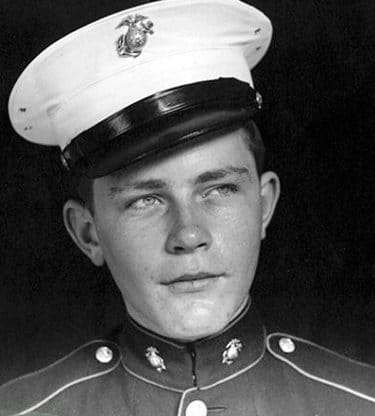
“It was bad,” Phillips reported in an interview with me. “I didn’t think W.O. was going to survive.”
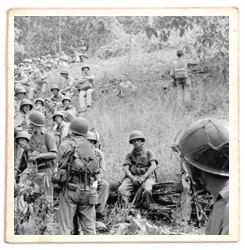
Each day, Phillips carried W.O. to the ocean and helped him get clean. I asked Phillips if he remembered any specific conversations he had with W.O. during these times of carrying him. Here, I was expecting a poignant story. I pictured this young battle-hardened Marine carrying his nearly-dead buddy to the water. “Keep holding on,” Phillips would whisper. “Have courage. Just think of mom and apple pie.” Something like that.
But Phillips just chuckled. “Oh yeah, I remember. I told W.O. to stop being such a faker and take a salt tablet.”
The response threw me. I asked Phillips (who eventually became a medical doctor) what his strategy was.
“Well, it didn’t help a man to overly commiserate with him,” Phillips said. “If you did, it just depressed him. But if you kidded him, it made him smile. The ribbing was all good natured. He’d fire back some wisecrack at you, and soon he’d get to fighting again.”
Phillips respected W.O. Brown as someone who had the capacity to get up and go on. So let’s believe the same about ourselves.
Anytime a man is in a downed place—i.e. he’s annoyed, angry, tired, hurt, lonely, stressed, or frustrated—he is tempted to become overly sympathetic with himself. He gets that insidious, creepy, pampering mindset that tells him he deserves a break—just this once.
I’m not talking about kicking back on the couch with a bag of Doritos. Not that kind of a break.
I’m talking about blowing it: the lie that it’s okay to run to a favorite vice. We’ve all got them. We run to whatever ultimately harms us, because we’ve convinced ourselves it helps. It’s the worst form of coddling.
Get tough with yourself. Knock it off, ya faker. Take a salt tablet, and get back to the battle. Sure, frustrations exist. But you don’t need that bottle. You don’t need that porn. You don’t need to give in to that moment of rage on the freeway. You’ve only convinced yourself you do.
By the way, the strategy works. W.O. Brown survived the dysentery—and the war.
Thursday, April 21, 2016
DON BOSCO: IT’S ABOUT EVIL TREMBLING IN FRONT OF THE GOOD, & NOT THE OTHER WAY AROUND

DON BOSCO
NARRATES:
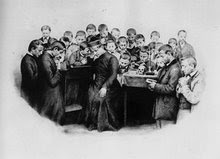
I was a lively and attentive boy who, with
Mom’s permission, went to the various festivals where there were acrobats and
magicians. I always put myself in the front row, eyes fixed on their movements
with which they tried to distract the audience. Little by little I could see
their tricks; returning home, I repeated them for hours. But often the moves
didn’t produce the desired effect. It wasn’t easy to walk on that blessed rope strung
between two trees. How many tumbles, how many skinned knees! And how many times
I was wanted to throw everything into the air! Then I’d start again, sweaty,
tired, sometimes even disappointed. Then, a little by little, I was able to get
it together; I could feel the soles of my bare feet clinging to the rope, which
seemed to become one with my footsteps, and I then did as I wanted, glad to
repeat and to invent other movements. That’s why, when I spoke to my boys in
later years, I’d said to them: “Let’s hold on to easy things, but let’s do them
with perseverance.” There you have it: my down-to-earth pedagogy, the result of
so many victories and as many defeats, with the stubbornness that was one of my
most marked characteristics.
That’s how my style came into being, to
educate without using big words, without any great ideological schemes, without
references to many famous authors. That’s how my pedagogy was born: I learned in
the meadows of Becchi, later in the streets of Chieri, later still in prisons,
in the streets, in the alleys of Valdocco. Mine is a pedagogy built in a
courtyard.
I dared to prove it a few years later when
I went to Chieri to continue my studies and was accepted by the teacher, in
front of the whole class, with a not very exciting sentence: “This fellow’s either a simpleton or a genius.”
It made me feel awkward in the extreme; I remember coping with these words: “Something in between. I just am a poor
young fellow who has the goodwill to do his work and get along in his studies.”
Then there was that blessed dream when I
was nine or ten years old (the dream which was repeated many more times!), which
came to torment me, and the desire to become a priest for the boys became
stronger. And then I did something that didn’t make a genius of me, but in
fact, achieved a beautiful victory in my character, a real breakthrough; I stretched
out my hand to ask for help, something just to realise my dream. I would admit much
later to a Salesian: “You don’t know how much this begging cost me.” With my
proud temperament, it was certainly not easy to be humble enough to ask. My
courage was empowered by a high level of trust in Providence; and also what I
had learned from my mother. At her school I had learned one rule that guided me
everywhere: “Whenever I am faced with difficulties, even grave ones, I do what
a hiker does in finding his trail blocked. If I can’t shove the obstacle out of
the way, I either go over it or around it.” (BM 7:271)
And I assure you: I found many large
boulders on my path. I shall briefly mention some of them: The year 1860, for
example, was typically difficult. Fr Cafasso, my friend, confessor, and
spiritual director had died. How much I missed his presence, his advice, and
his financial help.
Then, from the government side, I
encountered serious difficulties, authentic “boulders”: targeted searches which
were devastating to Valdocco, as if I were a criminal! My boys were living in
terror, while armed guards entered everywhere. The searches continued, creating
a climate of fear and uncertainty. I wrote to the Minister of the Interior,
Louis Farini, for an interview. I had the courage to tell him with humble
determination: “For my boys I demand
justice and restoration of honour so that they don’t lack the bread of life.” I
know that I was taking a great risk because these government officials were
anticlerical, but I didn’t lack the necessary courage. And so gradually the
searches stopped.
I never gave up! I said to the boys: “The courage of the wicked depends on the
fear in which others regard them. Be brave, and you’ll see how they wilt.” A
French benefactor from Lyons sent me a holy picture
with a phrase I’ve never forgotten because it served as a guide: “Be with God like the sparrow that feels the
branch shake but still continues to sing, knowing that it has wings.” It
wasn’t just a poetic expression, but an act of courageous confidence in the Lord’s
Providence, because he alone “is the
master of our hearts.”
When they were about to leave for summer
vacation, I used to say this to my boys: “Be
men and not branches! Lift your head high, walk straight in the service of God,
at home and outside, in the church and in the square. What is human respect? A papier-mâché
monster that doesn’t bite. What are the impertinent words of the wicked? Soap bubbles
that disappear in an instant. Let’s not
pay any attention to adversaries and their taunts. Remember that knowledge
without conscience is nothing but the ruin of the soul. ”And I used to add, “Nothing in the world
must frighten us. So behave today that tomorrow you’ll have nothing to be
ashamed of”.
I never got tired of instilling into their
little heads: “By your conduct give glory to God, consolation to your parents and your
superiors. On the other hand, a lazy, undisciplined youth will be a disgrace, a
burden to his parents, a burden to his superiors, and a burden for himself.”
From Valdocco would rise “good citizens
and honest Christians” of whom the world has much need.
Tuesday, May 5, 2015
Fear vs. Encouragement

The following comes from Mark Giszczak at Catholic Exchange:
Fear prevents us from doing a lot of things that we want to do, ought to do. Fear divides people against one another. Fear builds walls, invisible psychological walls, between us. Sometimes we need another person to shake us out of our fear, to encourage us, to stir up the boldness that lies within.
Including and Excluding
This Sunday’s first reading begins on a note of fear. The recently converted persecutor of the Church, Saul (later Paul), comes to Jerusalem as a new convert and seeks to join the Christian community. But knowing his background as an enemy of the Church, they refuse to accept him. Perhaps they think he’s a spy or they don’t believe that a person can have such a dramatic conversion. But ultimately, they are driven by fear. They exclude Saul because they are afraid of him. While we might not confront a murderous persecutor of the Church at the doors of our parish, we would do well to think of the people that we “fear” because of their lifestyle, their social status, their appearance. Can we get past that fear and “touch the hands of the poor” as Pope Francis repeatedly encourages us?
Son of Encouragement
The journey from fear to boldness is not usually a solo journey. Often we need someone to encourage us, to “put heart” into us, to slap us on the back, tell us our potential, and push us to perform. We might think of a good coach, an inspiring teacher, or a loving parent, as an this kind of uplifting voice in our lives. Here in the Book of Acts, we get a great example in Barnabas. His real name was Joseph, but his nickname was “son of encouragement” or “son of exhortation,” in Aramaic, Barnabas (Acts 4:36). As we see from his name and actions, Barnabas was known for encouraging people. He was the one who went and sought out the newly converted Saul in Tarsus to bring him on one of the greatest mission trips in the history of the Church (Acts 11:25). Barnabas was so successful in encouraging and mentoring Saul that he himself fades into the background while Saul/Paul takes center stage.
After the Jerusalem Christians exclude Saul, the text says that Barnabas “took hold of him,” from epilambanomai, which can mean to “seize” or “grasp.” I like to think of him grabbing Paul by the shirt collar and hauling him away. Barnabas then brings Saul to the apostles and advocates for him. His exhortation releases Saul from fear of being excluded from the Church and turns the Church’s fear into faith. His attitude toward Saul and his words of encouragement turn a bad situation of exclusion into a great reception of one of the greatest apostles.
Boldness
After being received into the Christian community at Jerusalem, Saul is soon exhibiting the great faith which Barnabas saw in him. He boldly proclaims the gospel in public in Jerusalem—a dangerous gamble in a time when Christians are being persecuted. Saul takes a stand with the Church he has just joined and even sets an example of fearless preaching for them. Saul is unafraid to proclaim the gospel, despite the dangers. Of course, soon some of the “Hellenists,” that is, Greek-speaking Jews, are seeking to put him to death.
Guarding the Treasure
While Paul does eventually die as a martyr in Rome, this is not the time. God still has work for him to do, so the Christians at Jerusalem hide him and send him away where those who want to harm him won’t be able to find him. To me, this is an interesting example. Often I think we view martyrs as reckless or determined, walking straight into the lion’s mouth. But for many martyrs, like St. Paul, there were many times when their life was threatened and they fled rather than be killed. Only at the time appointed by God do they come to offer themselves to him as martyrs for the Faith.
Fear vs. Encouragement
After Saul’s eventful visit, Acts offers a summary: The Church is growing just like Jesus said it would, starting at Jerusalem, then Galilee, then Samaria. The Christians throw off the fear of persecution and the world, embracing instead the right kind of fear: fear of the Lord (Acts 9:31). Fear of the Lord is not a servile, quaking, nasty fear, but a beautiful surrender of one’s life to the Author of Life, a giving back of what has been given, a wise submission to “the only wise God” (Acts 16:27). Not only do the Christians embrace fear of the Lord, they also have the “paraklesis of the Holy Spirit.” The word paraklesis is related to “Paraclete,” one of the titles of the Holy Spirit. Often it is translated as “comfort” or “consolation,” but I think the best translation is “encouragement.” The Holy Spirit comes to vanquish fear and to encourage our hearts to believe, to hope, to love.
No doubt fear has a good purpose—to help us hide from a tornado or escape from a sinking ship—but too often, we allow fear to boil over and invade areas of our lives where it should not. Fear of others, fear of failure, fear of being laughed at, often prevent us from doing what God wants us to do. This reading from Acts shows us that through the power of the Spirit and the aid of a good, encouraging mentor, we can overcome fear with faith. And sometimes we are called to be like Barnabas, encouraging and exhorting another person, helping him or her to let go of fear and grab onto courage. “There is no fear in love, but perfect love casts out fear” (1 John 4:18 RSV).
Saturday, September 13, 2014
Friday, July 25, 2014
The Courage To Rejoice by Pope Benedict

The following comes from Celebrating the Year of Faith:
“The loss of joy does not make the world better—and, conversely, refusing joy for the sake of suffering does not help those who suffer. The contrary is true. The world needs people who discover the good, who rejoice in it and thereby derive the courage and impetus to do good.
“We have a new need for the primordial trust which ultimately faith can give. That the world is basically good, that God is there and is good too. That it is good to live and be a human being. This results, then, in the courage to rejoice, which in turn becomes commitment to making sure that other people too can rejoice and receive good news.”
Pope Emeritus Benedict XVI in Salt of the Earthpp 36-37
Friday, May 30, 2014
Courage Needed

The following comes from Austin Ruse at The Catholic Thing:
The great Russian dissident Aleksandr Solzhenitsyn despaired of many things, not the least of which was courage, not in himself, but in others. He despaired of courage among the elite classes; politicians, Western business and intellectual leaders, and he knew their cowardice would naturally flow down to everyone else.
Like all virtues, courage is a habit built up by repeated acts over a lifetime, like a muscle, like all virtues. But courage may also be squandered.
There are moments when each of us has betrayed courage. Forty years later, I still see a basketball bounce a few feet from my grasp, back and forth between two guards on the opposing team. And how with the right timing, a few steps and a confident grab, there was nothing but open court before me. But I stood there frozen, and never grabbed that ball. That may sound a trifle, but it is a moment of cowardice that haunts me still.
A week later, it got worse. The coach looked down the bench to send in a scrub. His eyes met mine – and I looked away. Down and away. Message received. In the locker room, he told us that anyone who did not want to play ought to quit. So, I did. What a coward. Quitting, cowardice’s wicked companion, is an easy habit to start and hard to break.
I often think about Lenny Skutnick. Driving in Washington near the 14th Street Bridge, he heard that a passenger jet had just crashed into the icy water of the Potomac River. He nosed his car through stopped traffic, steered it close to the water’s edge, looked out at the freezing water, plane submerged and sinking, a wing sticking out with people clinging to it. He dove into the icy water over and over and saved them.
A lifetime of cowardice and quitting does not prepare you for that moment. Plenty of others had good reasons to stand mouths agape doing nothing. Not Skutnik. He dove in. How had he prepared for that moment?
I think I know why years ago I did not lunge for that ball – and almost certain, though momentary, glory. The kind of fear I experienced was not the kind of physical fear that kept those hundreds of people standing and watching Skutnik, and not helping him. Mine was the fear of embarrassment, perhaps the most common kind of fear in our age.
What if I lunged and missed? What if I got the ball and missed an easy layup down the court, or worse, got stuffed. Simply, what if I got caught out, laughed at? Better to do nothing.
I am not immune even now. A conservative friend was presenting his new book on national sovereignty at the Council on Foreign Relations. Around the table were top officials from the United Nations, U.S. State Department, and think tanks. My friend oddly mocked the way pro-lifers have critiqued a certain U.N. committee. Instead of stepping up and defending the critique, I sat there. It would have been an easy layup. But I sat there.
And this is the fear we must all grapple with in this day and age. Those Skutnick moments are mostly for soldiers, moments where you overcome a fear of physical harm and even death. For us, there is fear of embarrassment, fear of getting caught out, laughed at.
Who among us has not hesitated to engage social issues; contraception, abortion, stem cell research? Who among us has not hesitated to engage on the gay question with friends, family, or even strangers, for fear of getting caught out, knowing simple assertions, but not the second and third and fourth thing to say? And then there is the mockery, a specialty of the other side.
David French, who works for the American Center for Law and Justice, went from a state university to the Harvard Law School. Before he went he fretted about whether he was up to the intellectual cut and thrust of an Ivy League law school. What he found was no intellectual engagement at all. What he got from the other side was mockery, only mockery.
Of all the virtues, the Church teaches prudence is the queen, for she teaches what to be courageous about. But without courage, at least in some cases, prudence might be all good intentions and not much more. Churchill said courage is the supreme virtue because of that. Fine, Churchill was no theologian. Still, he was onto something, and that is prudence needs her muscular friend courage.
Like all virtues, courage is a habit built up by repeated acts over a lifetime, like a muscle, like all virtues. But courage may also be squandered.
There are moments when each of us has betrayed courage. Forty years later, I still see a basketball bounce a few feet from my grasp, back and forth between two guards on the opposing team. And how with the right timing, a few steps and a confident grab, there was nothing but open court before me. But I stood there frozen, and never grabbed that ball. That may sound a trifle, but it is a moment of cowardice that haunts me still.
A week later, it got worse. The coach looked down the bench to send in a scrub. His eyes met mine – and I looked away. Down and away. Message received. In the locker room, he told us that anyone who did not want to play ought to quit. So, I did. What a coward. Quitting, cowardice’s wicked companion, is an easy habit to start and hard to break.
I often think about Lenny Skutnick. Driving in Washington near the 14th Street Bridge, he heard that a passenger jet had just crashed into the icy water of the Potomac River. He nosed his car through stopped traffic, steered it close to the water’s edge, looked out at the freezing water, plane submerged and sinking, a wing sticking out with people clinging to it. He dove into the icy water over and over and saved them.
A lifetime of cowardice and quitting does not prepare you for that moment. Plenty of others had good reasons to stand mouths agape doing nothing. Not Skutnik. He dove in. How had he prepared for that moment?
I think I know why years ago I did not lunge for that ball – and almost certain, though momentary, glory. The kind of fear I experienced was not the kind of physical fear that kept those hundreds of people standing and watching Skutnik, and not helping him. Mine was the fear of embarrassment, perhaps the most common kind of fear in our age.
What if I lunged and missed? What if I got the ball and missed an easy layup down the court, or worse, got stuffed. Simply, what if I got caught out, laughed at? Better to do nothing.
I am not immune even now. A conservative friend was presenting his new book on national sovereignty at the Council on Foreign Relations. Around the table were top officials from the United Nations, U.S. State Department, and think tanks. My friend oddly mocked the way pro-lifers have critiqued a certain U.N. committee. Instead of stepping up and defending the critique, I sat there. It would have been an easy layup. But I sat there.
And this is the fear we must all grapple with in this day and age. Those Skutnick moments are mostly for soldiers, moments where you overcome a fear of physical harm and even death. For us, there is fear of embarrassment, fear of getting caught out, laughed at.
Who among us has not hesitated to engage social issues; contraception, abortion, stem cell research? Who among us has not hesitated to engage on the gay question with friends, family, or even strangers, for fear of getting caught out, knowing simple assertions, but not the second and third and fourth thing to say? And then there is the mockery, a specialty of the other side.
David French, who works for the American Center for Law and Justice, went from a state university to the Harvard Law School. Before he went he fretted about whether he was up to the intellectual cut and thrust of an Ivy League law school. What he found was no intellectual engagement at all. What he got from the other side was mockery, only mockery.
Of all the virtues, the Church teaches prudence is the queen, for she teaches what to be courageous about. But without courage, at least in some cases, prudence might be all good intentions and not much more. Churchill said courage is the supreme virtue because of that. Fine, Churchill was no theologian. Still, he was onto something, and that is prudence needs her muscular friend courage.
Sunday, April 27, 2014
Why Silencing Christians will Continue

The number of subjects we cannot talk about in public discourse are rapidly multiplying. The older notion of “free speech” as a search for the truth through reasonable argument is being replaced. We no longer want to hear speech if it “offends” someone’s feelings or self-defined identity. We would rather “just get along” than to have to decide about the truth of any issue or confront the consequences of its violation.
We thus have become infinitely “tolerant” of anything but truth itself. Speech is not directed to truth or falsity of an issue but to the “sensitivity” and “compassion” of those who hear it. “Objective” standards are subject to the listener’s “right” to hear only what he wants to hear. Thus, whatever is “permitted” in positive or civil law becomes a “right” for those who follow it. Furthermore, we cannot criticize the law as if there were some “standard” by which to judge its worth. There are no standards as there is no nature on which to base them. “Hate speech” laws become effective tools to suppress any objective judgment about the rightness or wrongness of what is legislated or practiced.
Academia and the press were once considered places where delicate and sensitive topics could be more freely discussed without being compromised by human passions. This presumption is no longer the case. Universities and the media are more likely to participate in the suppression of truth or objective reasoning than their advocates. The phrase “political correctness” accurately describes a culture that seeks to silence challenges to ruling orthodoxies. Arguments become unwelcome because they might challenge our way of life.
Read the rest here.
Thursday, April 3, 2014
Pope Francis: Real prayer is courageous, frank dialogue with God

“The Bible says that Moses spoke to the Lord face to face, like with a friend. This is how prayer should be: free, insistent, with debate. And also scolding the Lord a little,” the Pope said April 3.
Speaking to those present in the Vatican's Saint Martha guesthouse, the pontiff centered his address on the encounter between Moses and God in the day's first reading, taken from Exodus, in which Moses intercedes for the people of Israel, asking the Lord not to destroy them as he threatens for worshipping idols.
Moses’ prayer he noted, “is a real struggle with God. A struggle (on the part of) the leader of a people to save his people, who are the people of God.”
The Pope went on to express how when Moses prayed, he did so freely, courageously and with insistence, stating that prayer ought to be a “negotiation with God” to which we bring our “arguments.”
Highlighting how “the Lord repented of the evil that he had threatened to do to His people” thanks to Moses’ intercession, Pope Francis asked the question “But who changed here? Has the Lord changed? I think not.”
“The one who is changed, is Moses, because Moses believed that the Lord would do this, believed that the Lord would destroy the people and he searches, in his memory, for how good the Lord had been with his people, how he had taken out them out of slavery in Egypt and brought them forward with a promise.”
With these arguments the prophet attempts to persuade God “but in this process he regains the memory of the people, and finds the mercy of God,” the Pope observed.
“This Moses, that was afraid, afraid that God would do this, eventually comes down from the mountain with a great thing in his heart: our God is merciful. He pardons. He goes back on his decisions. He is a Father.”
Explaining how Moses knew all of these things already, Pope Francis pointed out that he only “vaguely knew it,” and that “he rediscovers it in prayer. This is what prayer does to us: it changes our heart.”
“Prayer changes our heart. It makes us understand better how our God is. But, for this it is important to speak with the Lord, not with empty words – Jesus says 'As the pagans do.'”
“No, no: speak with reality,” the Pope insisted, encouraging those present to say in prayer “'But, look, Lord, I have this problem, in my family, with my son, with this or that...What can be done? But look, you can't leave me like this!'”
“This is prayer!” he exclaimed, asking “But does this prayer take a long time? Yes, it takes time,” he noted, adding that the time it takes is the time we need in order to know God better and to be able to speak to him as a friend.
Drawing attention to how the scripture passaged describes Moses as speaking to God “face to face, like a friend,” the pontiff observed “This is how prayer should be: free, insistent, with debate, and should also scold “the Lord a little: 'But, you promised me this, and you haven't done it...'”
“Open the heart to this prayer,” he implored of those in attendance, stating that after his encounter with God “Moses came down from the mountain invigorated: 'I have known the Lord more.'”
“With that strength that gave him prayer, he resumes his task of leading the people to the Promised Land. Because prayer renews: renews. The Lord gives grace to all of us, because prayer is a grace.”
Concluding his reflections, Pope Francis noted how the Holy Spirit “is in every prayer,” and that “You cannot pray without the Holy Spirit. It is He who prays in us, He makes us change our heart, it is He who teaches us to call God ‘Father.’”
“Let us ask the Holy Spirit to teach us to pray, as Moses prayed, to negotiate with God, with freedom of spirit, with courage. And may the Holy Spirit, who is always present in our prayer, lead us on this path.”
Wednesday, February 12, 2014
Wednesday, January 29, 2014
The Brave Monks Of Kiev

The following comes from Rod Dreher at American Conservative:
Via Elizabeth Scalia, here’s a story, with astonishing photos, of Orthodox monks (including no doubt priest-monks) in Kiev, keeping vigil between riot police and protesters, trying to prevent bloodshed. Scalia writes, underneath one of the shots:
An Orthodox priest here places himself between the frustrated mobs and the armed soldiers; urging calm, he holds up the cross. Note the rifle, poised, behind him. He is directly in the line of fire, where he clearly feels called to be.Priests tend to do stuff like this. In fact, while people may misunderstand and deride the vows of celibacy taken by Catholics priests, and also by Orthodox monks, these Christ-minded men consistently show the sort of toughness that is conceived and nurtured within a most paradoxical tenderness; in pictures like these, they are the very model of forthright masculinity, quite unlike anything preferred by the pop culture.
Amen. Last night, I was telling my son Lucas a few things about St. Herman of Alaska (Lucas and his mother are going to Alaska later this summer for 12 days; he received an icon of St. Herman, above, for his birthday). “He was not soft,” I said. “He was a real man, tougher than anybody you know. And he loved God and the people he served with all his heart.”
I have a feeling that those monks of Kiev are made of the same stuff.
Sunday, November 10, 2013
To Rise Again: Scott Hahn Reflects on the 32nd Sunday in Ordinary Time

With their riddle about seven brothers and a childless widow, the Sadducees in today’s Gospel mock the faith for which seven brothers and their mother die in the First Reading.
The Maccabean martyrs chose death - tortured limb by limb, burned alive - rather than betray God’s Law. Their story is given to us in these last weeks of the Church year to strengthen us for endurance - that our feet not falter but remain steadfast on His paths.
The Maccabeans died hoping that the “King of the World” would raise them to live again forever (see 2 Maccabees 14:46).
The Sadducees don’t believe in the Resurrection because they can’t find it literally taught in the Scriptures. To ridicule this belief they fix on a law that requires a woman to marry her husband’s brother if he should die without leaving an heir (see Genesis 38:8; Deuteronomy 25:5).
But God’s Law wasn’t given to ensure the raising up of descendants to earthly fathers. The Law was given, as Jesus explains, to make us worthy to be “children of God” - sons and daughters born of His Resurrection.
“God our Father,” today’s Epistle tells us, has given us “everlasting encouragement” in the Resurrection of Christ. Through His grace, we can now direct our hearts to the love of God.
As the Maccabeans suffered for the Old Law, we will have to suffer for our faith in the New Covenant. Yet He will guard us in the shadow of His wing, keep us as the apple of His eye, as we sing in today’s Psalm.
The Maccabeans’ persecutors marveled at their courage. We too can glorify the Lord in our sufferings and in the daily sacrifices we make.
And we have even greater cause than they for hope. One who has risen from the dead has given us His word - that He is the God of the living, that when we awake from the sleep of death we will behold His face, be content in His presence (see Psalm 76:6; Daniel 12:2).
Wednesday, August 7, 2013
Pope Francis: “Proclaiming the truth of the Gospel is not an assault on freedom”

“Each community is "mature" when it professes faith, celebrates it with joy during the liturgy, lives charity, proclaims the Word of God endlessly, leaves one’s own to take it to the “peripheries”, especially to those who have not yet had the opportunity to know Christ,” Francis says in his message for the 87thWorld Mission Day which will be celebrated next 20 October, just after the end of the Year of Faith.
“The strength of our faith, at a personal and community level can be measured by the ability to communicate it to others, to spread and live it in charity, to witness to it before those we meet and those who share the path of life with us,” the Pope writes in his message.
The way Francis sees it, faith must be a “secure light” that illuminates people’s path at this time of crisis and conflict. He stressed this in Lumen Fidei, the encyclical he wrote with Benedict XVI.
The papal message also takes into account the difficult social situation many countries are going through at the moment: “We also live in a time of crisis that touches various sectors of existence, not only the economy, finance, food security, or the environment, but also those involving the deeper meaning of life and the fundamental values that animate it,” Francis said.
In the text dated 19 May, the Pope says human coexistence “is marked by tensions and conflicts that cause insecurity and difficulty in finding the right path to a stable peace.” “In this complex situation, where the horizon of the present and future seems threatened by menacing clouds, it is necessary to proclaim courageously and in very situation, the Gospel of Christ, a message of hope, reconciliation, communion, a proclamation of God's closeness, his mercy, his salvation, and a proclamation that the power of God’s love is able to overcome the darkness of evil and guide us on the path of goodness,” the Pope writes.
So “the men and women of our time needs the secure light that illuminates their path and that only the encounter with Christ can give.” “The Church’s missionary spirit is not about proselytizing, but the testimony of a life that illuminates the path, which brings hope and love.”
“All too often, we see that it is violence, lies and mistakes that are emphasized and proposed. It is urgent in our time to announce and witness to the goodness of the Gospel, and this from within the Church itself,” Francis recalls, referring to Paul VI’s words in the Evangelii Nuntiandi to illustrate the fact that faith is a tribute to human freedom: “It would be... an error to impose something on the consciences of our brethren. But to propose to their consciences the truth of the Gospel and salvation in Jesus Christ, with complete clarity and with total respect for free options which it presents... is a tribute to this freedom."
Francis points out that “the work of evangelization often finds obstacles, not only externally, but also from within the ecclesial community.” “Sometimes there is lack of fervour, joy, courage and hope in proclaiming the Message of Christ to all and in helping the people of our time to an encounter with him.”
“We must always have the courage and the joy of proposing, with respect, an encounter with Christ, and being heralds of his Gospel,” the Pope writes, touching on a topic that is very dear to him.
Jesus came amongst us to show us the way of salvation and he entrusted to us the mission to make it known to all to the ends of the earth. All too often, we see that it is violence, lies and mistakes that are emphasized and proposed. “The Church – I repeat once again – is not a relief organization, an enterprise or an NGO, but a community of people, animated by the Holy Spirit, who have lived and are living the wonder of the encounter with Jesus Christ and want to share this experience of deep joy, the message of salvation that the Lord gave us. It is the Holy Spirit who guides the Church in this path.”
Subscribe to:
Posts (Atom)