Showing posts with label Fatima. Show all posts

Friday, July 2, 2021

Blessed Alexandria Maria da Costa: Victim Soul of Fatima

The following comes from Unity Publishing: 


There are many stories of Fatima and for everything to be told would be like an Encyclopaedia.  One of these stories will be better known on April 25, 2004 when Pope John Paul II declares Alexandrina blessed.  If you do not know her story, you can get a great book from Tan Book and Publishers called "Alexandrina, The Agony and The Glory" by Francis Johnson.   

Some of the pilgrimages which go to Fatima visit the town of Balasar north of Fatima.  It became famous in 1832 when the earth changed to form the appearance of a large cross which you can still see today inside a chapel which has been built over it.  Almost exactly 100 years later in the same town, Alexandrina Maria da Costa started suffering the passion of Jesus in answer to the request of Our Lady of Fatima.  She ended her life living on the Eucharist alone for the last thirteen years.  

Alexandrina was born in April 1904.  In 1918, the year after the apparitions of Fatima, Alexandrina and her sister Deolinda and another girl were home when three men knocked at the door, one of whom had previously tried to molest Alexandrina.  They broke into the house.  Alexandrina (to preserve her chastity) jumped from an upstairs window.  The men fled but Alexandrina’s spine had been irreparably injured and she had to remain in bed for the rest of her life.  The slightest movement caused her intense pain.  She began to grow closer and closer to the Lord and realised that she was suffering in a special way for the salvation of souls.  She received Holy Communion every day and her thoughts frequently turned to Jesus in the tabernacle.  

She went into her first ecstasy in 1931 when she heard Jesus say to her, “Love, suffer and make reparation.”  She saw her vocation to be that of a victim soul, to make reparation for all of us.  Under the order of her spiritual director she was dictating her life’s story to her sister but many times the devil threatened her not to write any more.  In 1936 Our Lord asked her to spread the message of Fatima and to urge the consecration of the world to the Immaculate Heart and she offered herself as a victim soul for this. 

In one of her ecstasies Jesus said to her,

“Keep me company in the Blessed Sacrament.  I remain in the tabernacle night and day, waiting to give my love and grace to all who would visit me.  But so few come.  I am so abandoned, so lonely, so offended…. Many…do not believe in my existence; they do not believe that I live in the tabernacle.  They curse me.  Others believe, but do not love me and do not visit me; they live as if I were not there… You have chosen to love me in the tabernacles where you can contemplate me, not with the eyes of the body, but those of the soul.  I am truly present there as in Heaven, Body, Blood, Soul and Divinity.” 

From October 1938 Alexandrina began to suffer the passion of Jesus every Friday.  She suffered the passion of Jesus 180 times.  Until 1942 she was suffering in silence without fame but after a report appeared in a newspaper from then on she was besieged by pilgrims asking for prayer.  During the Holy Week the same year Jesus said to her,

“You will not take food again on earth.  Your food will be my Flesh; your drink will be my Divine Blood …”

So on Good Friday 1942 she began an absolute fast which lasted for the more than thirteen years until her death.  The only nourishment which her body filled with pain received was Jesus in Holy Communion every morning.  News of her fast spread and the crowds became even bigger.  Some people had doubts and suspicions about her fast and accused her, her sister and mother of fraud.  Therefore she agreed to medical observation.  The doctor asked her, “Why do you not eat?”  She replied, “I do not eat because I cannot.  I feel full.  I do not need it.  However, I have a longing for food.”  It was decided that she should be admitted to a nearby hospital for a thirty day observation of her fast.  While she was in the hospital some tried to persuade her to take food.  The doctor in charge of the examination was nasty to her and at the end of the thirty days said the nurses watching her must have been deceived and decided she was to remain there for a further ten days.  They even showed her tasty food to entice her to eat.  When the test was finally over the doctor said to her he would visit her at home not as a doctor-spy but as a friend who esteems her.  Part of the medical report reads as follows:

“Her abstinence from solids and liquids was absolute during all that time.  We testify also that she retained her weight, and her temperature, breathing, blood pressure, pulse and blood were normal while her mental faculties were constant and lucid and she had not, during these forty days, any natural necessities…The laws of physiology and biochemistry cannot account for the survival of this sick woman…”

While medical science could not explain, the explanation was simple.  Jesus had said to Alexandrina,

“You are living by the Eucharist alone because I want to prove to the world the power of the Eucharist and the power of my life in souls.”

She died on 13th October 1955, having received nourishment only from Holy Communion for more than thirteen years.  Some of the pilgrimages to Fatima visit her town Balasar and you can visit her house, see her room and visit the local Church where she is buried to the left of the altar.

Sunday, October 13, 2019

The Miracle of the Sun in Fatima October 13, 1917


The following comes from the Catholic Herald:

The Miracle of the Sun at Fatima, which took place exactly a century ago, on October 13, 1917, was one of the most stupendous, if not the most stupendous event of the 20th century. And yet it is hardly known outside the Church, and not well enough known within it. 
The people who braved the terrible rainstorm which struck Fatima that day had gone there because of the promise of a miracle. Exactly what sort of miracle they didn’t know, but they knew that something exceptional was going to happen. Many sceptics and unbelievers were also drawn there in the expectation of a fiasco in which the Church would be turned into a laughing stock.The previous July, Our Lady had told the three Fatima children that she would perform a miracle in October, and this sensational report spread throughout Portugal, ensuring that a huge crowd was present on October 13, despite the appalling weather.At noon, Our Lady appeared to the children, and after repeating her requests for the daily rosary, and promising that World War I would soon end, she said to them plaintively and sadly: “Do not offend the Lord our God any more, because He is already so much offended.” 
Then, while the three seers saw visions of the Holy Family, the crowd of at least 70,000 people were mesmerised as the Miracle of the Sun unfolded. What happened was so incredible that even non-believers couldn’t deny it, as this report, which appeared in the secular Lisbon paper O Dia, indicates: 
The silver sun … was seen to whirl and turn in the circle of broken clouds. A cry went up from every mouth and the people fell on their knees on the muddy ground. … The light turned a beautiful blue as if it had come through the stained-glass windows of a cathedral and spread itself over the people who knelt with outstretched hands. The blue faded slowly and then the light seemed to pass through yellow glass. … People wept and prayed with uncovered heads in the presence of the miracle they had awaited. The seconds seemed like hours, so vivid were they.
Read the rest here.

Monday, May 13, 2019

Our Lady of Fatima

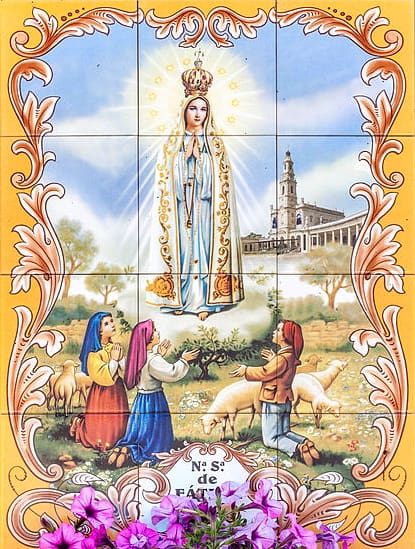
Our Lady of Fatima is the title given to the Blessed Virgin Mary after she appeared to three shepherd children at Fátima, Portugal on the 13th day of six consecutive months in 1917, starting on 13 May. The three children were Lucia dos Santos and siblings Blessed Francisco and Blessed Jacinta Marto. The title of Our Lady of the Rosary is also sometimes used in reference to the same apparition because the children related that the Lady in the apparition specifically identified Herself as "the Lady of the Rosary."

Lúcia described seeing the lady as "brighter than the sun, shedding rays of light clearer and stronger than a crystal glass filled with the most sparkling water and pierced by the burning rays of the sun." According to Lúcia's account, the lady confided to the children three secrets, known as the Three Secrets of Fatima. She exhorted the children to do penance and to make sacrifices to save sinners. The children wore tight cords around their waists to cause pain, abstained from drinking water on hot days, and performed other works of penance. Most important, Lúcia said that the lady asked them to say the Rosary every day, reiterating many times that the Rosary was the key to personal and world peace.

Monday, January 29, 2018

Faces Among Icons: Conversion of Russia to her Christian Roots


The following comes from Crux:

One hundred years after the Russian Revolution - when the Bolsheviks and Vladimir Lenin overthrew the Tsar and took control of the Russian state, eventually leading to the formation of the Soviet Union - a new documentary produced by Catholic News Service, chronicles both the ruin and the rebirth of the Russian Orthodox Church during that time.
The documentary, Faces among Icons, was released earlier this month, and showcases a range of individuals providing firsthand accounts of the changes that have occurred within the country since the fall of communism and offering their perspectives on the extent to which church-state cooperation is healthy for the future.
Following the Revolution, Russian believers faced severe persecution. While the exact numbers are unknown, an estimated 12-20 million Russian believers were killed for their faith throughout the twentieth century.
As one of the documentary’s main subjects, Eugene Vodolazkin, recounts, “There were more martyrs in our country during the 20th century than there were during all previous epochs.”
Yet despite such devastation, the persecuted faithful kept the Church alive during this time and in many ways, Faces among Icons is a testimonial to the resilience of faith and proof that indeed, “the blood of the martyrs is the seed of the Church,” as the Church father Tertullian once said.
Another interviewee, Daniel Khudyakor, a Russian Orthodox churchgoer, highlights the recent progress by noting “There has never been a time in our history when so many churches and monasteries were being opened without persecution.”
In the past thirty years, 20,000 churches have been restored and over 800 monasteries restored or reopened.
“We are modern, but we are keeping our traditions,” says another churchgoer in the film.
By some accounts, eighty percent of the country’s 144 million inhabitants identify as Russian Orthodox, yet only an estimated five to eight percent attend services at Easter, the Church’s largest feast, an indication that the work of renewal is an ongoing effort.
Yet, the documentary focuses predominantly on the faith of the younger generations, who are still influenced by the country’s recent history, but are eager not to let it define them.
“For us students, young people of the faith, the whole idea of the Church was our search for something unique, something different from the Soviet environment,” says one of the film’s subjects.
He goes on to add that it is “not only a search for faith, but a search for the true Russia.”

Tuesday, May 19, 2015

Fr. Longenecker on Francis, Fatima and the End of the World

The following comes from Fr. Longenecker at Aleteia:

At the end of April it was confirmed that Pope Francis will travel to Fatima for the one hundredth anniversary of the Marian apparitions, and it is rumored that he will use the occasion to canonize the two youngest seers, Jacinta and Francisco Marto.
 
This week, on the celebration of the Feast of Our Lady of Fatima, the original image was venerated by the Holy Father at the Vatican. What is Pope Francis’ understanding of the message of Fatima, and why does the Virgin of Fatima seem so important to him, as she was to his two predecessors?
 
The stunning events at Fatima in May 1917 took place as the world lurched into the twentieth century—a century that would see two world wars, genocide on a massive scale, the invention of the atomic bomb and the rapid rise of technologies that would transform the world and the human race.
 
The Pope’s planned visit to Fatima and his celebration this week continues his interest and involvement with Fatima. His pontificate was consecrated to Our Lady of Fatima on May 13, 2013, by the cardinal of Lisbon. During the ceremony the cardinal prayed that Pope Francis be granted “the gift of discernment to know how to identify the paths of renewal for the Church.” He also prayed that the Holy Father be protected “in the difficult hours of suffering, so that he may overcome, in charity, the trials that the renewal of the Church will bring him.” This was followed five months later by Pope Francis consecrating the world to Our Lady of Fatima on October 13, 2013.
 
Pope Francis’ continued devotion to Our Lady of Fatima indicates a historic and significant link of the papacy with the prophecies of Fatima. John Paul II visited Fatima three times, and in 2000 beatified Jacinta and Francisco in 2000, and was also responsible for entrusting the Third Millennium to the Immaculate Heart of Mary in front of our Lady’s statue, on Sunday, October 8, 2000, when over 1,400 bishops were present for the Jubilee Mass.
 
Pope Benedict XVI also strongly supported Fatima and visited the shrine in May 2010, when, among other things he said: “We would be mistaken to think that the prophetic mission of Fatima is complete.”
 
In the famous vision of Pope Leo XIII Satan said if he had one hundred years he would be able to destroy the church. It is interesting to note that the dates were October 13, 1884. Two “Fatima Dates” crop up time and again. Pope John Paul II’s attempted assassination took place on May 13, 1981. Pope Francis consecrated the world to Our Lady of Fatima October 13, 2013. The apparitions began on May 13, 1917 and ended with the miracle of the sun on October 13, 1917. Could these momentous sign from heaven indicate the beginning of the one hundred years in which Satan would attempt to destroy the church? If so, are we approaching the end of that time? Does this make the pope’s visit to Fatima in 2017 more important than a mere centenary celebration?
 
When he celebrated the consecration to Our Lady of Fatima in October 2013, Pope Francis said: “The statue of our Lady, which has come from Fatima, helps us to feel her presence in our midst. Mary always brings us to Jesus…nothing is impossible for God’s mercy! Even the most tangled knots are loosened by His grace. And Mary, whose ‘yes’ opened the door for God to undo the knot of the ancient disobedience, is the Mother who patiently and lovingly brings us to God, so that He can untangle the knots of our soul by His fatherly mercy.”
 
This Pope, like his two predecessors seems acutely aware not only of the spiritual battle with Satan, but also of the possibility that time is short. In contemplating “the end of the world” we have to ask ourselves what that means.


Read the rest here!

Wednesday, May 13, 2015

The Month of Mary Part 2 – 1917

The following comes from the Catholic Exchange:

What do Russia, the rise of Communism, the fall of Communism, Islam and Catholicism share in common? Fatima, 1917. We will unpack these connections over the next few blog posts as we reflect on the revolutionary message of Fatima.
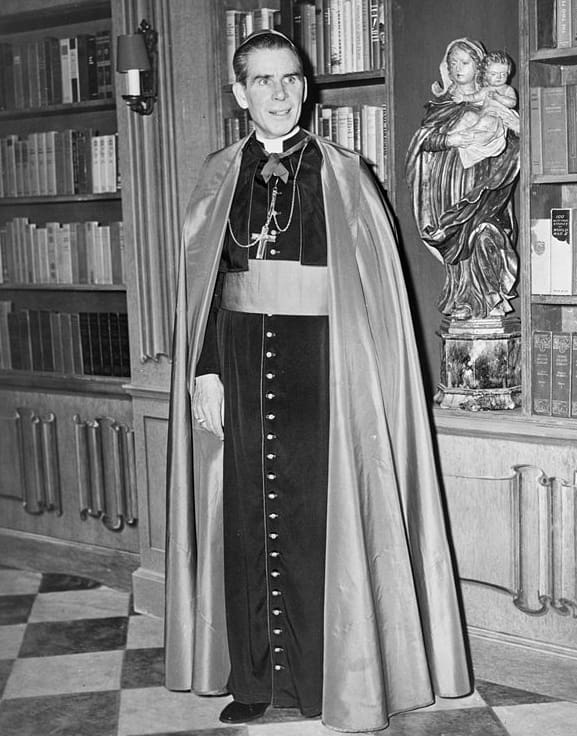
When we look at the complex web of world events today, it can be too easy to get caught up in daily news reports that tirelessly remind us we are living in one of the most challenging times in history, but never ask the right questions, VenFultonJSheenNYWTSbeginning with “Why?” What is tragic in the midst of that reporting is that most of the time, we do not receive the truth of world events when it comes to their causes. And this is why having a Catholic view of the world is so important. Society has been conditioned to focus only on what are the symptoms of today’s evils and not relentlessly pursue the truth of their causes. When we have the courage to pursue the truth about “what is wrong with the world” (to borrow a phrase of G.K. Chesterton), we discover that most things in the present world are not what they seem. And instead of focusing on all the “whats” going on in the world, we should be focusing on the “why;” because, as Venerable Fulton Sheen said during World War II, the real reason behind today’s wars and evils is not dialectical, but theological. The world has rejected God and that rejection comes with earth-shattering consequences—consequences we are living with today.
So, how do we understand this reality and what do we do about it? After the French Revolution dealt the death blow to the last vestiges of Christendom, which included the rejection of intelligence (for God is Intelligence Himself), God did not abandon His Church—nor did He abandon a deeply wounded world and those declared to be His enemies.
OurLadyOfLourdes1MaryBeginning in 1830 with Mary’s appearances to St. Catherine Labourè, God inaugurated the greatest Marian age in history, and He did so in the same city which launched the darkest philosophical age in world history, Paris. Now, the very fact that God sent His Mother onto the world stage should be enough to make us pause and ask how serious our times truly are that the King of Kings sent His own Mother as a last resort to beckon the world back to Christ.
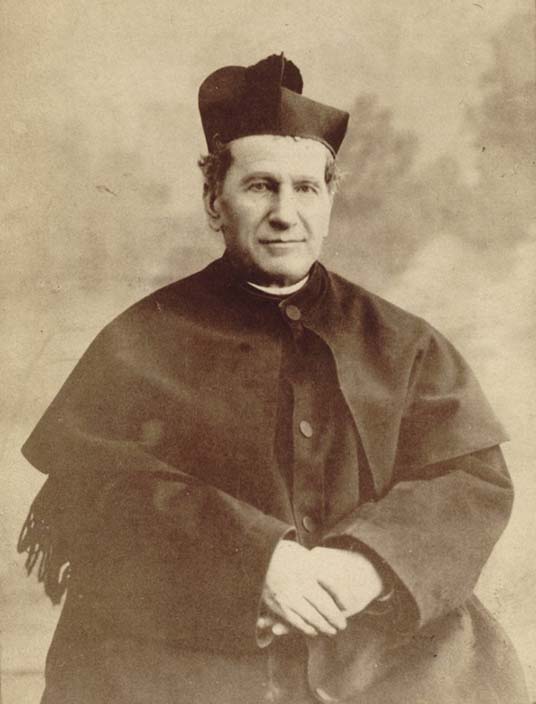
Following Paris were the Marian apparitions at La Salette in 1846, followed by those at Lourdes in 1858. Shortly after Lourdes, in 1862, St. John Bosco received his now famous Carlo Felice Deasti, Don Bosco, Torino, 1887vision of the two pillars that would save the Church during its most tumultuous time in history—the pillars of Mary, Help of Christians, and Jesus in the Holy Eucharist. In his vision, it was only when the Church chained itself to both pillars that She was able to defeat Her enemies. And in his dream, it was the Pope who steered the ship and bound it between those two pillars. Mary, the Eucharist and fidelity to the Pope are at the heart of surviving our troubling times.
The prophetic nature of this dream of Don Bosco was already being played out by Mary’s visitations just mentioned and would be confirmed shortly after during a year which marked the announcement of two revolutions: 1917.
It was in 1917 that Russia would declare its revolution against God, replacing God with the counterfeit absolute of the totalitarian state. We know it as the Bolshevik Revolution of 1917, which began the cancerous spread of Communism in the East. At the same time another revolution was declared that would involve the revolution within the heart of every man, and it took place in an obscure city in Portugal, a little place whose name is now known in every corner of the world: Fatima.
Venerable Fulton Sheen described how Mary’s visitations to Fatima were no mere coincidence as they played a significant part in God’s plan for Russia and the world:
It is particularly interesting that the theology of the Russians, before they were overshadowed by the cold heart of the anti-God, taught that, when the world rejected the Heavenly Father, He sent His Divine Son, Jesus Christ, to illumine the world. Then they went on to predict that, when the world would reject Our Lord as it has done today, on that Dark Night the light of His Mother would arise to illumine the darkness and lead the world to peace. The beautiful revelation of Our Blessed Mother at Fatima in Portugal from April to October 1917 was another proof of the Russian thesis that, when the world would fight against the Savior, He would send His Mother to save us. And her great revelation took place in the very month the Bolshevik Revolution began (The World’s First Love, Chapter 22, paragraph 12).
2014ANosaSenoraDeFatimaFontecadaSantaCombaGaliza2Most are familiar with the apparitions of Mary between the months of May and October 1917 to the three children: Lucia, Jacinta and Francisco. But, many do not know that the seeds of the Marian revolution would be sewn a year prior in 1916 and in a way that aligns completely with the message of Don Bosco’s dream of the two pillars. In the Spring of 1916 “the Angel of Portugal,” who first identified itself as “the angel of peace,” visited the three little seers and offered them a catechesis on prayer and adoration in preparation for the coming of the Mother of God and her message to the world.
The oldest of the seers, Lucia, described the encounter in this way [taken from the EWTN website]:
. . . a light whiter than snow in the form of a young man, quite transparent, and as brilliant as crystal in the rays of the sun. As he came near we were able to see his features. We were astonished and absorbed and we said nothing to one another. And then he said: 
[The angel said]: Do not be afraid. I am the angel of peace. Pray with me.
He knelt, bending his forehead to the ground. With a supernatural impulse we did the same, repeating the words we heard him say:
My God, I believe, I adore, I hope, and I love You. I ask pardon for those who do not believe, do not adore, do not hope, and do not love You.
After repeating this prayer three times the angel rose and said to us:
Pray in this way. The hearts of Jesus and Mary are ready to listen to you.
In the third and final apparition of the Angel of Portugal, the angel taught the children a beautiful prayer of adoration of the Blessed Sacrament as recounted by Lucia:
After we had repeated this prayer I don’t know how many time[s] we saw… shining over us a strange light. We lifted our heads to see what was happening. [T]he Angel was holding in his left hand a chalice and over it, in the air, was a host from which drops of blood fell into the chalice. The Angel leaves the chalice in the air, kneels near us and tells us to repeat three times:
TriniteGrandesHeuresAnneDeBretagne3Most Holy Trinity, Father, Son and Holy Spirit, I adore You profoundly, and I offer You the Most Precious Body, Blood, Soul and Divinity of Jesus Christ, present in all the tabernacles of the world, in reparation for the outrages, sacrileges and indifferences by which He is offended. And by the infinite merits of His most Sacred Heart and the Immaculate Heart of Mary, I beg the conversion of poor sinners.
We therefore see that the proper preparation for the visitations of the Blessed Virgin Mary (and integral to her message) involved frequent acts of adoration, frequent prayers of reparation and adoration of the Blessed Sacrament. We also see in these angelic messages the revelation of the end for which Mary will Rosarycome – to restore peace in the world by teaching the world the perfect way back to her Son. And that way is set forth throughout the messages of Our Lady of Fatima which can be summed up as follows:
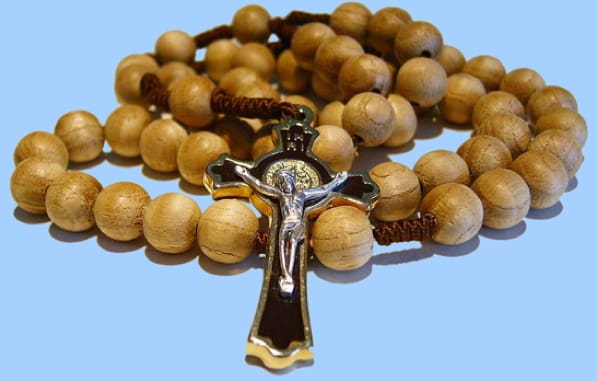
  1. Pray the Rosary daily for peace in the world.
  1. Consecrate Russia [and the world] to the Immaculate Heart of Mary in order to end its evil of Communism.
  1. “Make sacrifices for sinners, and say often, especially while making a sacrifice: O Jesus, this is for love of Thee, for the conversion of sinners, and in reparation for offences committed against the Immaculate Heart of Mary” [Mary’s words to the children, 13 July 1917].
  1. “I shall ask that on the First Saturday of every month Communions of reparation be made in atonement for the sins of the world” [Mary’s words to the children, 13 July 1917].
In our upcoming blogs this May, we will take a special look at why Mary would single out the Rosary as such an important prayer for our times, as well as the significance and power of consecration to the Immaculate Heart of Mary for achieving the triumph Mary promised at Fatima.
But wait, some of you are probably asking, “You said the apparitions at Fatima have a connection with the Moslems. What’s that about?” Well, make sure you check out next week’s blog post to find out. Between now and then, let’s be like the children of Fatima who were faithful to Our Lady’s request to pray the Rosary each day, especially in our families.

Tuesday, May 12, 2015

Finding Fatima

Monday, May 11, 2015

Fatima and Hope

Thursday, April 30, 2015

Pope Francis wants to visit Fatima in 2017

The following comes from the Catholic Herald:

Pope Francis plans to visit the Basilica of Our Lady of Fatima in 2017, on the 100th anniversary of the apparitions of the Virgin Mary to three children, according to the diocese in Portugal.
“Pope Francis confirmed to Bishop Antonio Marto that, ‘if God gives him life and health’, he wants to be in Cova di Iria to celebrate the centenary of the Apparitions of Fatima,” the diocese of Leiria-Fátima said in a press release.
Three shepherd children, Lucia dos Santos, Jacinta Marto and Francisco Marto, had a vision of the Blessed Virgin Mary on May 13 1917.
St John Paul II credited the Virgin Mary with saving his life when he was shot in 1981. He later placed the bullet in the crown of the statue of Our Lady of Fatima.

Wednesday, April 22, 2015

Archbishop Sheen on Fatima

This video is classic Archbishop Sheen! It takes about 20 minutes to watch all three parts, but it is worth it! We need to pray for another Fulton Sheen for our times!


Friday, April 17, 2015

Pope Francis to Consecrate World to Mary's Immaculate Heart

The following comes from Aleteia:

Pope Francis will consecrate the world to the Immaculate Heart of Mary this Oct. 13 as part of the Marian Day celebration that will involve the statue of Our Lady of the Rosary of Fatima.

“The Holy Father strongly desires that the Marian Day may have present, as a special sign, one of the most significant Marian icons for Christians throughout the world and, for that reason, we thought of the beloved original Statue of Our Lady of Fatima,” wrote Archbishop Rino Fisichella.

Archbishop Fisichella, who serves as president of the pontifical council for the Promotion of the New Evangelization, made his remarks in a letter to Bishop Antonio Marto of Leiria-Fatima.

According to the Portuguese shrine's website, the statue of Our Lady of Fatima will leave for Rome on the morning of Oct. 12 and return on the afternoon of Oct. 13. The statue normally resides in the shrine’s Little Chapel of Apparitions.

The archbishop said that “all ecclesial entities of Marian spirituality” are invited to take part in the celebration. Hundreds of movements and institutions that emphasize Marian devotion are expected to attend, the Shrine of Our Lady of Fatima says.

The two-day observance includes an Oct. 12 pilgrimage to the tomb of St. Peter and moments of prayer and meditation. On Oct. 13, Pope Francis will celebrate Mass in St. Peter’s Square.

Our Lady of Fatima appeared to three shepherd children in the village of Fatima in Portugal in 1917. She warned of violent trials in the twentieth century if the world did not make reparation for sins. She urged prayer and devotion to the Immaculate Heart of Mary.

At the request of Pope Francis, Cardinal Jose Polycarp, the Patriarch of Lisbon, consecrated the Pope’s pontificate to Our Lady of Fatima on May 13, her feast day.

Tuesday, June 17, 2014

A Homily on Mercy and Justice: Fr. Kenneth Walker, FSSP

Tuesday, October 15, 2013

Pope Francis and Our Lady

Sunday, October 13, 2013

Pope Francis: Mary's faith unties the knots of sin

Pope Francis: Let God untie your knotted hearts


 Pope Francis led a Marian prayer vigil Saturday, stressing that the Virgin Mary leads Christians to the mercy of God who can untie “all knotted hearts.”

Each one of us has “knots” in our souls, caused by sin, said Pope Francis.

“These knots take away our peace and serenity,” he said at the Oct. 12 vigil in St. Peter’s Square.

He acknowledged that some might believe they are without hope and say “But Father, mine can’t be untied.”

“That’s a mistake. All knots in the heart, all knots in the conscience, can be untied,” he emphasized.
If we ask Mary, “the woman of faith” for help, he continued, “she will surely say to us, ‘go forward, go to the Lord, he will understand you.’ And she takes us with the hand of a mother to the embrace of the Father, to the Father of mercy.”

As the crowds prayed, the Pope spoke of Mary’s example and reflected on her desire to lead others away from the “knots” of sin to divine healing. Mary is “the mother who patiently and lovingly brings us to God, so that he can untangle the knots of our soul by his fatherly mercy.”

In preparation for the Pope’s consecration of the world to Mary on Sunday, the original statue of Our Lady of Fatima was brought to St. Peter’s Square from the shrine in Portugal. Pope Francis took a moment to pray before the image, which depicts how Mary appeared to three shepherd children in Fatima, Portugal in 1917.

The crowds of diverse pilgrims held up various images of Mary, celebrating her universal motherhood. The vigil, which interspersed international music with scripture readings that served as points of meditation and prayer.

Pope Francis taught that Mary, through her witness of faith, is the paradigm for all believers.

“Mary first conceived Jesus in faith and then in the flesh, when she said ‘yes’ to the message God gave her through the angel,” he told the vigil audience.

The Pope then challenged his listeners to consider their own faith more profoundly:

“Do we think that Jesus’ Incarnation is simply a past event which has nothing to do with us personally? 

Believing in Jesus means giving him our flesh with the humility and courage of Mary, so that he can continue to dwell in our midst.”

The crowds cheered as Pope Francis preached about following God.

“How was Mary’s faith a journey? In the sense that her entire life was to follow her Son: he is the way, he is the path!” he said.

The path of any Christian is the “way of the Cross,” even and especially for Mary. 

“When Jesus was rejected, Mary was always there, with Jesus, following Jesus, in the midst of the people. And she heard the gossip, the hatred of those who did not love the Lord. And this cross, she was carrying,” he told the pilgrims.

During Jesus’ crucifixion, Mary’s faith was “like a little flame burning in the night.”

“And when she received word that the tomb was empty, her heart was filled with the joy of faith: Christian faith, in the death and resurrection of Christ, because faith always brings us joy. And she is the mother of joy!” he exclaimed.

“Mary teaches us to go forward with joy and live this joy!”

The prayer vigil at St. Peter’s Square preceded a world-wide vigil at various Marian sites throughout the globe.

These opportunities for prayer are being held as special events during the Catholic Church’s observance of the Year of Faith.

Saturday, October 12, 2013

Marian Day: Pope Francis and Benedict XVI to welcome statue of Our Lady of Fatima


(Vatican Radio) Pope Francis will consecrate the world to the Immaculate Heart of Mary on October 13th as part of Marian Day celebrations that will involve the statue of Our Lady of Fatima.
The statue is normally kept in the Shrine of Fatima in Portugal but will be in Rome this weekend for the consecration which is one of the highlights of the ongoing Year of Faith.
Our Lady of Fatima appeared to three shepherd children in the village of Fatima in Portugal in 1917. She warned of violent trials in the twentieth century if the world did not make reparation for sins. She urged prayer and devotion to the Immaculate Heart of Mary. John Preiss is President of the Fatima Family Apostolate in Alabama, U.S. and he spoke to Susy Hodges about the significance of this weekend’s events and the veneration of Our Lady of Fatima.
Listen to the full interview with John Preiss: 
Preiss says Our Lady of Fatima “gives us a message of hope” and notes how at Pope Francis’s specific request, his pontificate was consecrated to Our Lady of Fatima on May 13th, her feast day. Asked whether this message of Fatima is sufficiently well known and appreciated, Preiss says there is a need for Catholics “to learn the message, to live the message and to spread the message” and agrees that it needs “to be publicized better.” He says the younger generations, in particular, lack the religious formation of the older generation and often have not been taught to pray the rosary at home as Our Lady of Fatima asked us to do.
Preiss also spoke about Blessed Pope John Paul’s known devotion to Our Lady of Fatima and how the bullet that a gunman fired at him during an attempted assassination attempt that occurred on the feast day of Fatima (May 13th, 1981) was donated to the crown adorning the head of the statue of Our Lady of Fatima.

Tuesday, May 14, 2013

Pontificate of Pope Francis consecrated to Our Lady of Fatima


.- At the Holy Father’s personal request, Cardinal Jose Polycarp, the Patriarch of Lisbon, consecrated the pontificate of Pope Francis to Our Lady of Fatima on her feast day.

Addressing Our Lady of Fatima during the ceremony, Cardinal Polycarp said, “Grant (Pope Francis) the gift of discernment to know how to identify the paths of renewal for the Church, grant him the courage to not falter in following the paths suggested by the Holy Spirit, protect him in the difficult hours of suffering, so that he may overcome, in charity, the trials that the renewal of the Church will bring him.”

In statements to CNA, Vatican spokesman Father Federico Lombardi said, “As we know, an important celebration takes place on May 13 in Fatima during which it is normal that the pontificate be entrusted to Our Lady of Fatima.”

The consecration took place at the Portuguese shrine dedicated to Our Lady, with thousands of the faithful present.

Cardinal Polycarp recalled that Popes John Paul II and Benedict XVI visited Fatima and expressed his desire that Pope Francis do so as well.

“From here, at this altar of the world, he will be able to bless humanity, to make the world of today feel that God loves all men and women of our time, that the Church loves them and that you, Mother of the Redeemer, lead them with tenderness on the paths of salvation,” the cardinal said.

The path of Church renewal leads to a “rediscovery of the relevance” of the Fatima message and of the need to “converse with God,” he explained.

“Contemporary humanity needs to feel loved by God and by the Church,” Cardinal Polycarp said. “If humanity feels loved, it will overcome the temptation to violence, materialism, estrangement from God, loss of direction, and it will be able to advance towards a new world in which love will prevail.”
During the Mass, Bishop Antonio Marto of Leiria-Fatima read a message from Pope Francis to the Apostolic Nunciature in Portugal.

“The Holy Father said he was pleased with the initiative and expressed deep acknowledgment for satisfying his desire united in prayer with all the pilgrims of Fatima, upon whom he whole-heartedly confers the apostolic blessing,” the message stated.

Sunday, May 5, 2013

Francis, Mary, and the Deceiver


The following comes from Robert Moynihan at The Moynihan Letters:
Pope Francis returned to the Basilica of St. Mary Major this evening for the second time since he became Pope — the first time was at 8 a.m. on March 14, the morning after his election, to pray before an icon of the Virgin known as the Salus Populi Romani (“Protectress of the Roman People”).
He came to pray a Rosary and to dedicate his papacy to the Virgin Mary.
He also gave a homily this morning in the chapel of the Domus Santa Marta, where he is living. Once again this morning he mentioned the devil, referring to him as a “hater” who wishes ill to men and women, and who must be resisted by faith and prayer.
The coincidence today of these two prayers — one in the evening to Mary in her greatest basilica on earth, the other in the morning against the “prince of this world,” the devil, in a small chapel — seemed to emphasize a key theme of this pontificate: that the battle against the devil, against evil, is won with and through Mary, the daughter of Israel who was, and is, called “full of grace.”
And this explains a great deal about where this “Franciscan” pontificate is, and may be heading…
Note also that, in about one week, in accordance with the clear requests of Pope Francis, this Pope’s papacy will be formally consecrated to Our Lady of Fatima in Fatima, Portugal, on May 13 — the day of the first apparition to the three shepherd children of Fatima in 1917, 96 years ago.
During those apparitions, which occurred always on the 13th of each month, until October 13 (with the exception of August, when the children were in prison, when it occurred on the 19th), “the Lady” spoke to the children of future events, including the coming of great wars, and then, in the end, of a time of peace for the entire world.

Thursday, April 11, 2013

Francis' Petrine Ministry Consecrated to Our Lady of Fatima


The following comes from Zenit:
Earlier this week, in his opening address to the 181st plenary assembly of the Portuguese episcopal conference, its president, Cardinal José Policarpo, said that Pope Francis asked him twice to consecrate his ministry to Our Lady of Fatima.
"Pope Francis asked me twice to consecrate his new ministry to Our Lady of Fatima," the cardinal said. 
"It is a request," he added, "that I can fulfill in the silence of prayer," but that would be better if "all the episcopal conference associated itself to the realization of this request. Mary will guide us in all our works and also in the way of fulfilling this desire of Pope Francis."
"We begin our works inspired in the two events that mark this present moment of the life of the Church: the Resurrection of Christ and the election of the new Bishop of Rome," continued the president of the episcopal conference.
Cardinal Policarpo reflected on the fact that in the short span of this pontificate, strong lines are emerging that "challenge our pastoral ministry." And he reminded that the Pope’s power cannot be understood in the light of the powers of this world. "The crowds need to be loved, attracted by the love of the good shepherd. In that love, charged with joy and tenderness, he spoke to us immediately of the importance of tenderness in our pastoral relations."
The cardinal specified that Francis "has given a privileged place to the poor, the marginalized, to all those who suffer." He was very clear in affirming that the model of the Church which attracts him is a poor Church at the service of the poor.
"He had the daring to translate that vision of the Church in the external symbols," added the patriarch of Lisbon.
The cardinal said that the Pope’s "predilection for young people" was seen immediately, as well as his "clear affirmation of the importance of the conciliar spirit, playing down tensions and currents actualizing the hope of John XXIII in a springtime of the Church, which must flower from the seeds of the Council."
This message of hope, he continued, will certainly be translated into inevitable reforms in the life of the Church. 
"Everyone speaks of the reform of the Curia," the cardinal noted, applying it to the local situation: "To correct something that we also see in our dioceses, which is to give priority to pastoral vitality, not allowing the administrative bureaucracy to take the first place."
"The Church will always be the place of conversion and forgiveness. And the Pope has already reminded us of two key aspects: God forgives by loving; only one who rejects love is not open to forgiveness. God forgives always; we are the ones who can grow tired of asking him for forgiveness," he added.
"Let us be open to the exigencies of surprise. In our diocesan structures there is also much to change, in the light of that pastoral priority of the Church," invited the patriarch of Lisbon.

Sunday, May 13, 2012

95 years since apparitions of Fatima