Showing posts with label martyrs. Show all posts

Monday, July 5, 2021

The Miraculous Conversion of Alessandro Serenelli

The following comes from MariaGoretti.org:

Maria Goretti's heroic story of love and forgiveness would not be complete without one of its first miraculous fruits: the conversion of Alessandro Serenelli, Maria's murderer.

Immediately after his brutal assault on young Maria Goretti, Alessandro was imprisoned temporarily in Nettuno and then transferred to Regina Coeli prison in Rometo stand trial. After vehemently denying his guilt, he finally broke down in the face of overwhelming testimony. Since he was a minor, he was sentenced to only thirty years hard labor.

A priest came to see him soon afterward, and he turned on the cleric in rage, howling like a maniac and lunging at him.

In the days which followed, Alessandro lost his appetite and grew nervous. After six years of prison, he was near the brink of despair. Then one night, Maria appeared to him in his cell. She smiled at Alessandro and was surrounded by lilies, the flower symbolic of purity.

From that moment, peace invaded Alessandro's heart, and he began to live a constructive life.

After serving his sentence, Alessandro took up residence at a Capuchin monastery, working in the garden as a tertiary. He asked pardon of Maria's mother and accompanied her to Christmas Mass in the parish church where he spoke before the hushed congregation, acknowledging his sin and asking God's forgiveness and the pardon of the community.

Forty years later, on June 24, 1950, Maria was canonized at St. Peter's basilica in Rome, with Alessandro's heart now firmly converted to the Lord. A miraculous fruit of Maria's life, indeed!

Alessandro Serenelli died on May 6th, 1970 in the Capuchin convent of Macerata. He left the following testimony, dated May 5, 1961, as his spiritual legacy:


"I'm nearly 80 years old. I'm about to depart.
"Looking back at my past, I can see that in my early youth, I chose a bad path which led me to ruin myself.
 
"My behavior was influenced by print, mass-media and bad examples which are followed by the majority of young people without even thinking. And I did the same. I was not worried. 
"There were a lot of generous and devoted people who surrounded me, but I paid no attention to them because a violent force blinded me and pushed me toward a wrong way of life. 
"When I was 20 years-old, I committed a crime of passion. Now, that memory represents something horrible for me. Maria Goretti, now a Saint, was my good Angel, sent to me through Providence to guide and save me. I still have impressed upon my heart her words of rebuke and of pardon. She prayed for me, she interceded for her murderer. Thirty years of prison followed.
"If I had been of age, I would have spent all my life in prison. I accepted to be condemned because it was my own fault. 
"Little Maria was really my light, my protectress; with her help, I behaved well during the 27 years of prison and tried to live honestly when I was again accepted among the members of society. The Brothers of St. Francis, Capuchins from Marche, welcomed me with angelic charity into their monastery as a brother, not as a servant. I've been living with their community for 24 years, and now I am serenely waiting to witness the vision of God, to hug my loved ones again, and to be next to my Guardian Angel and her dear mother, Assunta. 
"I hope this letter that I wrote can teach others the happy lesson of avoiding evil and of always following the right path, like little children. I feel that religion with its precepts is not something we can live without, but rather it is the real comfort, the real strength in life and the only safe way in every circumstance, even the most painful ones of life."
 Signature, Alessandro Serenelli


Tuesday, June 22, 2021

Saints John Fisher and Thomas More

Tuesday, January 21, 2020

Saint of the day: Agnes


The following comes from the CNA:

On Jan. 21, the Roman Catholic Church honors the virgin and martyr St. Agnes, who suffered death for her consecration to Christ.

Eastern Catholics of the Byzantine tradition celebrate her feast day Jan. 14.

Although the details of Agnes' life are mostly unknown, the story of her martyrdom has been passed on with reverence since the fourth century. On the feast day of the young martyr – whose name means “lamb” in Latin – the Pope traditionally blesses lambs, whose wool will be used to make the white pallium worn by archbishops.

Born into a wealthy family during the last decade of the third century, Agnes lived in Rome during the last major persecution of the early Church under the Emperor Diocletian. Though he was lenient toward believers for much of his rule, Diocletian changed course in 302, resolving to wipe out the Church in the empire.

Agnes came of age as the Church was beginning to suffer under a set of new laws decreed by Diocletian, and his co-ruler Galerius, in 303. The emperor and his subordinate called for churches to be destroyed and their books burned. Subsequent orders led to the imprisonment and torture of clergy and laypersons, for the sake of compelling them to worship the emperor instead of Christ.

Meanwhile, Agnes had become a young woman of great beauty and charm, drawing the attention of suitors from the first ranks of the Roman aristocracy. But in keeping with the words of Christ and Saint Paul, she had already decided on a life of celibacy for the sake of God's kingdom. To all interested men, she explained that she had already promised herself to a heavenly and unseen spouse.

These suitors both understood Agnes' meaning, and resented her resolution. Some of the men, possibly looking to change her mind, reported her to the state as a believer in Christ. Agnes was brought before a judge who tried first to persuade her, and then to threaten her, into renouncing her choice not to marry for the Lord's sake.

When the judge showed her the various punishments he could inflict – including fire, iron hooks, or the rack that destroyed the limbs by stretching – Agnes smiled and indicated she would suffer them willingly. But she was brought before a pagan altar instead, and asked to make an act of worship in accordance with the Roman state religion.

When Agnes refused, the judge ordered that she should be sent to a house of prostitution, where the virginity she had offered to God would be violated. Agnes predicted that God would not allow this to occur, and her statement proved true. The first man to approach her in the brothel was struck blind by a sudden flash of light, and others opted not to repeat his mistake.

But one of the men who had at first sought to make Agnes his own, now lobbied the judge for her execution. In this respect, the suitor obtained his desire, when the public official sentenced her to die by beheading. The executioner gave her one last chance to spare her life, by renouncing her consecration to Christ – but Agnes refused, made a short prayer, and courageously submitted to death.

St. Agnes, who died in 304, was venerated as a holy martyr from the fourth century onward. She is mentioned in the Latin Church's most traditional Eucharistic prayer, the Roman Canon.

Saturday, October 19, 2019

Jesuit Martyrs

Thursday, October 17, 2019

Saint of the Day: Ignatius of Antioch


The following comes from the CNA:

On Oct. 17, the Roman Catholic Church remembers the early Church Father, bishop, and martyr Saint Ignatius of Antioch, whose writings attest to the sacramental and hierarchical nature of the Church from its earliest days. Eastern Catholics and Eastern Orthodox Christians celebrate his memory on Dec. 20. 

In a 2007 general audience on St. Ignatius of Antioch, Pope Benedict XVI observed that “no Church Father has expressed the longing for union with Christ and for life in him with the intensity of Ignatius.” In his letters, the Pope said, “one feels the freshness of the faith of the generation which had still known the Apostles. In these letters, the ardent love of a saint can also be felt.” 

 Born in Syria in the middle of the first century A.D., Ignatius is said to have been personally instructed – along with another future martyr, Saint Polycarp – by the Apostle Saint John. When Ignatius became the Bishop of Antioch around the year 70, he assumed leadership of a local church that was, according to tradition, first led by Saint Peter before his move to Rome. 

Although St. Peter transmitted his Papal primacy to the bishops of Rome rather than Antioch, the city played an important role in the life of the early Church. Located in present-day Turkey, it was a chief city of the Roman Empire, and was also the location where the believers in Jesus' teachings and his resurrection were first called “Christians.” 

Ignatius led the Christians of Antioch during the reign of the Roman Emperor Domitian, the first of the emperors to proclaim his divinity by adopting the title “Lord and God.” Subjects who would not give worship to the emperor under this title could be punished with death. As the leader of a major Catholic diocese during this period, Ignatius showed courage and worked to inspire it in others. 

After Domitian's murder in the year 96, his successor Nerva reigned only briefly, and was soon followed by the Emperor Trajan. Under his rule, Christians were once again liable to death for denying the pagan state religion and refusing to participate in its rites. It was during his reign that Ignatius was convicted for his Christian testimony and sent from Syria to Rome to be put to death. 

Escorted by a team of military guards, Ignatius nonetheless managed to compose seven letters: six to various local churches throughout the empire (including the Church of Rome), and one to his fellow bishop Polycarp who would give his own life for Christ several decades later. 

Ignatius' letters passionately stressed the importance of Church unity, the dangers of heresy, and the surpassing importance of the Eucharist as the “medicine of immortality.” These writings contain the first surviving written description of the Church as “Catholic,” from the Greek word indicating both universality and fullness. 

One of the most striking features of Ignatius' letters, is his enthusiastic embrace of martyrdom as a means to union with God and eternal life. “All the pleasures of the world, and all the kingdoms of this earth, shall profit me nothing,” he wrote to the Church of Rome. “It is better for me to die in behalf of Jesus Christ, than to reign over all the ends of the earth.” 

“Now I begin to be a disciple,” the bishop declared. “Let fire and the cross; let the crowds of wild beasts; let tearings, breakings, and dislocations of bones; let cutting off of members; let shatterings of the whole body; and let all the dreadful torments of the devil come upon me: only let me attain to Jesus Christ.” 

St. Ignatius of Antioch bore witness to Christ publicly for the last time in Rome's Flavian Amphitheater, where he was mauled to death by lions. “I am the wheat of the Lord,” he had declared, before facing them. “I must be ground by the teeth of these beasts to be made the pure bread of Christ.” His memory was honored, and his bones venerated, soon after his death around the year 107.

Monday, June 3, 2019

Saints of the day: Charles Lwanga and Companions


The following comes from the Savior.org site:

St. Charles was one of 22 Ugandan martyrs who converted from paganism. Though he was baptized the night before being put to death, he became a moral leader. He was the chief of the royal pages and was considered the strongest athlete of the court. He was also known as "the most handsome man of the Kingdom of the Uganda." He instructed his friends in the Catholic Faith and he personally baptized boy pages. He inspired and encouraged his companions to remain chaste and faithful. He protected his companions, ages 13-30, from the immoral acts and homosexual demands of the Babandan ruler, Mwanga.


Mwanga was a superstitious pagan king who originally was tolerant of Catholicism. However, his chief assistant, Katikiro, slowly convinced him that Christians were a threat to his rule. The premise was if these Christians would not bow to him, nor make sacrifices to their pagan god, nor pillage, massacre, nor make war, what would happen if his whole kingdom converted to Catholicism?


When Charles was sentenced to death, he seemed very peaceful, one might even say, cheerful. He was to be executed by being burnt to death. While the pyre was being prepared, he asked to be untied so that he could arrange the sticks. He then lay down upon them. When the executioner said that Charles would be burned slowly so death, Charles replied by saying that he was very glad to be dying for the True Faith. He made no cry of pain but just twisted and moaned, "Kotanda! (O my God!)." He was burned to death by Mwanga's order on June 3, 1886. Pope Paul VI canonized Charles Lwanga and his companions on June 22,1964.


Most of the twenty-two Uganda martyrs who have been proclaimed saints were killed on June 3, 1886. They were forced to walk thirty-seven miles to the execution site. After a few days in prison, they were thrown into a huge fire. Seventeen of the martyrs were royal pages, One of the martyred boys was St. Mbaga. His own father was the executioner that day. Another of the martyrs, St. Andrew Kagwa, died on January 27, 1887. He was among the twenty-two proclaimed saints in 1964 by Pope Paul VI.


St. Charles Lwanga is the patron of black African young people. He and his companions greatly appreciated their gift of faith. They were heroes! We all can pray to St. Charles and these African martyrs. We can ask them to show us how to witness to Jesus and the Church as they did.

Monday, March 18, 2019

A Girl Who Inspired Archbishop Fulton Sheen


The following comes from St. Mary Valley:

A few months before he died in 1979, Bishop Fulton Sheen gave a tv interview. The reporter asked, “Your Excellency, you have inspired millions. Who inspired you? Was it the pope?”

Bishop Sheen responded that it was not the pope or a cardinal or another bishop or even a priest or nun. It was an eleven-year-old girl. He explained that when the communists took over China in the late forties, they imprisoned a priest in his own rectory. Looking through the window, he saw the soldier enter the church and break open the tabernacle, scattering the Blessed Sacrament on the floor. The priest knew the exact number of hosts: thirty-two.

Unnoticed by the soldiers, a young girl had been praying in the back of the church and she hid when they came in. That night the girl returned and spent an hour in prayer. She then entered the sanctuary, knelt and bent over to take one of the hosts on her tongue.

The girl came back each night, spent an hour in prayer and received Jesus by picking up a sacred host with her tongue. The thirty-second night, after consuming the final host, she made an accidental sound, awakening a soldier. He ran after her and when he caught her, he struck her with his rifle butt. The noise woke the priest – but too late. From his house, he saw the girl die.

Bishop Sheen said that when he heard about this, it inspired him so much that he made a promise that he would spend one hour each day before Jesus in the Blessed Sacrament. He always said that the power of his priesthood came from the holy hour.

Tonight, brothers and sisters, we celebrate the institution of the Eucharist. At the end of the Mass we will have a procession inside the church to adore our Savior. We will invite you to spend an hour with Jesus. From him comes our strength.

Friday, October 20, 2017

Blessed Fr. Jerzy Popieluszko: Polish Priest and Martyr


Today the church remembers the Polish Martyr Fr. Jerzy Popieluszko.  He was beatified by Pope Benedict in 2010.  The following comes from the St. Stanislaus Kostka parish in Brooklyn, NY:

Fr. Jerzy Popieluszko was born on September 14, 1947 in Poland on the feast of Holy Cross Day. He was  the fourth child born to Marianna and Wladyslaw Popiełuszko. Two days later, he was baptized in his family  parish church in Suchowola. His mother, still in a blessed state, offered him up as a servant God. In 1954, he started elementary school and then continued his education in the local high school. After  graduation, he entered the seminary in Warsaw. After a year of study, he was drafted into the army and  inducted into a special unit created to destroy priestly vocations among young people. Two years in the army  had adversely affected his health. Later it even interfered with his priestly ministry. He was ordained at the hands of Cardinal Stefan Wyszynski on May 28, 1972.  During the years 1972-1980 he was a vicar in the following parishes: Holy Trinity  in Zabkach, Our Lady of the Rosary in Anin and Child Jesus in Warsaw. Due to  his failing health and inability to continue the duties of a vicar, he was assigned to  work with students in St. Anne’s Church in Warsaw. In 1979, he began his priestly  ministry as a chaplain to medical workers in the archdiocese of Warsaw.
On May 20, 1980 he was transferred to the St. Stanislaus Kostka Parish in  Warsaw. There he continued his ministry and assisted in the parish as a resident.
On August 31, 1980, at  the request of Cardinal Stefan Wyszynski he celebrated Mass for striking workers. This was the beginning of  his ministry among workers.  All along, Fr. Jerzy was involved in assisting the needy – especially families with many children, poor, and  close to those in prison camps. He collected food and medicine for them. He attended hearings of those  arrested for interfering with martial law. He supported political prisoners.
In February of 1982 he started  celebrating Mass on the last Sunday of every month for freedom of Poland. As months passed, more and  more people came from near and far to participate in the Mass.  The communist leaders at that time were not pleased with the actions of Fr. Jerzy and the respect he was  enjoying from people all over Poland. More and more often things happened that were meant to scare  Fr. Jerzy and force him to resign from ministry. Twice his home was broken into, he was constantly being  followed, harassed, stopped by police. His home was bombed and his car was doused with paint. At the  same time letters were arriving at the Bishop’s office complaining that his sermons „were consistently taking  aim at the People’s Republic of Poland”. In September 1983, a case was brought against him accusing him  of „excessive use of his rights as a priest in an effort to cause harm to the People’s Republic of Poland.”
In  December 1983 he was arrested. Upon the intervention of the Church, he was released. He was facing a  possible 10 years in prison. From January to June 1984, he was interrogated 13 times. His prison sentence  was later dropped as a result of the amnesty program of 1984. However, simultaneously a slander campaign  was being conducted by Jerzy Urban, the then spokesman for the government newspaper.
On October 13, 1984, near the town of Ostróda an attempt was made on the life of Fr. Jerzy Popieluszko  who was returning from Gdansk to Warsaw.
On October 19, along with the driver Waldemar Chrostowski he  travelled to Bydgoszcz. At 6:00pm on that day, he celebrated Rosary Devotions and Holy Mass in Polish  Saints Martyred Brothers Church.
On their return trip at about 10:00pm he was abducted in a place called  Przysiek near Torun by three members of the Ministry of Internal Affairs. He was brutally beaten, he was tied  up in a way that any movement caused the noose to tighten around his neck, and then he was locked in the  trunk of a car. A boulder weighing about 24 pounds was tied to his legs, and he was thrown into a tributary of  the Wistula River near Wloclawek.
His body was finally found on October 30.

Read the rest here.

Monday, July 17, 2017

Carmelite Martyrs of Compiegne


Today we remember Sixteen Carmelites caught up in the French Revolution and martyred for their faith. The story of their heroic deaths is well worth reading about! The following comes from the Catholic Online site:

When the revolution started in 1789, a group of twenty-one discalced Carmelites lived in a monastery in Compiegne France, founded in 1641. The monastery was ordered closed in 1790 by the Revolutionary gov­ernment, and the nuns were disbanded. Sixteen of the nuns were accused of living in a religious community in 1794. They were arrested on June 22 and imprisoned in a Visitation convent in Compiegne There they openly resumed their religious life. On July 12, 1794, the Carmelites were taken to Paris and five days later were sentenced to death. They went to the guillotine singing the Salve Regina. They were beatified in 1906 by Pope St. Pius X. The Carmelites were: Marie Claude Brard; Madeleine Brideau, the subprior; Maire Croissy, grandniece of Colbert Marie Dufour; Marie Hanisset; Marie Meunier, a novice; Rose de Neufville Annette Pebras; Anne Piedcourt: Madeleine Lidoine, the prioress; Angelique Roussel; Catherine Soiron and Therese Soiron, both extern sisters, natives of Compiegne and blood sisters: Anne Mary Thouret; Marie Trezelle; and Eliza beth Verolot. The martyrdom of the nuns was immortalized by the composer Francois Poulenc in his famous opera Dialogues des Carmelites.

The Terror, you may recall, was a fanatical anti-christian fury that was fueled by the blood of thousands of priests and religious; that smashed the priceless stained-glass windows of ancient churches; that dug up and desecrated the bodies of saints; that erected a platform over the sacred high altar at Notre Dame de Paris and there enthroned a prostitute to mock God; and then even eradicated the 7 day Biblical week and replaced it with a 10 day version that had no reference to God.

The nuns of Compiègen, knowing of this reign of sacrilege, were faced with the decision to scatter and hide, or to face the Terror. Famously, they chose the latter and did so with the explicit intention of vanquishing it and its principle architect, Robespierre.

It soon came; they were arrested on trumped up charges of counter-revolutionary activity and led by wagon to the Place du Trone where the guillotine waited to consume them as it had thousands before. It is said that the evil aura of the place and the stench from the rotting blood was so horrible that it was difficult even to prod the horses into the square. But the 16 Carmelite nuns entered the site with perfect serenity, chanting hymns to God and the Blessed Virgin Mary. The usually raucous crowd, inebriated with the killing, fell silent that day at the spectacle of such women. They were called to the scaffold one by one. And each nun in turn knelt before Mother Superior and said, "Permission to die, Mother?" To which Mother Superior responded by holding out a small statue of our Lady for the nun to kiss one last time, and was sent off with the words, "Go, my daughter".

That was on July 17, 1794. That very week the tide turned against Robespierre and on the tenth day he lost his own head at the very same guillotine and the Terror sputtered to an end, defeated ultimately. I firmly believe, not by a Christian army, but by 16 holy women who understood perfectly the logic of the Cross of Jesus Christ. My friends, the history of the Church is replete with tales of this kind of self-sacrificial love. They are not all as glorious as that of the Carmelite Nuns of Compiègne, but they all participate in the same vision of one degree or another.


For more information on these holy women please check out New Advent!

Sunday, March 26, 2017

Saint of the day: Margaret Clitherow


The following comes from the Catholic.org site:


St. Margaret Clitherow was born in Middleton, England, in 1555, of protestant parents. Possessed of good looks and full of wit and merriment, she was a charming personality. In 1571, she married John Clitherow, a well-to-do grazier and butcher (to whom she bore two children), and a few years later entered the Catholic Church. Her zeal led her to harbor fugitive priests, for which she was arrested and imprisoned by hostile authorities. Recourse was had to every means in an attempt to make her deny her Faith, but the holy woman stood firm. Finally, she was condemned to be pressed to death on March 25, 1586. She was stretched out on the ground with a sharp rock on her back and crushed under a door over laden with unbearable weights. Her bones were broken and she died within fifteen minutes. The humanity and holiness of this servant of God can be readily glimpsed in her words to a friend when she learned of her condemnation: "The sheriffs have said that I am going to die this coming Friday; and I feel the weakness of my flesh which is troubled at this news, but my spirit rejoices greatly. For the love of God, pray for me and ask all good people to do likewise." Her feast day is March 26th.

Tuesday, September 13, 2016

Pope Francis will celebrate Mass for Fr. Jacques Hamel

Wednesday, July 6, 2016

Saint of the Day: Maria Goretti


St. Maria Goretti drew over a quarter of a million people to her canonization. She is one of the most popular of modern saitns. She is an icon of purity in an age where this virtue is needed more than ever. The following is a bit more information on the saint:

Born in Corinaldo, Ancona, Italy, on October 16 1890; her farmworker father moved his family to Ferrier di Conca, near Anzio. Her father died of malaria and her mother had to struggle to feed her children.

In 1902 an eighteen-year-old neighbor, Alexander, grabbed her from her steps and tried to rape her. When Maria said that she would rather died than submit, Alexander began stabbing her with a knife.

As she lay in the hospital, she forgave Alexander before she died. Her death didn't end her forgivness, however.

Alexander was captured and sentenced to thirty years. He was unrepentant until he had a dream that he was in a garden. Maria was there and gave him flowers. When he woke, he was a changed man, repenting of his crime and living a reformed life. When he was released after 27 years he went directly to Maria's mother to beg her forgiveness, which she gave. "If my daughter can forgive him, who am I to withold forgiveness," she said.

When Maria was declared a saint in 1950, Alexander was there in the St. Peter's crowd to celebrate her canonization. She was canonized by Pope Pius XII in 1950 for her purity as model for youth.

She is called a martyr because she fought against Alexander's attempts at sexual assault. However, the most important aspect of her story is her forgiveness of her attacker -- her concern for her enemy extending even beyond death. Her feast day is July 6. St. Maria Goretti is the patroness of youth and for the victims of rape.
For more information on St. Maria please click here.

Monday, April 11, 2016

St. Stanislaus: Bishop and Martyr


Today is the Feast of St. Stanislaus the Bishop and Martyr. Stanislaus was a great hero to Pope John Paul II and is beloved in his native Poland. The last poem written by him was entitled "Stanislaus" on the eve of his election as Pope. The following comes from the Catholic Online site:

Stanislaus was born of noble parents on July 26th at Szczepanow near Cracow, Poland. He was educated at Gnesen and was ordained there. He was given a canonry by Bishop Lampert Zula of Cracow, who made him his preacher, and soon he became noted for his preaching. He became a much sought after spiritual adviser. He was successful in his reforming efforts, and in 1072 was named Bishop of Cracow. He incurred the enmity of King Boleslaus the Bold when he denounced the King's cruelties and injustices and especially his kidnapping of the beautiful wife of a nobleman. When Stanislaus excommunicated the King and stopped services at the Cathedral when Boleslaus entered, Boleslaus himself killed Stanislaus while the Bishop was saying Mass in a chapel outside the city on April 11. Stanislaus has long been the symbol of Polish nationhood. He was canonized by Pope Innocent IV in 1253 and is the principle patron of Cracow. His feast day is April 11th.

Friday, March 4, 2016

4 Missionaries of Charity killed, Salesian priest missing in Yemen

Please pray for the Missionaries of Charity, the Salesians, and all the victims of this horrible violence against innocent people.

  India Matters: Four Missionaries of Charity nuns from India were among 16 people gunned down by suspected Islamic fundamentalists on Friday in Aden, Yemen.
A Salesian priest from India who is in Aden at the time of attack has gone missing. “Seemingly they have taken him (Father Tom Uzhunnanil) along, but this is still to be confirmed,” says a message the Salesian Provincial secretary of Bangalore later in the day.
The Mother Teresa nuns were killed when four gunmen stormed an elderly care home in Aden’s Sheikh Othman district. They killed a guard and shot randomly at residents, news agencies reported.
The nuns had been working in the war-torn country for years, a source close to the congregation’s headquarters in Kolkata told Matters India.
Church leaders in India have mourned the nuns’ death.
Bro. Mani Mekkunnel, International Secretary, Montfortian Education, said the religious of India are in communion with the Missionaries of Charity as four of their Indian missionaries have become martyrs in the hands of ISIS in Yemen.
“They died serving the poor in a home for the aged. The Indian Church has become the biggest missionary movement, being present in more than 160 countries. We pray that hatred and violence gives way to love and peace,” the former national secretary of the Conference of Religious India told Matters India.
Reports said the gunmen first told the guard they had come to see their mother. After entered the home, they brandished rifles and opened fire. The dead also included two Yemeni women working at the home, eight elderly residents.
The motive of the gunmen was not immediately known. They fled after the attack, the official said.
The bodies of those killed have been transferred to a clinic supported by medical group Medecins Sans Frontieres (Medicine without Frontiers), medical sources said.
Dozens of stricken family members arrived at the site following the attack, witnesses said.
One official said the attackers were ‘extremists’ and blamed the Islamic State group, which has been gaining ground in Aden in recent months.
But no group claimed responsibility for the first such attack in Yemen. The country has been caught between an Iran-backed rebellion on one side and a growing jihadist presence on the other.
Meanwhile, the Salesians are frantically trying to get information about Father Uzhunnanil. The Bangalore provincial secretary said they received news from Yemen that around 8:30 am on Friday , militants suspected to be either Al Qaeda or Islamic State entered Mother Teresa’s convent.
“Presently we have no information about the whereabouts of Fr. Tom Uzhunnanil who too was in Aden when the incident took place. We had a call from Fr. M.K. George who is currently in Hodeidah. We are trying to establish the facts from various sources.”
The Bangalore provincial has urged all Salesian communities to hold half-hour adoration Friday evening and pray for “the safety of confreres and the sisters.”

Thursday, February 25, 2016

Remembering our Salesian Protomartyrs

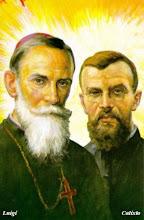
Today the Salesians remember our Protomartyrs St. Luigi Versiglia and St. Callistus Caravario. The following comes from the SDB site:

Luigi was born in Oliva Gessi (Pavia) on June 5, 1873. From his earliest years he used serve mass, so much so that the people already thought he would be a priest, but Louis never wanted to hear talk of that, because he wanted to be a vet.

The Salesian

As a twelve year old he was taken in by Don Bosco, who fascinated him to the extent that he wanted to change his mind. In 1888, soon after Don Bosco’s death, Louis was much taken by the ceremony where seven missionaries received their mission cross and decided to become a Salesian, with the hope of going to the missions.

The priest

He gained a degree in philosophy, and was soon ready for priestly ordination which took place in 1895. Don Rua appointed him as director of novices at just 23 years of age at Genzano in Rome, a task he carried out for ten years with kindness, firmness and patience.

Missionary to China

After much insistence from the bishop of Macao, in 1906 six Salesians arrived in China, led by Fr Versiglia. Thus a prophecy of Don Bosco’s came true. In Macao he established the Salesian "mother house" and also opened a mission at Heungchow. Fr Louis gave life to the area as Don Bosco would have done, setting up a music band which was much appreciated, and opening orphanages and oratories.

Exemplary bishop

In 1918 the Salesians received the mission of Shiuchow from the Vicar Apostolic of Canton, and on 9 January 1921 Fr Versiglia was consecrated its bishop. Wise, tireless and poor, he constantly set out to visit and encourage the confreres and Christians in his diocese. Whenever he arrived, the villages held a feast especially the children.

He was a true pastor, completely dedicated to his flock. He gave the Vicariate a solid structure with its own seminary, house of formation, and planned residences and hospitals for the elderly and those in need.

He looked after the formation of catechists with much care. In his notes he wrote: “The missionary who is not united to God is a canal detached from its source”. “The missionary who prays a lot achieves a lot”. Like Don Bosco he was an example of work and temperance.

Meanwhile in China the political situation had become very tense, especially for Christians and foreign missionaries. Persecutions began.

Martyrdom

On 13 February 1930, together with Fr Caravario, the bishop was at Shiuchow for the pastoral visit to the Linchow mission. Some young boys and girls went with them; they had been studying in Shiuchow. On 25 February a group of Bolshevik pirates stopped the bishop’s boat, wanting to take the girls. The bishop and Fr Caravario obstructed them with all the force they could muster.

They were forcibly taken and eventually shot. Before they were killed they heard one another’s confession. Their last breath was spent for their beloved China. Paul VI declared them martyrs in 1976, John Paul II declared them Blessed in 1983 and canonised them on 1st October 2000.

Callistus Caravario was born at Cuorgné, in the province of Turin, on 18 June 1903. From his earliest years everyone thought of him as an excellent child for his meek and reflective nature. He seemed naturally inclined to prayer and loved his mother very much, as witnessed by the many letters he wrote. At five years of age he and his family moved to Turin close to the Porta Nuova Oratory.

In Turin

He was amongst the first in his class at school, and served Mass each morning Mass. On the advice of Fr Garelli the Rector of the Oratory, he entered the Novitiate and became a Salesian. In 1922 Bishop Versiglia was in Turin who spoke of the missions to the Brothers. Callistus told him: "Bishop, you will see me in China".

China

Fr Garelli left for China and Callistus insisted so much that after a short time he followed him there. He kept his word. His mother told Fr Garelli: “I am willing to leave my son in Don Bosco’s hands”. “With all the affection I am capable of”, Callistus would write, “thank you Lord, for having given me such a good mother”. “Mother, here is news that will make you happy: This morning I gave my first catechsim lesson in Chinese”.

Timor

Callistus was sent to Macao, and then for two years to Timor where he edified everyone, including the rector, for his goodness and apostolic zeal. “My good mother”, he wrote, “pray that your Callistus may not be just a hlaf priest but completely the priest”.

Back to China - Linchow mission

On 18 May 1929, he returned to Shiuchow, where bishop Versiglia ordained him priest and entrusted him with the mission at Linchow. In a short time he had visited all the families and earned the sympathy of the school children. Meanwhile in China the political situation had become very tense, especially for Christians and foreign missionaries. Persecutions began.

Martyrdom

On 13 February 1930 Fr Caravario was in Shiuchow to accompany the bishop on his pastoral visit to the Linchow mission. Some young boys and girls went with them; they had been studying in Shiuchow. On 25 February a group of Bolshevik pirates stopped the bishop’s boat, wanting to take the girls. Bishop Versiglia and Fr Callistus stopped them.

They were taken by force and ultimately shot, but before they were killed they heard one another’s confessions. Their last breath was spent for their beloved China. Paul VI declared them martyrs in 1976, John Paul II declared them Blessed in 1983 and canonised them on 1st October 2000.

Sunday, January 24, 2016

Takayama Ukon: Samurai and Saint

(CNA/EWTN News)  The martyrdom of a 16th-century Samurai who died for his Catholic faith was approved this week by Pope Francis, making the Japanese warrior one among nine other causes that advanced toward sainthood.
Takayama Ukon was born in 1552 in Japan during the time when Jesuit missionaries were becoming introduced within the country. By the time Takayama was 12, his father had converted to Catholicism and had his son baptized as “Justo” by the Jesuit Fr. Gaspare di Lella.
Takayama's position in Japanese society as daimyo allowed him many benefits, such as owning grand estates and raising vast armies. As a Catholic, Takayama used his power to support and protect the short-lived missionary expansion within Japan, influencing the conversion of thousands of Japanese.
When a time of persecution set in within the country under the reign of Japan's chancellor Toyotomi Hideyoshi in 1587, many newly-converted Catholics abandoned their beliefs.
Instead of denying their faith, Takayama and his father left their prestigious position in society and chose a life of poverty and exile. Although many of his friends tried to persuade Takayama to deny Catholicism, he remained strong in his beliefs.
Takayama “did not want to fight against other Christians, and this led him to live a poor life, because when a samurai does not obey his 'chief,' he loses everything he has,” Fr. Anton Witwer, a general postulator of the Society of Jesus, told CNA in 2014.
Ten years passed, and the chancellor became more fierce in his persecution against Christians. He eventually crucified 26 Catholics, and by 1614, Christianity in Japan was completely banned.
The new boycott on Christianity forced Takayama to leave Japan in exile with 300 other Catholics. They fled to the Philippines, but not long after his arrival, Takayama died on February 3, 1615.
In 2013, the Japanese bishops' conference submitted the lengthy 400-page application for the beatification of Takayama to the Congregation for the Causes of Saints. On Jan. 22, 2016, Takayama's advancement in the cause for canonization was further promulgated when Pope Francis approved his decree of martyrdom.
“Since Takayama died in exile because of the weaknesses caused by the maltreatments he suffered in his homeland, the process for beatification is that of a martyr,” Fr. Witwer explained.
Takayama's life exemplifies the Christian example of "a great fidelity to the Christian vocation, persevering despite all difficulties," Fr. Witwer continued.
Takayama's cause was one of ten other new sainthood causes, which included three blesseds who have had approved miracles attributed to their intercession.
The other approved decrees included Bl. Stanislaus of Jesus, Bl. Jose Gabriel del Rosario Brochero, Bl. Jose Luis Sanchez del Rio, Francesco Maria Greco, Elisabetta Sanna, Fr. Engelmar Unzeitig CMM, Genaro Fueyo Castanon, Arsenio da Trigolo and Maria Luisa del Santissimo Sacramento.

Friday, January 22, 2016

Blessed Jose Luis Sanchez del Rio to be Canonized by Pope Francis

The following comes from Deacon Greg:


Anyone who saw the 2012 film For Greater Glory will recall the brutal, bloody martyrdom scene of a teenager in 1920s Mexico. That was a true story, and that teenager, José Luis Sánchez del Río, is on the way to being canonized.

Pope Francis on Thursday approved several decrees presented to him from the Congregation for the Causes of Saints, including a miracle attributed to Blessed José, a young member of the Cristero movement that fought for religious freedom when Mexico’s government was severely restricting the activities of the Catholic Church.

In the film version of his story, Blessed José, played by Mauricio Kuri,  is seen as constantly repeating the Cristero cry, “Viva Cristo Rey!” or “Long Live Christ the King.” That’s the same phrase Blessed Miguel Pro and others shouted as they were killed by Mexican government officials.

Pope Benedict XVI beatified him in 2005. The Vatican website has this for Blessed José’s biography:

José Sánchez del Río was born on 28 March 1913 in Sahuayo, Michoacán, Mexico. Wanting to defend the faith and rights of Catholics, he followed in the footsteps of his two older brothers and asked his mother for permission to join the Cristeros. She objected, telling him that he was too young. “Mama,” he replied, “do not let me lose the opportunity to gain Heaven so easily and so soon.” 

On 5 February 1928 the young boy was captured during a battle and imprisoned in the church sacristy. In order to terrorize him, soldiers made him watch the hanging of one of the other captured Cristeros. But José encouraged the man, saying, “You will be in Heaven before me. Prepare a place for me. Tell Christ the King I shall be with him soon.”
 

In prison, he prayed the Rosary and sang songs of faith. He wrote a beautiful letter to his mother telling her that he was resigned to do God’s will. José’s father attempted to ransom his son, but was unable to raise the money in time.On 10 February 1928 the teenager was brutally tortured and the skin of the soles of his feet was sheered off; he was then forced to walk on salt, followed by walking through the town to the cemetery. The young boy screamed with pain but would not give in
 

At times the soldiers stopped him and said, “If you shout, “Death to Christ the King,’ we will spare your life.” But he answered: “Long live Christ the King! Long live Our Lady of Guadalupe!”
 

Once he arrived at the cemetery, José was asked once more if he would deny his faith. The 14 year old shouted out: “Long live Christ the King!” and was summarily shot.

It wasn’t announced whether Pope Francis would canonize Blessed José when he makes his first visit to Mexico next month.

Tuesday, December 29, 2015

Saint of the day: Thomas Becket


Today we remember St. Thomas Becket. The following comes from the American Catholic site:

A strong man who wavered for a moment, but then learned one cannot come to terms with evil and so became a strong churchman, a martyr and a saint—that was Thomas Becket, archbishop of Canterbury, murdered in his cathedral on December 29, 1170.

His career had been a stormy one. While archdeacon of Canterbury, he was made chancellor of England at the age of 36 by his friend King Henry II. When Henry felt it advantageous to make his chancellor the archbishop of Canterbury, Thomas gave him fair warning: he might not accept all of Henry’s intrusions into Church affairs. Nevertheless, he was made archbishop (1162), resigned his chancellorship and reformed his whole way of life!

Troubles began. Henry insisted upon usurping Church rights. At one time, supposing some conciliatory action possible, Thomas came close to compromise. He momentarily approved the Constitutions of Clarendon, which would have denied the clergy the right of trial by a Church court and prevented them from making direct appeal to Rome. But Thomas rejected the Constitutions, fled to France for safety and remained in exile for seven years. When he returned to England, he suspected it would mean certain death. Because Thomas refused to remit censures he had placed upon bishops favored by the king, Henry cried out in a rage, “Will no one rid me of this troublesome priest!” Four knights, taking his words as his wish, slew Thomas in the Canterbury cathedral.

Thomas Becket remains a hero-saint down to our own times.

Monday, December 28, 2015

Feast of the Holy Innocents

The following comes from the Women of Faith and Family site:

Since the sixth century, on December 28, the Church has celebrated the memory of those children killed because of Herod's rage against Christ (cf. Mt 2:16-17). Liturgical tradition refers to them as the "Holy Innocents" and regards them as martyrs. Throughout the centuries Christian art, poetry and popular piety have enfolded the memory of the "tender flock of lambs"(125) with sentiments of tenderness and sympathy. These sentiments are also accompanied by a note of indignation against the violence with which they were taken from their mothers' arms and killed.

In our own times, children suffer innumerable forms of violence which threaten their lives, dignity and right to education. On this day, it is appropriate to recall the vast host of children not yet born who have been killed under the cover of laws permitting abortion, which is an abominable crime. Mindful of these specific problems, popular piety in many places has inspired acts of worship as well as displays of charity which provide assistance to pregnant mothers, encourage adoption and the promotion of the education of children.

As recorded in the gospel of Matthew (below), after the visit of the Magi, Herod, in rage and jealousy, slaughtered all the baby boys in Bethlehem and surrounding countryside in an attempt to destroy his perceived rival, the infant Messiah. These "innocents" are honored by the Church as martyrs.

In countries where our own innocents are daily being slaughtered by abortion, this feast day is a special time to remember the unborn, to pray for their cause, and perhaps to picket or pray at facilities where unborn babies are killed through abortion.

This would be a good day to begin a Novena for the Unborn.(Click here for Spanish Version)

The collect for the Holy Innocents may be said just before the blessing of the evening meal (see Christmas mealtime blessings), or at night prayers.

The ancient Coventry Carol is a mournful lullaby to the Holy Innocents. The words are printed below.

Family observances of this feast day have traditionally included serving baby food (oatmeal or pureed fruits), especially to the youngest member of the family. Another custom is eating a light-colored pudding with a red strawberry or raspberry sauce as a reminder of the blood of the tiny infant martyrs. While some adults may find this rather gory, many children appreciate this symbolism without the squeamishness their parents may feel.

Parents may also want to begin a nightly blessing of their children. Simply trace the sign of the cross on their foreheads while saying "May God bless you in the name of the Father, and the Son and the Holy Spirit".

Saturday, December 26, 2015

Saint of the day: Stephen the Martyr


The following comes from the CNA:

On December 26, the universal church will commemorate the death of St. Stephen, the first man to give his life in witness to the Faith.


St. Stephen was a deacon in the early church. The sixth chapter of the Acts of the Apostles says that, Stephen was “a man filled with faith and with the Holy Spirit... filled with grace and fortitude.” The Bible also notes that Stephen was a gifted orator and that his logic was sound. The conversions of many people are attributed to him.


However, his outspokenness provoked the ire of some of his listeners and he was accused of blaspheming against Moses and against God. He was brought before the high priest and many false witnesses testified against him.


In his defense, he gave an eloquent analysis of Salvation History and the love and mercy of God. He also recounted Israel's repeated ungratefulness towards their God. However, it didn't sway his accusers who proceeded to take him outside the city and stone him.


As he was about to die, Stephen looked up to heaven and said, “Behold, I see the heavens opened, and the Son of man standing at the right hand of God.” Then, as he was being stoned, he cried out, ““Lord Jesus, receive my spirit.”


His last words, as the stoning had brought him to his knees were, “Lord, do not hold this sin against them.”