Showing posts with label Military. Show all posts

Sunday, August 7, 2016

Get Tough With Yourself!


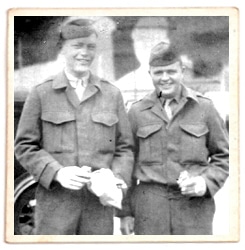
Sid Phillips, left, with W.O. Brown

This is a post from The Art of Manliness, and Men Who Lead Well.

One harmful mindset that can keep a man from fulfilling his calling and potential is self-coddling. This is when he convinces himself he deserves a break, and runs to something that ultimately harms himself.
The WWII Marines of K/3/5 had been fighting on Guadalcanal for weeks. C-rations had run out, and the men ate twice daily portions of coconuts and wormy rice they’d confiscated from the Japanese.
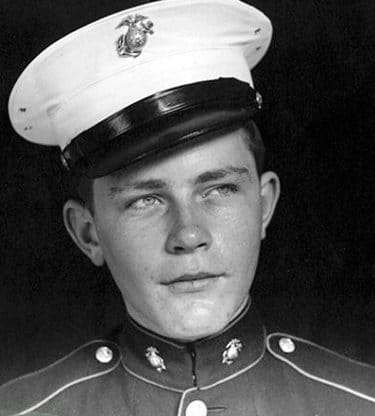
PFC Sid Phillips (featured in HBO’s The Pacific) grew increasingly concerned for his hometown friend, W.O. Brown, racked with severe dysentery. Everything W.O. tried to eat ran straight through him. There was no medicine. No cots to lie on. The sick were simply stretched out on the ground. W.O. grew so emaciated he was too weak even to sit up. Flies covered him as he lay in his own diarrhea.
“It was bad,” Phillips reported in an interview with me. “I didn’t think W.O. was going to survive.”
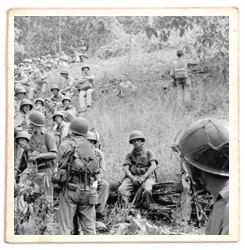
Each day, Phillips carried W.O. to the ocean and helped him get clean. I asked Phillips if he remembered any specific conversations he had with W.O. during these times of carrying him. Here, I was expecting a poignant story. I pictured this young battle-hardened Marine carrying his nearly-dead buddy to the water. “Keep holding on,” Phillips would whisper. “Have courage. Just think of mom and apple pie.” Something like that.
But Phillips just chuckled. “Oh yeah, I remember. I told W.O. to stop being such a faker and take a salt tablet.”
The response threw me. I asked Phillips (who eventually became a medical doctor) what his strategy was.
“Well, it didn’t help a man to overly commiserate with him,” Phillips said. “If you did, it just depressed him. But if you kidded him, it made him smile. The ribbing was all good natured. He’d fire back some wisecrack at you, and soon he’d get to fighting again.”
Phillips respected W.O. Brown as someone who had the capacity to get up and go on. So let’s believe the same about ourselves.
Anytime a man is in a downed place—i.e. he’s annoyed, angry, tired, hurt, lonely, stressed, or frustrated—he is tempted to become overly sympathetic with himself. He gets that insidious, creepy, pampering mindset that tells him he deserves a break—just this once.
I’m not talking about kicking back on the couch with a bag of Doritos. Not that kind of a break.
I’m talking about blowing it: the lie that it’s okay to run to a favorite vice. We’ve all got them. We run to whatever ultimately harms us, because we’ve convinced ourselves it helps. It’s the worst form of coddling.
Get tough with yourself. Knock it off, ya faker. Take a salt tablet, and get back to the battle. Sure, frustrations exist. But you don’t need that bottle. You don’t need that porn. You don’t need to give in to that moment of rage on the freeway. You’ve only convinced yourself you do.
By the way, the strategy works. W.O. Brown survived the dysentery—and the war.

Wednesday, July 27, 2016

Psalm 91: A Soldiers Prayer

Psalm 91 is called the Soldiers’ Psalm. We are told that in World War I, the soldiers of the 91st Brigade recited the 91 Psalm daily. This brigade engaged in three of the war’s bloodiest battles. Other units suffered up to 90% casualties, but the 91st Brigade did not suffer a single combat-related death. God is willing and able to keep His words of covenant promise. Plead God’s 91 shield daily. Confidently claim His rest, refuge, safety, covering, faithfulness, freedom from fear, angelic watchers, deliverance, and protection. 

Prayer is the War. God’s Word is the Weapon.

Psalm 91

He who dwells in the shelter of the Most High,
    who abides in the shadow of the Almighty,
will say to the Lord, “My refuge and my fortress;
    my God, in whom I trust.”
For he will deliver you from the snare of the fowler
    and from the deadly pestilence;
he will cover you with his pinions,
    and under his wings you will find refuge;
    his faithfulness is a shield and buckler.
You will not fear the terror of the night,
    nor the arrow that flies by day,
nor the pestilence that stalks in darkness,
    nor the destruction that wastes at noonday.
A thousand may fall at your side,
    ten thousand at your right hand;
    but it will not come near you.
You will only look with your eyes
    and see the recompense of the wicked.
Because you have made the Lord your refuge,[a]
    the Most High your habitation,
no evil shall befall you,
    no scourge come near your tent.
For he will give his angels charge of you
    to guard you in all your ways.
On their hands they will bear you up,
    lest you dash your foot against a stone.
You will tread on the lion and the adder,
    the young lion and the serpent you will trample under foot.
Because he cleaves to me in love, I will deliver him;
    I will protect him, because he knows my name.
When he calls to me, I will answer him;
    I will be with him in trouble,
    I will rescue him and honor him.
With long life I will satisfy him,
            and show him my salvation. 

Hat tip to Simple Prayers!

Wednesday, November 11, 2015

Happy Veterans Day!


This is amazing... God bless our Veterans!

Saturday, June 6, 2015

June 6, 1944: D-Day Remembered


Today is the anniversary of D-Day - the day on which the Invasion of Normandy began — commencing the Western Allied effort to liberate mainland Europe from Nazi occupation during World War II. The video above is a very nice tribute to those who fought!

The Invasion of Normandy was the invasion and establishment of Allied forces in Normandy, France during Operation Overlord in World War II. It covers from the initial landings on June 6, 1944 until the Allied breakout in mid-July.

It was the largest seaborne invasion at the time, involving over 850,000 troops crossing the English Channel from the United Kingdom to Normandy by the end of June 1944.

To learn more about World War II or the D-Day invasion go to the World War II Museum Site. This museum is amazing and I love to visit when I am home in New Orleans.

Saturday, December 27, 2014

The WWI Christmas Truce of 1914


Hat tip to Mental Floss:


Not much about life in the trenches of World War I is very festive. What is festive-ish is that in 1914, an unofficial Christmas Truce was spontaneously declared in many trenches, as British and German troops decided to put their differences aside for a bit.

Bizarre things happened, including unarmed soldiers venturing into No Man’s Land (the space between the trenches), exchanges of gifts (apparently mostly food and cigarettes), games of soccer, and even caroling. Here’s an eight-minute film documenting the Christmas Truce through animation and a letter from a British soldier.

Tuesday, November 11, 2014

Medal of Honor recipient Father Emil J. Kapaun


The following comes from US ARMY:

Chaplain Emil J. Kapaun, while assigned to Headquarters Company, 8th Cavalry Regiment, 1st Cavalry Division, distinguished himself by extraordinary heroism, patriotism, and selfless service between Nov. 1-2, 1950. During the Battle of Unsan, Kapaun was serving with the 3rd Battalion of the 8th Cavalry Regiment. As Chinese Communist forces encircled the battalion, Kapaun moved fearlessly from foxhole to foxhole under direct enemy fire in order to provide comfort and reassurance to the outnumbered Soldiers. He repeatedly exposed himself to enemy fire to recover wounded men, dragging them to safety. When he couldn't drag them, he dug shallow trenches to shield them from enemy fire. As Chinese forces closed in, Kapaun rejected several chances to escape, instead volunteering to stay behind and care for the wounded. He was taken as a prisoner of war by Chinese forces on Nov. 2, 1950.


After he was captured, Kapaun and other prisoners were marched for several days northward toward prisoner-of-war camps. During the march Kapaun led by example in caring for injured Soldiers, refusing to take a break from carrying the stretchers of the wounded while encouraging others to do their part.

Once inside the dismal prison camps, Kapaun risked his life by sneaking around the camp after dark, foraging for food, caring for the sick, and encouraging his fellow Soldiers to sustain their faith and their humanity. On at least one occasion, he was brutally punished for his disobedience, being forced to sit outside in subzero weather without any garments. When the Chinese instituted a mandatory re-education program, Kapaun patiently and politely rejected every theory put forth by the instructors. Later, Kapaun openly flouted his captors by conducting a sunrise service on Easter morning, 1951.

When Kapaun began to suffer from the physical toll of his captivity, the Chinese transferred him to a filthy, unheated hospital where he died alone. As he was being carried to the hospital, he asked God's forgiveness for his captors, and made his fellow prisoners promise to keep their faith. Chaplain Kapaun died in captivity on May 23, 1951.

Chaplain Emil J. Kapaun repeatedly risked his own life to save the lives of hundreds of fellow Americans. His extraordinary courage, faith and leadership inspired thousands of prisoners to survive hellish conditions, resist enemy indoctrination, and retain their faith in God and country. His actions reflect the utmost credit upon him, the 1st Cavalry Division, and the United States Army.

Monday, November 10, 2014

Chesty Puller and Catholic Chaplains

The following comes from the American Catholic:

Some men become legends after their deaths and others become legends while they are alive.  Lewis Burwell Puller, forever known as “Chesty”, was in the latter category.  Enlisting in the Marine Corps in 1918 he would serve until 1955, rising in rank from private to lieutenant general.  Throughout his career he led from the front, never asking his men to go where he would not go.  For his courage he was five times awarded the Navy Cross,  a Silver Star,  a Distinguished Service Cross, and a Bronze Star with a v for valor, along with numerous other decorations.  In World War II and Korea he became a symbol of the courage that Marines amply displayed in  both conflicts.

His fourth Navy Cross citation details why the Marines under his command would have followed him in an attack on Hades if he had decided to lead them there:

“For extraordinary heroism as Executive Officer of the Seventh Marines, First Marine Division, serving with the Sixth United States Army, in combat against enemy Japanese forces at Cape Gloucester, New Britain, from 26 December 1943 to 19 January 1944. Assigned temporary command of the Third Battalion, Seventh Marines, from 4 to 9 January, Lieutenant Colonel Puller quickly reorganized and advanced his unit, effecting the seizure of the objective without delay. Assuming additional duty in command of the Third Battalion, Fifth Marines, from 7 to 8 January, after the commanding officer and executive officer had been wounded, Lieutenant Colonel Puller unhesitatingly exposed himself to rifle, machine-gun and mortar fire from strongly entrenched Japanese positions to move from company to company in his front lines, reorganizing and maintaining a critical position along a fire-swept ridge. His forceful leadership and gallant fighting spirit under the most hazardous conditions were contributing factors in the defeat of the enemy during this campaign and in keeping with the highest traditions of the United States Naval Service.”

Stories began to cluster about him.  When he was first shown a flame thrower he supposedly asked, “Where do you mount the bayonet?”    Advised that his unit was surrounded he replied:  “All right, they’re on our left, they’re on our right, they’re in front of us, they’re behind us…they can’t get away this time.”  On an inspection tour of a Marine unit he became exasperated at the lack of spirit he saw and finally said,”Take me to the Brig. I want to see the real Marines!”  During the Chosin campaign in Korea when the Marines were fighting their way to the coast through several Communist Chinese corps he captured the tactical situation succinctly:  “Retreat! Hell, we’re just attacking in a different direction.”  Little surprise that Marine Drill Instructors at Parris Island still have their boots sing good night to Chesty Puller some four decades after his death.

Puller was an Episcopalian.  However he made no secret that he greatly admired Navy Catholic chaplains who served with the Marines, and had little use, with certain honorable exceptions, for the Navy Protestant chaplains sent to the Corps.  His reasons were simple.  The Catholic chaplains were without fear, always wanted to be with the troops in combat, and the men idolized them for their courage and their willingness, even eagerness, to stand with them during their hour of trial.

On New Guinea one Protestant chaplain complained to Puller that the Catholic chaplains were making converts among the Protestants.  Puller told the chaplain that he should work harder and not come whining to him.  Later, Puller encountered the Protestant chaplain again and Puller read him the riot act.  Instead of being with his men while they were fighting the chaplain had remained behind at the battalion aid station.  “They’ve got a chaplain of their own. Your place was with the fighting men — your own battalion. You remember our little talk about Protestant boys joining the Catholics? Well, conduct like yours is one reason for it. They see those priests doing their duty and see you evading it. I can’t work up much sympathy for you.”

Puller told his officers on another occasion that he had known only a few Protestant chaplains that were worth their ration cards.

He would receive letters from Protestant mothers concerned that their Marine sons had joined the Catholic Church.  He would write back that if the Protestant chaplains had the guts to go where the Catholic chaplains did, where the bullets were flying, maybe their sons wouldn’t be converting.

After he had retired, Puller complained to his Episcopal bishop:  “I can’t understand why our Church sends such poorly prepared men as chaplains when fighting breaks out — they look to me like men who can’t get churches, for the most part. The Catholics pick the very best, young, virile, active and patriotic. The troops look up to them.”

Small wonder that Puller sent his own kids to Catholic parochial school.  Good night Chesty, wherever you might be.

Monday, May 26, 2014

Memorial Day: Freedom isn't free

Wednesday, November 20, 2013

Marines, Royal Priesthood, and The Communion of Saints

The following comes from Frank Weathers:

“For Conspicuous Gallantry and Intrepidity in Action at the Risk of Life, Above and Beyond the Call of Duty . . . ”
As a kid growing up, I had a lot of daydreams floating through my head. Daydreams of Glory! The lines above (from the beginning of the citation for the Medal of Honor) would be read to throngs of adoring, thankful citizens as my exploits and heroic feats of daring-do and close-combat were read and celebrated throughout the land.
Is it any wonder that I was drawn to the vocation of a warrior?I wrote here about one of the Marines that every new recruit is taught about when he is undergoing either Marine Corps Recruit Training (boot camp) or Officer Candidates School (OCS). The Marine I am referring to is Sergeant Major Dan Daly. Was he a Catholic? Who knows? And frankly, that’s not the point.
The point is that the Marine Corps teaches all of her warriors her history. And if you like, you can think of Dan Daly, along with Smedley Butler, John H. Quick, Chesty Puller, O. P. Smith, Samuel Nicholas, John A. Lejuene, et al (I could go on naming Marines for hours) as the Marine Corps equivalent of the Communion of the Saintshere in the Church Militant. I have so much fun learning their names and reading about their heroic exploits! Talk about “Above and Beyond the Call of Duty”!

I don’t know much, but I do know this: Marines who have been “canonized” by the Corps were ordinary Marines who responded extraordinarily in a combat situation. A freshly minted private who has just graduated from boot camp is just as much a Marine as the hero Captain Kurcaba, whose bravery was written about by his comrade Joseph R. Owen in his memoir Colder Than Hell: A Marine Rifle Company at Chosin Reservoir.
It’s lump-in-my-throat time. As Owen recounts in his memoir:
Under enemy fire Captain Wilcox, Kurcaba, and Lee all walked straight up. It seemed impossible to me that they weren’t hit, especially Lee, who was usually far forward. It set a good example for the men, and I tried to do the same.
Yet when a fire-fight got hot, Owen would hit the deck and low-crawl to protect himself. Captain Kurcaba never “got down.” He said to Owen in the heat of a battle once, “If I get down, I may never get up again.” Owen writes, “I couldn’t speak to my superior officer who stood while I groveled on the deck [under fire]. I forced myself to stand up and I wished that Joe Kurcaba would get the hell away from me!”
Wow! — The saints are a lot like that to me too. Would you agree? Their exploits of daring are frightening and yet inspiring at the same time. Whether we’re talking about Joan of Arc or Charles Borromeo each challenges us to be better Christians the way the heroes of the Corps taught me to be a better Marine.
There is a fact about all Marines, whether they are flying F-18s or serving food in the chow hall: Every Marine is a rifleman. And there is a similar fact to be said of members of the Catholic Church: as Christians, each one of us is called to the Priesthood. Maybe not Holy Orders, but the Royal Priesthood all the same. If you don’t want this, then you joined the wrong outfit. If you were born into this, guess what, you still have to earn the title. Because Marines are made and not born, and so are Catholics.
But don’t worry and please don’t forget the mission of Our King’s Church: to save souls, at any cost. Most of us haven’t been called into the Church’s equivalent of the Officer Corps (Holy Orders). But we can still serve with distinction, whether we are butchers, bakers, or candle-stick makers. Again, one of the heroes of the Church (St. Francis of Assisi) serves as an example to me. “Preach the Gospel always,” he said. “Use words if necessary.” Also, there is no age requirements (17 – 28 to enlist) either and no minimum or maximum(6 – 8 years) contract length. Heck you can even get “out” and rejoin! Or join on your deathbed; just ask Oscar Wilde.
Our first Pope (dare I equate St. Peter with the first Commandant of the Marine Corps, Samuel Nicholas?) said as much in the second chapter of his first letter. Is this letter (1 Peter 2:9) similar to a Marine Corps Order? I’d say yes:
But you are a “chosen race, a royal priesthood, a holy nation, a people of his own, so that you may announce the praises” of him who called you out of darkness into his wonderful light.
Mother Church has remembered her heroes and canonized them in the Communion of the Saints so that by their “conspicuous gallantry” they can demonstrate to both raw Catholic recruits and grizzled Catholic veterans how to be good Catholic Christians.
By the way, if you graduate from the U.S. Naval Academy, you have to go to Marine Corps OCS if you decide you want to be an Officer of Marines. No excuses, no waivers, no questions. And if you were in the Army and want to try out the Marines next, you’d have to leave your rank behind and rejoin the Corps as a private.
Think about that the next time the “Renew” class is mentioned in your parish and you think to yourself, I don’t need that nor do I have the time.
Semper Fidelis

Tuesday, November 12, 2013

The Glory of the Soldier by Archbishop Sheen

Monday, November 11, 2013

God bless our Veterans!

Monday, May 27, 2013

Ronald Reagan and Memorial Day at Arlington National Cemetery


Mr. President, General, the distinguished guests here with us today, my fellow citizens:

In America's cities and towns today, flags will be placed on graves in cemeteries; public officials will speak of the sacrifice and the valor of those whose memory we honor.

In 1863, when he dedicated a small cemetery in Pennsylvania marking a terrible collision between the armies of North and South, Abraham Lincoln noted the swift obscurity of such speeches. Well, we know now that Lincoln was wrong about that particular occasion. His remarks commemorating those who gave their "last full measure of devotion" were long remembered. But since that moment at Gettysburg, few other such addresses have become part of our national heritage—not because of the inadequacy of the speakers, but because of the inadequacy of words.

I have no illusions about what little I can add now to the silent testimony of those who gave their lives willingly for their country. Words are even more feeble on this Memorial Day, for the sight before us is that of a strong and good nation that stands in silence and remembers those who were loved and who, in return, loved their countrymen enough to die for them.

Yet, we must try to honor them—not for their sakes alone, but for our own. And if words cannot repay the debt we owe these men, surely with our actions we must strive to keep faith with them and with the vision that led them to battle and to final sacrifice.

Our first obligation to them and ourselves is plain enough: The United States and the freedom for which it stands, the freedom for which they died, must endure and prosper. Their lives remind us that freedom is not bought cheaply. It has a cost; it imposes a burden. And just as they whom we commemorate were willing to sacrifice, so too must we—in a less final, less heroic way—be willing to give of ourselves.

It is this, beyond the controversy and the congressional debate, beyond the blizzard of budget numbers and the complexity of modern weapons systems, that motivates us in our search for security and peace. War will not come again, other young men will not have to die, if we will speak honestly of the dangers that confront us and remain strong enough to meet those dangers.

It's not just strength or courage that we need, but understanding and a measure of wisdom as well. We must understand enough about our world to see the value of our alliances. We must be wise enough about ourselves to listen to our allies, to work with them, to build and strengthen the bonds between us.

Our understanding must also extend to potential adversaries. We must strive to speak of them not belligerently, but firmly and frankly. And that's why we must never fail to note, as frequently as necessary, the wide gulf between our codes of morality. And that's why we must never hesitate to acknowledge the irrefutable difference between our view of man as master of the state and their view of man as servant of the state. Nor must we ever underestimate the seriousness of their aspirations to global expansion. The risk is the very freedom that has been so dearly won.

It is this honesty of mind that can open paths to peace, that can lead to fruitful negotiation, that can build a foundation upon which treaties between our nations can stand and last—treaties that can someday bring about a reduction in the terrible arms of destruction, arms that threaten us with war even more terrible than those that have taken the lives of the Americans we honor today.

In the quest for peace, the United States has proposed to the Soviet Union that we reduce the threat of nuclear weapons by negotiating a stable balance at far lower levels of strategic forces. This is a fitting occasion to announce that START, as we call it, strategic arms reductions, that the negotiations between our country and the Soviet Union will begin on the 29th of June.

As for existing strategic arms agreements, we will refrain from actions which undercut them so long as the Soviet Union shows equal restraint. With good will and dedication on both sides, I pray that we will achieve a safer world.

Our goal is peace. We can gain that peace by strengthening our alliances, by speaking candidly of the dangers before us, by assuring potential adversaries of our seriousness, by actively pursuing every chance of honest and fruitful negotiation.

It is with these goals in mind that I will depart Wednesday for Europe, and it's altogether fitting that we have this moment to reflect on the price of freedom and those who have so willingly paid it. For however important the matters of state before us this next week, they must not disturb the solemnity of this occasion. Nor must they dilute our sense of reverence and the silent gratitude we hold for those who are buried here.

The willingness of some to give their lives so that others might live never fails to evoke in us a sense of wonder and mystery. One gets that feeling here on this hallowed ground, and I have known that same poignant feeling as I looked out across the rows of white crosses and Stars of David in Europe, in the Philippines, and the military cemeteries here in our own land. Each one marks the resting place of an American hero and, in my lifetime, the heroes of World War I, the Doughboys, the GI's of World War II or Korea or Vietnam. They span several generations of young Americans, all different and yet all alike, like the markers above their resting places, all alike in a truly meaningful way.

Winston Churchill said of those he knew in World War II they seemed to be the only young men who could laugh and fight at the same time. A great general in that war called them our secret weapon, "just the best darn kids in the world." Each died for a cause he considered more important than his own life. Well, they didn't volunteer to die; they volunteered to defend values for which men have always been willing to die if need be, the values which make up what we call civilization. And how they must have wished, in all the ugliness that war brings, that no other generation of young men to follow would have to undergo that same experience.

As we honor their memory today, let us pledge that their lives, their sacrifices, their valor shall be justified and remembered for as long as God gives life to this nation. And let us also pledge to do our utmost to carry out what must have been their wish: that no other generation of young men will every have to share their experiences and repeat their sacrifice.

Earlier today, with the music that we have heard and that of our National Anthem—I can't claim to know the words of all the national anthems in the world, but I don't know of any other that ends with a question and a challenge as ours does: Does that flag still wave o'er the land of the free and the home of the brave? That is what we must all ask.
Thank you.

                                                                President Ronald Reagan

Sunday, January 27, 2013

Catholic MIlitary Chaplains and Religious Liberty

The following comes from Fr. George Rutler:

The Geneva Convention’s classification of military chaplains as noncombatants has traditionally been interpreted in the United States to mean that chaplains normally do not carry weapons. This often puts them in precarious positions when they are in war zones. Over four hundred chaplains have been killed in the line of duty. Catholic chaplains are especially exposed to dangerous situations by their obligation to administer Absolution and Anointing. They have received every kind of decoration for valor, and seven have been awarded the Medal of Honor.

All four chaplains awarded the Medal since the Civil War have been Catholic. Among them, Lieutenant Vincent Capodanno, a Maryknoll priest and Navy chaplain, who served with the Marine Corps and was killed while aiding the second Platoon of M Company at the battle of Dong Son in Vietnam, has been proposed for heaven’s highest honor, canonization as a saint.

The military chaplaincy is under threat by our own government as part of its social agenda. One year ago, the Army’s Office of the Chief of Chaplains tried to forbid Catholic chaplains from reading a statement from the Military Ordinary, Archbishop Timothy Broglio, who oversees all priests in the Catholic Ordinariate for the Armed Forces, in which he objected to federally mandated health insurance covering sterilization, abortifacients and contraception in violation of the right to religious freedom. Now the government would compel chaplains to acquiesce in “same-sex” simulations of marriage. The Army’s deputy chief of staff in charge of personnel has said that military members who dissent from this agenda are “bigoted” and “need to get out.”

As behavior contrary to Christian morality becomes a civil right, Catholics in particular could soon become, quite literally, outlaws. Our current President recently announced that he will disobey a provision in the National Defense Authorization Act, signed by his own hand, which states that chaplains cannot be forced “to perform any rite, ritual or ceremony that is contrary to the conscience, moral principles or religious beliefs of the chaplain.”

I am always edified by the sacrificing spirit of good soldiers, and as a chaplain to West Point alumni here in New York, I am pleased when cadets serve at Mass. Governments that have tried to manipulate soldiers and doctors and teachers in perverse ways have always had a short shelf life. The nineteenth-century French political philosopher Frédéric Bastiat warned: “When misguided public opinion honors what is despicable and despises what is honorable, punishes virtue and rewards vice, encourages what is harmful and discourages what is useful, applauds falsehood and smothers truth under indifference or insult, a nation turns its back on progress and can be restored only by the terrible lessons of catastrophe.”

Military chaplains do not bear arms, but they have recourse to another arsenal: “Therefore take unto you the armour of God, that you may be able to resist in the evil day, and to stand in all things perfect” (Ephesians 6:11).

Saturday, November 10, 2012

The Few, The Proud


The Marines did a fantastic job on this commercial! I saw it and I couldn't help but think of the many Priests and Religious who also serve this country and our world each and every day. We may be few, but we must be proud as well! We have to have pride in the great richness of our faith and in the beauty of our charisms! God has been so good to us and continues to bless us... I only wish we could get that message out as effectively as the Marine Corps! God bless our men and women in the service of our country!

Saturday, August 11, 2012

Christian Life in the Military

Monday, February 20, 2012

Marine Chaplain Fr. Vincent Capodanno on Road to Sainthood


The following comes from the Aquinas and More site:

Vincent Robert Capodanno was born into an Italian Catholic family on Staten Island in 1929. He attended Catholic schools and entered the Maryknoll Missionary Society after his first year in college and was sent on to the Maryknoll seminary to complete his education. He was ordained in June of 1957. Fr. Capodanno's first missionary assignment was to Taiwan where he served in many capacities for seven years, usually among the poor and disadvantaged. After a brief return to the U.S., he was reassigned to a Maryknoll school in Hong Kong.

Seeking new challenges, as he himself said, Fr. Capodanno requested a new assignment and in December 1965, after finishing officer's candidate school, he received his commission as a U.S. Navy chaplain. His first assignment came in 1966 when he joined the First Marine Division in Vietnam. When his tour was complete, he requested that it be extended and he served as chaplain in a Navy hospital. After serving briefly at the hospital, he reported to the 5th Marine Division.

As a chaplain with the Marines, Fr. Capodanno quickly earned a reputation for selfless and untiring service to his men. He became affectionately known as the “Grunt Padre” among the fighting men. As a chaplain he had no command authority as did the other officers, yet because of the special love and kindness he offered, and his willingness to share the ordinary hardships of the most junior Marines, he inspired a loyalty surpassing that of the very finest officers.

His division chaplain, David Casazza, once inquired what father did when he was with the troops. He replied “I am just there with them – I walk with them and sit with them; I eat with them and sleep in the holes with them – and I talk with them – but only when they are ready to talk. It takes time, but I never rush them.”

This compassionate Marine chaplain never feared danger. When troops assembled for combat operations, he was with them. When they went in to the heat of battle, he was with them. During the fiercest fighting, all the infantry men would watch over Fr. Capodanno because they knew he would be moving among the men, ministering to those in greatest need, even to the very front line – never concerned with his own safety – concerned only with his men. The men had an unspoken resolve to “watch over our padre.”

Father Capodanno went among the wounded and dying, giving last rites and taking care of his beloved Marines. Always watching out for them, as they watched out for him. Wounded in the face and suffering a severe shrapnel wound that nearly severed his hand, during the epic battle of Dong Son in September 1967, Father Vince moved to help a wounded Marine only yards from an enemy machine gun. Father Capodanno died from a machine gun blast taking care of this young Marine. When his body was recovered, he had 27 bullet wounds.

As a young seminarian, Vincent Capodanno had written to his superior about a book he was given to read, Radiating Christ, and said “this book will be a great help (to me) in directing God's light to the shadows throughout the world. The book's author, Fr. Raoul Plus, was a French military chaplain in World War I. The descent and incarnation described in Radiating Christ had now, in the end, brought Fr. Vincent to suffering and burial. The more he united himself with his Marines, the more he was united to Christ. As the Lord suffered with and for those He loved, so Fr. Vincent endured the harsh trials of war with and for those he served in love, for the sake of Christ and in imitation of Him.
 
On December 27, 1968 he was posthumously awarded the Medal of Honor in recognition of his selfless sacrifice.

On May 21, 2006 Fr. Capodanno was officially declared “Servant of God” as the cause for his sainthood moves forward.

Thursday, July 7, 2011

Fr. Emil Kapaun beatification cause heads to Rome


The following comes from the CNA:


U.S. Army chaplain Fr. Emil Kapaun’s cause for beatification is headed to Rome, an event the Diocese of Wichita celebrated with a July 1 Mass at the Cathedral of the Immaculate Conception.

Fr. John Hotze, episcopal delegate for the office of Fr. Kapaun’s beatification and canonization, said the event marks the culmination of years of work and also celebrates the “gift” of Fr. Kapaun.

“The fact that we, unlike any other diocese in the United States, in the world, have been blessed by the example of this saintly man, Father Emil Kapaun, boggles my mind,” he said in a June 30 statement. “How can we do anything less than give praise to God for this gift and strive to follow the example of Father Kapaun’s selfless giving.”
Fr. Kapaun, a native of Pilsen, Kansas, served in the Korean War. He courageously rescued wounded soldiers from the battlefield, risking his own life to prevent their execution at the hands of the Chinese.

He was captured by North Korean and Communist Chinese forces after he volunteered to stay behind on a battlefield with the injured.

The priest’s service to his fellow prisoners has become legendary among those who knew of him. Scores of men attributed their survival to his work tending the starving and the sick.
Fr. Kapaun died in a prison camp hospital on May 23, 1951. The Diocese of Wichita has investigated his life since 2001 and officially opened the cause for his beatification on June 29, 2008. 

Andrea Ambrosi, a lawyer investigating the case for the Vatican, told the Wichita Eagle he thinks Fr. Kapaun has a good chance to be raised to the altars.

“He showed that there was not just a devil working on the battlefields of the war, but something else.”

The investigator said Kapaun’s candidacy is unique compared with the hundreds of other cases he has investigated because it is so full of action and detailed. While most cases involve “very holy” priests and nuns who have miracles attributed to them, Fr. Kapaun’s story involves far more deeds of heroism, sacrifice and action.

Ambrosi has investigated two alleged miracles involving prayers for Fr. Kapaun’s intercession.

In 2006 Avery Gerleman, then 12 years-old, was near death for 87 days. She recovered after her parents prayed to Kapaun.

In October 2008 Chase Kear, a college track athlete, inexplicably survived a severe pole vaulting accident. His skull was fractured from ear to ear and caused some bleeding on his brain. Doctors said he would likely either die in surgery or from a post-surgery infection.
However, family and friends joined in petitions to Fr. Kapaun. Kear survived the surgery and left the hospital only a few days after the incident.

Doctors said both recoveries were medically inexplicable.

Ambrosi said the intensity of the priest’s devotees is “incredible.”

Several Catholic parishes and many parishioners pray for Fr. Kapaun’s intercession every week at Masses and many call upon him when loved ones become ill.

Fr. Hotze said that the diocese has finished collecting information that will “hopefully, with the grace of God, prove Father Kapaun worthy of beatification and then canonization as a saint of the Catholic Church.”

Ambrosi and other investigators must now closely study 8,268 documents about the chaplain’s deeds and sacrifices in the Korean War. Those documents are being sent to Rome.

If canonized, the priest would become the third American-born saint.

Monday, June 6, 2011

Remembering the D-Day Invasion

Friday, May 20, 2011

Marine Corps foundation honors heroic Vietnam War priest

The following comes from the CNA:

Servant of God Fr. Vincent Capodanno, a chaplain who was killed in action while protecting U.S. soldiers during the Vietnam War, was honored with a permanent tribute at the National Museum of the Marine Corps.

“The Marines who served with Chaplain Capodanno remember him as the Chaplain who went wherever his Marines needed his comfort and guidance, no matter the personal danger,” said Lt. Gen. Ron Christmas, president of the Marine Corps Heritage Foundation.

“From the foxholes to the front lines, Chaplain Capodanno was there.”

The Marine Corps Heritage Foundation dedicated the “Sacrifice Window” in the Semper Fidelis Memorial Chapel at the National Museum of the Marine Corps on May 11 to honor the late priest. Each window in the chapel is titled with a word that describes the ethos of the Marine Corps.

The private ceremony in Triangle, Virginia remembered Chaplain Capodanno for his support of Marines in combat and his recognition as the only chaplain to receive the Medal of Honor for service in the corps.

Foundation members said they established the permanent tribute in Chaplain Capodanno's name in “recognition of his dedicated service to Marines and the ultimate sacrifice he made in Vietnam, in an effort to save a Marine's life.”

Fr. Capodanno was born on Staten Island in New York City to Italian immigrant parents. In 1957 he was ordained a Catholic priest by Cardinal Francis Spellman, then vicar of the U.S. Military Ordinariate.

He entered the Maryknoll religious order and served as a missionary in Taiwan and Hong Kong from 1958 to 1965. Having successfully petitioned his Maryknoll superiors to release him to serve as a U.S. Navy chaplain, he arrived in Vietnam during Holy Week of 1966.

Holding the rank of Lieutenant, Fr. Capodanno participated in seven combat operations. He became known for putting the well-being of Marines above his personal safety, moving among those wounded and dying on the battlefield in order to provide medical aid, comfort, and Last Rites.

During Operation Swift on September 4, 1967, Fr. Capodanno was injured by an exploding mortar round which caused multiple injuries on his arms and legs and severed part of his right hand.

Fred Smith, head of FedEx Corporation, who served with Fr. Capodanno, recalled during the May 11 ceremony how the chaplain nearly lost his hand to shrapnel as he tended to the wounded, but refused care so that medical supplies could go to his injured Marines.

The priest directed Marines to help the wounded and continued to move about the battlefield, encouraging them with his words and example.

As he sought to administer aid to one particular marine, he placed his own body between the wounded man and an enemy machine gunner and was killed.

In 2006, the Catholic Church declared Fr. Capodanno a Servant of God, which is the first step towards being officially recognized as a saint.

Tuesday, November 23, 2010

Staff Sgt. Salvatore Giunta on Medal of Honor: 'I Can't Wear This for Myself'