Showing posts with label peace. Show all posts

Wednesday, November 18, 2015

Padre Pio: The Spirit of God

“The Spirit of God is a spirit of peace. Even in the most serious faults he makes us feel a sorrow that is tranquil, humble, and confident. This is precisely because of his mercy. The spirit of the devil, instead, excites, exasperates, and makes us feel, in that very sorrow, anger against ourselves. We should, on the contrary, be charitable with ourselves first and foremost. Therefore if any thought agitates you, this agitation never comes from God, who gives you peace, being the spirit of peace, but from the devil.”
— St. Pio of Pietrelcina

Saturday, November 14, 2015

Paris Attacks: How Should One Respond?

The following comes from Fr. Dwight Longenecker:
One of the things which secular Westerners find so mind blowing about Islamic terrorist attacks is the irrationality of the evil.
We cannot understand a religion that drives young men to such mindless barbarism.
We don’t have the tools in our toolbox. We simply cannot understand their culture, their mentality, their religion or their reasoning.
In our materialistic, pleasantly hedonistic, tolerant lifestyle we cannot comprehend a worldview that demands such utter self sacrifice, murder of innocents and wanton destruction.
Even those who no longer believe are the products of two thousand years of Christian culture and the development of a Christian worldview. Even if we are not religious we believe in goodness, forgiveness, kindness and self control. We believe in honesty, rationality and the ability to compromise and live together. We believe in beauty, innocence, purity and the pursuit of genuine love. Even if we are hypocrites and failures we believe in these things and view the world in this way.
We can’t imagine what it is like to follow a religion that demands the kidnapping and torture of children and the slaughter of innocents.
When faced with the carnage what do we do?
First, I think we naturally do what humans do. We cry out for an answer and yearn for revenge. We want to retaliate. We want to wipe these scum from the face of the earth. We want to meet rage with rage and seek vengeance.
However, as  Christians we step up to stand with the victims in grief, compassion and prayer. We hold them in our silence, incomprehension and hope somehow that our support and solidarity will help them see a way through the mindless dark.
Then we step back from the lust for revenge. Justice and self defense are justified, but the cycle of revenge and bloodshed becomes endless.

Wednesday, October 21, 2015

"Our Hearts are Restless Until They Rest in You"

The following comes from St. Augustine's Confessions:

Great are you, O Lord, and exceedingly worthy of praise; your power is immense, and your wisdom beyond reckoning. And so we men, who are a due part of your creation, long to praise you – we also carry our mortality about with us, carry the evidence of our sin and with it the proof that you thwart the proud. You arouse us so that praising you may bring us joy, because you have made us and drawn us to yourself, and our heart is unquiet until it rests in you.

Grant me to know and understand, Lord, which comes first. To call upon you or to praise you? To know you or to call upon you? Must we know you before we can call upon you? Anyone who invokes what is still unknown may be making a mistake. Or should you be invoked first, so that we may then come to know you? But how can people call upon someone in whom they do not yet believe? And how can they believe without a preacher?

But scripture tells us that those who seek the Lord will praise him, for as they seek they find him, and on finding him they will praise him. Let me seek you then, Lord, even while I am calling upon you, and call upon you even as I believe in you; for to us you have indeed been preached. My faith calls upon you, Lord, this faith which is your gift to me, which you have breathed into me through the humanity of your Son and the ministry of your preacher.

How shall I call upon my God, my God and my Lord, when by the very act of calling upon him I would be calling him into myself? Is there any place within me into which my God might come? How should the God who made heaven and earth come into me? Is there any room in me for you, Lord, my God? Even heaven and earth, which you have made and in which you have made me – can even they contain you? Since nothing that exists would exist without you, does it follow that whatever exists does in some way contain you? 

But if this is so, how can I, who am one of these existing things, ask you to come into me, when I would not exist at all unless you were already in me? Not yet am I in hell, after all but even if I were, you would be there too; for if I descend into the underworld, you are there. No, my God, I would not exist, I would not be at all, if you were not in me. Or should I say, rather, that I should not exist if I were not in you, from whom are all things, through whom are all things, in whom are all things? Yes, Lord, that is the truth, that is indeed the truth. To what place can I invite you, then, since I am in you? Or where could you come from, in order to come into me? To what place outside heaven and earth could I travel, so that my God could come to me there, the God who said, I fill heaven and earth?

Who will grant it to me to find peace in you? Who will grant me this grace, that you should come into my heart and inebriate it, enabling me to forget the evils that beset me and embrace you, my only good? What are you to me? Have mercy on me, so that I may tell. What indeed am I to you, that you should command me to love you, and grow angry with me if I do not, and threaten me with enormous woes? Is not the failure to love you woe enough in itself?

Alas for me! Through your own merciful dealings with me, O Lord my God, tell me what you are to me. Say to my soul, I am your salvation. Say it so that I can hear it. My heart is listening, Lord; open the ears of my heart and say to my soul, I am your salvation. Let me run towards this voice and seize hold of you. Do not hide your face from me: let me die so that I may see it, for not to see it would be death to me indeed.

Tuesday, June 30, 2015

Learn to Preserve Inner Peace

The following comes from the Catholic Exchange:
Sometimes you might fall into some sin or negligence in word or deed, such as disturbing yourself at anything which happens to you, or murmuring, or listening to murmuring, or falling into some dispute, irritation, curiosity, or suspicion of others, or into any other fault, whether it be one or many falls.
In such cases, you ought not to be disturbed or disheartened or saddened at the thought of what has happened, nor be confounded within yourself, at one time, believing that you will never be free from such infirmities, at another, that your faults and irresolution are the cause of them, or again, imagining that you are not walking in the spirit and way of the Lord, with a thousand other fears, pressing down your soul at every step with discontent and cowardice.
Otherwise you would feel ashamed to present yourself before God, or you would do so in a spirit of distrust, as though you had not preserved that faith in Him which is His due. And as a remedy, you would waste time in pondering over these things, scrutinizing how much you harbored the thought and whether you consented to it, whether it was voluntary or was at once put away. And, from taking the wrong road, the more you think of it, the less you are able to make up your mind about it, and the more your weariness, perplexity, and anxiety to confess it increase.
And so you go to Confession with a tedious fear, and, after having lost much time in making your confession, your spirit is even more uneasy than it was before it, for fear that you have not told all. Thus your life is one spent in bitterness and anxiety, with little fruit, and with the loss in a great measure of its reward.
All this comes from not knowing your own natural weakness and the way the soul should bear itself toward God. For after having fallen into all the faults we have enumerated, or into any others, we may more easily approach God by a humble and loving conversion, than by the spirit of grief and discontent at the fault itself, in the case of the examination of venial and ordinary sins, to which alone I now allude. For it is only into such sins as these that a soul that lives in the manner I am now supposing is wont to fall. And I am speaking only of those persons who lead a spiritual life and are striving to ad­vance in it, and are free from mortal sin. For those who live carelessly and in mortal sin, and are always more or less of­fending God, have need of a different kind of exhortation; and this medicine is not for them. Such persons should be troubled and ought to weep and to make their examination and confession with much thought, lest, through their own fault and indifference, they render the remedy that is necessary for their salvation unavailing.
To return, then, to speak of the quiet and peace in which the servant of God should ever abide, I will go further and say that this conversion must be understood to apply — in order that there might be entire trust in God — not only to slight and daily faults, but also to such as are greater and more grave than usual, if at any time the Lord should permit you to fall into such; even though they may be many together, and are not merely the effects of weakness and frailty, but of willfulness. For the contrition that only disturbed the soul and filled it with scruples will never lead it to perfection, unless it is combined with this loving confidence in the goodness and mercy of God.
And this is especially necessary in the case of persons who not only seek to rise out of their miseries, but would also ac­quire a high degree of sanctity and a great love for and union with God.
Many spiritual persons, from not wishing to understand this aright, ever bear about with them a heart and a spirit bro­ken and distrustful, which hinders their spiritual progress and capacity for the higher graces, which one after another God has prepared for them. These often lead a sort of life that is very wretched, useless, and pitiable, because they will follow only their own imaginations and will not embrace the true and wholesome doctrine that leads by the royal road to the high and solid virtues of the Christian life and to that peace which was left us by Christ Himself.
Such persons, whenever they find themselves in some dis­quietude through doubts of conscience, should seek the coun­sel of their spiritual father or of someone whom they think capable of giving them the advice they need, and should com­mit themselves to him and rest entirely in his judgment.

Saturday, June 6, 2015

Pope Francis: There is an “atmosphere of war” in the world, we need real peace-builders

The following comes from Vatican Insider:

“In the context of global communications” today, “we sense an atmosphere of war. Those who want “conflict between different cultures and societies, and those who speculate on wars for the purpose of selling arms,” seek to “foment this atmosphere”. What we need is “peacemakers”, “that is, those who make peace”, not those who just talk about it.

At Koševo stadium in Sarajevo, which hosted the opening and closing ceremonies for the 1984 Winter Olympics, Pope Francis was welcomed by a huge crowd, meeting Catholics in the same place where John Paul II was welcomed in April 1997. Back then, it was cold and snowing; today, however, the over 50,000 faithful present sat under a scorching sun. A section of the stadium was reserved for those mutilated and wounded in the civil war which crushed the city’s inhabitants in the 1990’s. Arriving at the stadium, the improvised cemeteries created during the last conflict and filled with hundreds of Christian and Muslim graves, are in plain sight.

The Pope pronounced the homily in Italian, and interpreted into Croatian. “The word peace echoes several times through the Scripture readings.” Peace is God’s dream, his plan for humanity, for history, for all creation. And it is a plan which always meets opposition from men and from the evil one,” the Pope added. Even in our time, the desire for peace and the commitment to build peace collide against the reality of many armed conflicts presently affecting our world. They are a kind of third world war being fought piecemeal and, in the context of global communications, we sense an atmosphere of war.

Some wish to incite and foment this atmosphere deliberately, mainly those who want conflict between different cultures and societies, and those who speculate on wars for the purpose of selling arms. But war means children, women and the elderly in refugee camps; it means forced displacement of peoples; it means destroyed houses, streets and factories; it means, above all, countless shattered lives. You know this well, having experienced it here: how much suffering, how much destruction, how much pain! Today, dear brothers and sisters, the cry of God’s people goes up once again from this city, the cry of all men and women of good will: war never again!”

“Within this atmosphere of war,” Francis continued, “like a ray of sunshine piercing the clouds, resound the words of Jesus in the Gospel: “Blessed are the peacemakers”. Francis pointed out that Jesus did not say “Blessed are the preachers of peace”, since all are capable of proclaiming peace, even in a hypocritical, or indeed duplicitous, manner,” instead he said: “Blessed are the peacemakers”, “that is, those who make peace.”

Crafting peace is a skilled work,” the Pope stressed. “It requires passion, patience, experience and tenacity. Blessed are those who sow peace by their daily actions, their attitudes and acts of kindness, of fraternity, of dialogue, of mercy...” “Peacemaking is a work to be carried forward each day, step-by-step, without ever growing tired.”

So how does one do this, how do we build peace?” Francis then asked. He found his answer in the Prophet Isaiah, who reminds us that “the effect of righteousness will be peace”. Opus justitiae pax (“the work of justice is peace”, Ed.), from the Vulgate version of Scripture, has become a famous motto, even adopted prophetically by Pope Pius XII. Peace is a work of justice. Here too,” Francis added, “not a justice proclaimed, imagined, planned... but rather a justice put into practice, lived out. The Gospel teaches us that the ultimate fulfilment of justice is love: “You shall love your neighbour as yourself”.

When, by the grace of God, we truly follow this commandment, how things change! Because we ourselves change! Those whom I looked upon as my enemy really have the same face as I do, the same heart, the same soul. We have the same Father in heaven. True justice, then, is doing to others what I would want them to do to me, to my people.”

But the Pope also urged us “not to fool ourselves into thinking that this all depends on us”. “We would fall into an illusive moralizing. Peace is a gift from God, not in the magical sense, but because with his Spirit he can imprint these attitudes in our hearts and in our flesh, and can make us true instruments of his peace.”

Wednesday, November 26, 2014

Pope Francis on Peace

"Lord, defuse the violence of our tongues and our hands. Renew our hearts and minds, so that the word which always brings us together will be "brother", and our way of life will always be that of: Shalom, Peace, Salaam! Amen."    Pope Francis 

Friday, November 14, 2014

The Spirit of God is a Spirit of Peace

The following comes from Spirit Daily:

The Spirit of God is a spirit of peace, and He speaks and acts in peace and gentleness.

Underscore his words: the motions of God are delicate touches; they don't make noise; and they can penetrate our spiritual consciousness only if we have within us a sort of calm "zone," and tranquility.

So says a priest named Jacques Philippe, in a new book of note: In the School of the Holy Spirit.

In other words: don't cause yourself trouble. Don't let agitation inside make it difficult to hear His still, small Voice (I Kings 19:12).

How to reach the calm zone?

It is a gradual process, this priest points out. We have to work at it. We have to desire it. We have to orient toward it. We have to keep at it, in all situations. We have to pray for it.

And we have to achieve the ability to block out troublesome thoughts (which so often come from the enemy -- or should we say: the Agitator).

If we don't seek peace of mind actively, "in all circumstances," we lose direct contact with the Lord.

In spite of everything, make this effort. (An effort it is!)

But what results.

In short, we have to practice peace of mind, and the heart follows. We have to hold it as a goal. When we don't we react to situations in a human, agitated, hasty way, we maintain inner tranquility.

Fighting fire with fire causes a mess (note the scorching, note the soot), as well as interior consternation.

"It isn't easy," writes the priest, "but by practicing hope in God, abandonment, humility, and the acceptance of our inner poverty through an unshakeable truth in God's Mercy, we will reach peace little by little."

Don't you hate that feeling of losing that? Of disturbance? Of anxiety? Yet, it happens every day all day, even at night. The devil's playground (or battlefield) is the mind. As John of the Cross said, "Take care to preserve your heart in peace; let no happening of this world upset it." When you have peace, you have faith. Watch God answer wondrously!

Wednesday, July 23, 2014

Fr. Robert Barron: The Attack on Christians in the Middle East

The following comes from Fr. Robert Barron at National Review:

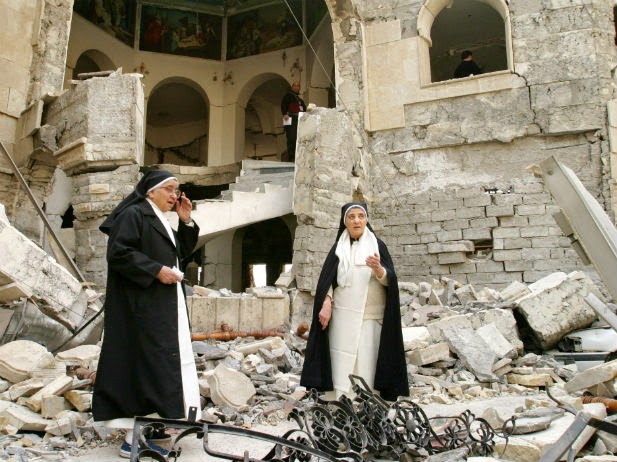
Though you would never guess it from the paucity of coverage in the major news media, there is a fierce persecution of Christians going on in the Middle East. In Egypt, convents and churches are being burned to the ground and Copts, members of one of the most ancient Christian communities, are being routinely harassed, tortured, and arrested. In Iraq, the ISIS group, hoping to re-establish a “caliphate” across the northern sector of the Middle East, is brutally persecuting Christians. Just recently, an ultimatum was issued in Mosul, where Christians have been living for over 1,600 years, that believers in Jesus have to pay a stiff fine, leave the country, or be put to death. And the sheer shock of these extreme instances can allow us to overlook the fact that in Saudi Arabia Christians are not permitted to build churches or to practice their faith publicly in any way. 

Moreover, Muslim persecution of Christianity is not limited to the Middle East. Islamist radicals have been attacking Christians in Indonesia, India, and Philippines for quite some time. And perhaps the most extreme examples of this persecution are the attacks launched by the Islamist group Boko Haram in Nigeria. This terrorist sect has burned churches, wantonly killed innocent Christians at worship, and most recently, kidnapped hundreds of Christian girls whose crime was attending school. 

It is easy enough to condemn these actions as deeply inhumane, but I would like to press the critique a bit further, drawing attention to the work of Pope Francis’s two immediate predecessors. Pope John Paul II was the most vocal defender of human rights in the 20th century. Across the world and in hundreds of different venues, he insisted that the respect for fundamental human rights must be the key to a just political order. And of all the human rights—to life, liberty, a just wage, access to the ballot—the most basic, he taught, was the right to religious freedom. This is because the spiritual aspiration of the human heart is what defines us as human beings. The violation of that most sacred of “spaces” is, therefore, the most offensive, the most heinous and de-humanizing. To use the threat of force to compel someone to change his religious beliefs—which we are regularly seeing in the Middle East—is not only criminal but wicked. 

It is also deeply irrational—a point made by Pope Benedict XVI in his address at the University of Regensburg in September of 2006. In that controversial speech, Pope Benedict drew attention to a little-known dialogue between the 14th-century Byzantine emperor Manuel II Paleologus and a Muslim interlocutor. The Emperor pointed out that the idea of spreading the faith through violent conquest, which is recommended in the Qur’an, is supremely irrational, and the reasons he gives anticipate John Paul II by six centuries. Faith is a function, not of the body, but of the soul, and therefore coercion through bodily persecution cannot even in principle awaken authentic faith. One must, instead, be skilled in arguments that would appeal to the mind: “to convince a reasonable soul, one does not need a strong arm, or weapons of any kind, or any other means of threatening a person with death.” In a word, the idea of the holy war is not syn logon (according to the word or reason). And here is the decisive point: what is unreasonable is out of step with God’s own nature, since God, on the Christian reading, is identified with Logos: “In the beginning was the Word, and the Word was with God, and the Word was God.”   

However, in Muslim teaching, Allah’s nature is so transcendent that it goes beyond any and all categories, including that of reason. Pope Benedict cites the noted French Islamic scholar R. Arnaldez, who points out that Allah is not even bound by his own word, so that if he so chose, he could recommend idolatry as morally praiseworthy. This elevation of the divine will over the divine mind, called “voluntarism” in the West, is, for Benedict, the source of enormous confusion and mischief. Most notably and dangerously, it opens the door to the idea of divinely sanctioned violence. Now I fully realize that many Christians over the centuries have done terrible things in the name of God and that the overwhelming majority of Muslims are peaceful and non-violent. But I think it is clear that when Christians act in such a way, they are unequivocally at odds with their own conception of God. Is the same true of Muslims? I am still waiting for a compelling answer from the Muslim camp to the question posed eight years ago by Pope Benedict. At the time, of course, Islamist radicals responded by killing a number of innocent Christians – certainly a curious way of refuting the notion that divinely sanctioned violence is irrational!

In the meantime, I believe that all people of good will ought to pray for both the victims and their persecutors, for the best way to honor God is through an act of compassion. The same God who is identified with Logos is, according to the first letter of John, also identified with Love.

Saturday, July 12, 2014

Sport

Sunday, June 8, 2014

Presidents of Israel and Palestine meet with Pope Francis, before praying for peace

Wednesday, April 30, 2014

Thomas Merton on Pope John XXIII

"Pope John died yesterday. A holy and good man, and he was both because he was first of all a man — that is to say, human. This is the great meaning of his papacy, of the Council, of Pacem in Terris. Not humanism, “but the bare statement of the fundamental value of humanity.” Pacem in Terris is not theological. It simply says war is unhuman, and therefore a sin — (not war is a sin and therefore you must not use the bomb). Certainly everyone loved him, and statements to this effect, despite the fact that language is too exhausted to convey it, are probably sincere. May he rest in peace, this great and good Father, whom I certainly loved, and who had been good to me, sending me the stole and many blessings. And I don’t think he has stopped being a father to us, to me. He will one day be canonized, I think (if we last that long), and I do not hesitate to ask his intercession now." 

Turning Toward the World: The Journals of Thomas Merton, Volume Four, 1960-1963

Pope's Morning Homily: 3 Marks of a People Reborn

The following comes from Zenit:

During the homily of his morning Mass at his residence today, Pope Francis proposed three marks of a "people reborn," which characterized the early Christian community.

At Casa Santa Marta, the Holy Father said the Christian community should be characterized by interior unity, witness of Christ, and care of its members.

He spoke of the "rebirth from on high" in the Holy Spirit, who gave life to the first group of "new Christians" when "they still didn’t have that name."

"They had one heart and mind," the Pope said. "Peace. A community in peace. This means that in this community there was no room for gossip, envy, calumnies, defamation. Peace. Forgiveness: 'Love covered everything.'"

Francis stressed the importance of Christians' attitudes: "Are they meek, humble? Do they vie for power between each other in that community? Are there envious quarrels? Is there gossip? [Then] they are not on the path of Jesus Christ. This feature is so important, so important, because the devil always tries to divide us. He is the father of division."

Pope Francis recognized that problems existed even for the first Christians.

He recalled "the infighting, the doctrinal struggles, power struggles."

As an example of this he pointed to the widows who complained of a lack of assistance so that the Apostles "had to create deacons."

Pope Francis proposed a reflection for today's Christian communities: "Does this community give witness to the Resurrection of Jesus Christ? Does this parish, this community, this diocese really believe that Jesus Christ is Risen?"

The Bishop of Rome said the third characteristic from which we can measure the life of a Christian community is "the poor."

"First, what's your attitude or the attitude of this community toward the poor?" he asked. "Second, is this community poor? Poor in heart, poor in spirit? Or does it place its trust in riches? In power?"

"Harmony, witness, poverty and care for the poor. This is what Jesus explained to Nicodemus: This comes from above. Because the only one who can do this is the Holy Spirit," the Pope concluded. "This is the work of the Spirit. The Church is built up by the Spirit. The Spirit creates unity. The Spirit leads us to witness. The Spirit makes us poor, because He is our wealth and leads us to care for the poor."

Wednesday, April 23, 2014

A Prayer for Peace by Pope John XXIII


Lord Jesus Christ, who are called the Prince of Peace, who are yourself our peace and reconciliation, who so often said, "Peace to you," grant us peace. Make all men and women witnesses of truth, justice, and brotherly love. Banish from their hearts whatever might endanger peace. Enlighten our rulers that they may guarantee and defend the great gift of peace. May all peoples of the earth becomes as brothers and sisters. May longed-for peace blossom forth and reign always over us all.

Sunday, April 20, 2014

Pope Francis' Urbi et Orbi blessing


Easter Sunday: Pope prays for peace in Ukraine, Venezuela and Syria. He asked the for an end to the terrorist attacks in Nigeria.

Monday, March 17, 2014

Pope Francis: The way to peace is through mercy

(Vatican Radio) To find mercy we must first forgive. It is through forgiveness that our hearts, and the world, are filled with peace. This was the overarching theme of Pope Francis’ homily during Monday morning’s Mass at the Casa Santa Marta.
“Be merciful as your Father is merciful.” Commenting on these words of Jesus, the Pope added that “it is not easy to understand this attitude of mercy” because we are habitually judgmental. “We are not [the sorts of people] who naturally [allow for understanding and mercy.”]
“To be merciful,” he said, “two attitudes are needed. The first is knowledge of oneself”. This self-knowledge means that we acknowledge “we have done many bad things: we are sinners!” And, when faced with the need for repentance, “the justice of God transforms us in mercy and forgiveness.” However, we must have shame for our sins.
“It is true none of us have murdered anyone, but many little things, many daily sins, every day… and when someone thinks: ‘ But what a small heart: I have done this against the Lord!’ And he is ashamed! He is ashamed before God, and this shame is a grace: it is the grace of being sinners. ‘I am a sinner, and I am ashamed before You and ask your forgiveness.’ It is simple, but very difficult, to say: ‘I have sinned.’”
Often, Pope Francis said, we blame others for our sins, like Adam and Eve did. “Maybe,” he continued “someone else did help me, facilitated the way to do it, but I did it myself!
If we [think like] this, how much good will occur, because we will be humble!” And “with this attitude of penitence we are more able to be merciful, because we feel within us the mercy of God,”. Just like in the Our Father: “Forgive, as we are forgiven.” Therefore, “if I do not forgive, I am somewhat out of the game!”
The other attitude we need to have in order to be merciful, the Pope continued, is to have a large heart, because “a small” and “egotistical heart is incapable of mercy.”
“Make the heart grow! ‘But I myself am a sinner.’ ‘Who am I to judge?’ This statement, ‘Who am I to judge this? Who am I to gossip about this?... Who am I, who have done the same or worse?’ The heart grows! And the Lord says, ‘Judge not, and you will not be judged! Condemn not, and you will not be condemned! Forgive, and you will be forgiven! Give, and you will receive!’ This [is] generosity of heart! And what will you receive? A good measure, pressed down and overflowing will be poured into your lap. And the image of the person of the person who goes out to collect the wheat with the apron and makes the apron larger so as to receive more, more wheat. If you have a wide, large heart, you can receive more.”
The merciful heart, said Pope Francis, “does not condemn, but forgives, forgets” because God has forgotten my sins; God has forgiven my sins. Enlarge the heart. This is beautiful,” the Pope said: “You are merciful.”
“Merciful men and women have a wide, wide heart: always forgiving others and thinking about their [own] sins. This is the way of mercy for which we must ask. But if all of is, if all people, individuals, families, neighbourhoods, had this attitude, how much peace there would be in the world – how much peace in our hearts! Because mercy brings us peace. Always remember: ‘Who am I to judge? Have shame and enlarge your heart. May the Lord give us this grace.”

Sunday, October 13, 2013

Pope Francis on the 'real St. Francis'

Tuesday, September 3, 2013

Pope Francis: “The light of Jesus doesn’t put on a show”

The following comes from the Vatican Insider:

Light is the main symbol of Christianity. It characterises and adequately captures the essence of Christianity. The light of the world on the other hand is an “artificial” light. This was the focus of Pope Francis’ second mass in St. Martha’s House since the end of the brief summer break.

“You can know everything; you can have knowledge of all things and this light on things. But the light of Jesus is something else. It is not a light of ignorance, no! It’s a light of wisdom and sagacity, but it is something other than the light of the world. The light that the world offers us is an artificial light, strong, perhaps – but that of Jesus is stronger, eh! - strong like a firework, like a flash of photography. Instead, the light of Jesus is a mild light, it is a quiet light, it is a light of peace, it’s like the light on Christmas night: without pretence,” Francis said in his homily, published on the Vatican Radio website.

Sometimes we inevitably find ourselves blinded by the wrong kind of light, the kind that brings one into the limelight or the light of personal success that fulfils one’s own interests. We often give more importance to appearing rather than being. But this glimmer of light could be the devil in disguise, “an angel of light” who “likes to imitate Jesus and do good, he speaks to us quietly, as he spoke to Jesus after the fast in the desert.” “The light of Jesus, he continued, “doesn’t put on a show. It’s a light that comes into the heart … It’s a light that speaks to the heart, and also a light that offers you the Cross. If we, in our inner light are meek, if we hear the voice of Jesus in the heart and look on the Cross without fear: that is the light of Jesus.”

This is not the first time Pope Francis invites faithful to come out of the spotlight (of their own vocations), that pretentious light that makes humans slaves of their own image. “But if a light comes that “makes you arrogant,” a light that “brings you to look on others from on high” to despise others, “that leads you to pride” – that is not the light of Jesus: it’s the light of the devil, disguised as Jesus, as an angel of light,” the Pope said. “Wherever Jesus is, there is always humility, meekness, love, and the Cross.” But, he added, sometimes “we find a Jesus that is not humble, that is not meek, that is without love, and without the Cross.” So we must follow the true Jesus “without fear,” following His light because the light of Jesus “is beautiful and does so much good,” Francis added.

Speaking about the devil’s disguises and his deceptive ways, Francis said: “Jesus doesn’t need an army to cast out the demons, He has no need of pride, no need of force, of arrogance. ‘What is there about His word? For with authority and power He commands the unclean spirits, and they come out.’ This is a humble word, meek, with so much love; it is a word that accompanies us in the moments of the Cross. Let us ask the Lord to give us today the grace of His Light, and to teach us to distinguish when the light is from Him, and when it is an artificial light, made by the enemy to deceive us.”

Monday, September 2, 2013

Pope Francis Appeals for Peace

(Vatican Radio) Pope Francis has called for a day of fasting and prayer for peace in Syria, in the entire Mideast region, and throughout the whole world to be held this coming Saturday, September 7th, 2013. The Pope made the announcement during the course of remarks ahead of the traditional Angelus prayer this Sunday. 

Below, please find the full text of the Holy Father's Angelus appeal.
Dear Brothers and Sisters,
Hello!
Today, dear brothers and sisters, I wish to make add my voice to the cry which rises up with increasing anguish from every part of the world, from every people, from the heart of each person, from the one great family which is humanity: it is the cry for peace! It is a cry which declares with force: we want a peaceful world, we want to be men and women of peace, and we want in our society, torn apart by divisions and conflict, that peace break out! War never again! Never again war! Peace is a precious gift, which must be promoted and protected.
There are so many conflicts in this world which cause me great suffering and worry, but in these days my heart is deeply wounded in particular by what is happening in Syria and anguished by the dramatic developments which are looming.
I appeal strongly for peace, an appeal which arises from the deep within me. How much suffering, how much devastation, how much pain has the use of arms carried in its wake in that martyred country, especially among civilians and the unarmed! I think of many children will not see the light of the future! With utmost firmness I condemn the use of chemical weapons: I tell you that those terrible images from recent days are burned into my mind and heart. There is a judgment of God and of history upon our actions which are inescapable! Never has the use of violence brought peace in its wake. War begets war, violence begets violence.
With all my strength, I ask each party in this conflict to listen to the voice of their own conscience, not to close themselves in solely on their own interests, but rather to look at each other as brothers and decisively and courageously to follow the path of encounter and negotiation, and so overcome blind conflict. With similar vigour I exhort the international community to make every effort to promote clear proposals for peace in that country without further delay, a peace based on dialogue and negotiation, for the good of the entire Syrian people.
May no effort be spared in guaranteeing humanitarian assistance to those wounded by this terrible conflict, in particular those forced to flee and the many refugees in nearby countries. May humanitarian workers, charged with the task of alleviating the sufferings of these people, be granted access so as to provide the necessary aid.
What can we do to make peace in the world? As Pope John said, it pertains to each individual to establish new relationships in human society under the mastery and guidance of justice and love (cf. John XXIII, Pacem in Terris, [11 April 1963]: AAS 55, [1963], 301-302).
All men and women of good will are bound by the task of pursuing peace. I make a forceful and urgent call to the entire Catholic Church, and also to every Christian of other confessions, as well as to followers of every religion and to those brothers and sisters who do not believe: peace is a good which overcomes every barrier, because it belongs all of humanity!
I repeat forcefully: it is neither a culture of confrontation nor a culture of conflict which builds harmony within and between peoples, but rather a culture of encounter and a culture of dialogue; this is the only way to peace.May the plea for peace rise up and touch the heart of everyone so that they may lay down their weapons and be let themselves be led by the desire for peace.
To this end, brothers and sisters, I have decided to proclaim for the whole Church on 7 September next, the vigil of the birth of Mary, Queen of Peace, a day of fasting and prayer for peace in Syria, the Middle East, and throughout the world, and I also invite each person, including our fellow Christians, followers of other religions and all men of good will, to participate, in whatever way they can, in this initiative.
On 7 September, in Saint Peter’s Square, here, from 19:00 until 24:00, we will gather in prayer and in a spirit of penance, invoking God’s great gift of peace upon the beloved nation of Syria and upon each situation of conflict and violence around the world. Humanity needs to see these gestures of peace and to hear words of hope and peace! I ask all the local churches, in addition to fasting, that they gather to pray for this intention.
Let us ask Mary to help us to respond to violence, to conflict and to war, with the power of dialogue, reconciliation and love. She is our mother: may she help us to find peace; all of us are her children! Help us, Mary, to overcome this most difficult moment and to dedicate ourselves each day to building in every situation an authentic culture of encounter and peace. Mary, Queen of Peace, pray for us!

Monday, August 19, 2013

Pope Francis: peace is not neutral, but violence and faith are incompatible

Friday, April 5, 2013

Pope Francis: A Christian Should Live in Perpetual Peace


Vatican City,  (Zenit.org)

Francis celebrated his usual morning Mass today at Domus Sanctae Marthae, drawing from the Gospel passage from Luke to reflect on peace, which he said is a gift that "is not sold and we do not buy."
Drawing from the first reading, he said that the disciples who were witnesses of the lame man's healing and now see Jesus, “are a bit out of themselves, but not because of some mental illness: outside themselves because of their awe." 
But what is this awe? “It is something," said the Holy Father, “that drives us out of ourselves, for joy: this is great, it is very great. This is not mere enthusiasm: even fans in a stadium are enthusiastic when their team wins, right? No, this is not some enthusiasm, it is something more profound: it is the wonder that comes when we find ourselves with Jesus."
This astonishment, the Holy Father explained, is the beginning “of the habitual state of the Christian." Certainly, he noted, we cannot live forever in wonder, but this is condition is the beginning which allows a “mark to be left on the soul and spiritual consolation." Actually, the condition of being a Christian should be one of spiritual consolation, notwithstanding problems, pains, sickness.
"The last step of consolation," the Pontiff said, “is peace: one begins with awe, and the minor tone of this wonder, of this consolation, is peace." The Christian, even in the most painful trials, never loses “the peace and the presence of Jesus” and with “a little courage," we are able to say to the Lord: “Lord, give me this grace that is the sign of the encounter with you: spiritual consolation”; and, above all, he emphasized, “never lose peace." We look to the Lord, who “suffered so upon the Cross, but he never lost peace. Peace, this peace, is not our own: it is not sold and we do not buy it." It is a gift of God for which we must beg.
Peace is like “the final step of this spiritual consolation, which begins with a joyful wonder." Wherefore, we must not “trick ourselves with our or others' fantasies, which lead us to believe that these fantasies are reality." In truth, it is more Christian “to believe that reality may not be so pretty."
The Pope ended by asking for the grace of spiritual consolation and of peace, which “begins with this joyful wonder in the encounter with Jesus Christ."
The first reading for today's Mass is Acts 3:11-26, which begins: As the crippled man who had been cured clung to Peter and John, all the people hurried in amazement toward them in the portico called “Solomon’s Portico.” When Peter saw this, he addressed the people, “You children of Israel, why are you amazed at this, and why do you look so intently at us as if we had made him walk by our own power or piety?
The Gospel for today's Mass is Luke 24:35-48, which includes: While they were still speaking about this, he stood in their midst and said to them, “Peace be with you.” But they were startled and terrified and thought that they were seeing a ghost. Then he said to them, “Why are you troubled? And why do questions arise in your hearts? Look at my hands and my feet, that it is I myself. Touch me and see, because a ghost does not have flesh and bones as you can see I have.” And as he said this, he showed them his hands and his feet. While they were still incredulous for joy and were amazed, he asked them, “Have you anything here to eat?” They gave him a piece of baked fish; he took it and ate it in front of them.