Today is the Feast of Our Lady of Mount Carmel! Let's pray today for all the Carmelites throughout the world and especially for those who are cloistered and praying for the world!
Also, the Church celebrates on this day the feast of the Brown Scapular of Mount Carmel. The scapular, which derives its name from the Latin word scapulæ, meaning shoulders, is a dress which covers the shoulders. It is mentioned in the rule of Saint Benedict as worn by monks over their other dress when they were at work, and it now forms a regular part of the religious dress in the old Orders. But it is best known among Catholics as the name of two little pieces of cloth worn out of devotion to the Blessed Virgin over the shoulders, under the ordinary garb, and connected by strings. The devotion of the scapular, now almost universal in the Catholic Church, began with the Carmelites. The history of its origin is as follows: During the thirteenth century the Carmelite Order suffered great persecution, and on 16 July 1251, while Saint Simon Stock, then general of the Order, was at prayer, the Blessed Virgin appeared to him, holding in her hand a scapular. Giving it to the saint, she said,
"Receive, my dear son, this scapular of thy Order, as the distinctive sign of my confraternity, and the mark of the privilege which I have obtained for thee and the children of Carmel. It is a sign of salvation, a safeguard in danger, and a special pledge of peace and protection till the end of time. Whosoever dies wearing this shall be preserved from eternal flames."
It is much to be wished that people should everywhere join this confraternity, for the honor of Mary and for the salvation of souls, by a life fitted to that end.
In order to have a share in the merits of the sodality every member must:
1. Shun sin, and, according to his state of life, live chastely.
2. Say every day, if possible, seven times, Our Father, Hail Mary, and Glory be to the Father.
3. Strive to serve God by venerating Mary, and imitating her virtues.
I have always loved this song and the rich way that Tony Melendez sings it! It is coupled with this wonderful video that must have been put together from a Steubenville Youth Conference. Those are wonderful experiences and the video gives you an idea of what they are like! God bless!
May 20 is the Feast of Bernardine of Siena, a great preacher and teacher of prayer. We could sure use another St. Bernardine today! Bernardine of Siena came from the noble Sienese family of the Albizeschi. He was born at Massa Marttima, where his father was governor, on September 8th, 1380. He was left an orphan at age six and was brought up by his aunts. At school in Siena he was remarkable for intelligence and a general popularity. He was known for his outstanding goodness and purity. When he was seventeen, he joined a Marian confraternity at the La Scala hospital and began a secluded religious life. In the year 1400 he willingly emerged to become the successful organizer of the hospital services during a severe outbreak of the plague. Although he escaped infection, he fell ill through exhaustion and never entirely recovered.
In 1402 he joined the Franciscans, throwing in his lot with the 'Observant' reform-party. Their spectacular growth during this period owes much to his influence. He was for twelve years their vicar general. His ordination in 1404 was followed by a dozen years of hidden life, but the rest of his career is a record of tireless preaching journeys, usually on foot, all over Italy. He was the greatest popular preacher of his time, a worthy successor to St. Vincent Ferrer, a true 'apostle of Italy.'
His regular topics were the need for penance and denunciation of prevalent vices, especially civil and political strife, usury, gambling and 'vanity' in dress and social behavior. He treated these worn themes in a fresh manner, using stories and illustrations, holding vast crowds for hours and bringing about incredible conversions.
Bernardine will be remembered for his promotion of the devotion to the Holy Name of Jesus, of Mary as dispenser of the graces merited by her divine Son, and of St. Joseph. He was accustomed to preach holding a board on which were the first three letters of the Savior's name in its Greek form--'IHS'--surrounded by rays, and he persuaded people to copy these plaques and erect them over their dwellings and public buildings. His last sermons--on Inspirations--show him to have been a profound psychologist on the mystical way and a great teacher of contemplative prayer.
He died, worn out from missionary work, on May 20th, 1444, at Aquila in the Abruzzi, and was buried there. The miracles at his tomb induced Nicholas V to canonize him only six years later. The preaching of St. Bernardine, especially the verbatim versions of his popular sermons in Italian, still deserves attention in an age no longer much addicted to preaching. Modern readers will at least admire his direct approach and the earthiness of his style. They will applaud his social awareness and the eminently practical methods he adopted to drive his lessons home and make them permanent. Let's pray for more great saints like Bernardine for our own time!
The following comes from Catholic.org: St. John, the son of Zebedee, and the brother of St. James the Great, was called to be an Apostle by our Lord in the first year of His public ministry. He became the "beloved disciple" and the only one of the Twelve who did not forsake the Savior in the hour of His Passion. He stood faithfully at the cross when the Savior made him the guardian of His Mother. His later life was passed chiefly in Jerusalem and at Ephesus. He founded many churches in Asia Minor. He wrote the fourth Gospel, and three Epistles, and the Book of Revelation is also attributed to him. Brought to Rome, tradition relates that he was by order of Emperor Dometian cast into a cauldron of boiling oil but came forth unhurt and was banished to the island of Pathmos for a year. He lived to an extreme old age, surviving all his fellow apostles, and died at Ephesus about the year 100.
St. John is called the Apostle of Charity, a virtue he had learned from his Divine Master, and which he constantly inculcated by word and example. The "beloved disciple" died at Ephesus, where a stately church was erected over his tomb. It was afterwards converted into a Mohammedan mosque.
John is credited with the authorship of three epistles and one Gospel, although many scholars believe that the final editing of the Gospel was done by others shortly after his death. He is also supposed by many to be the author of the book of Revelation, also called the Apocalypse, although this identification is less certain.
August 14 is the feast of St. Maximilian Kolbe! This wonderful saint was a remarkable witness to the world of the love of Christ for others. The following comes from Holy Spirit Interactive:
Raymond Kolbe was born in Poland in 1894. He joined the Franciscan order in 1907 and took the name that we know him by: Maximilian. Maximilian loved his vocation very much, and he especially loved the Blessed Mother. He added the name "Mary" when he pronounced solemn vows in 1914. Father Maximilian Mary was convinced that the world of the twentieth century needed their Heavenly Mother to guide and protect them. He used the press to make Mary more widely known. He and his fellow Franciscans published two monthly newsletters that soon went to readers around the world. The Mother of God blessed Father Maximilian's work. He built a large center in Poland. This center was called "City of the Immaculate." By 1938, eight hundred Franciscans lived there and labored to make the love of Mary known. Father Kolbe also started another City of the Immaculate in Nagasaki, Japan. Still another was begun in India. ~1938, the Nazis invaded the Polish City of the Immaculate. They stopped the wonderful work going on there. In 1941, the Nazis arrested Father Kolbe. They sentenced him to hard manual labor at Auschwitz. He was at Auschwitz three months when a prisoner successfully escaped. The Nazis made the rest of the prisoners pay for the escape. They chose ten prisoners at random to die in the starvation bunker. All the prisoners stood at attention, while ten men were pulled out of line. One chosen prisoner, a married man with a family, begged and pleaded to be spared for the sake of his children. Father Kolbe, who had not been picked, listened and felt deeply moved to help that suffering prisoner. He stepped forward and asked the commander if he could take the man's place. The commander accepted his offer.
Father Kolbe and the other prisoners were marched into the starvation bunker. They remained alive without food or water for several days. One by one, as they died, Father Kolbe helped and comforted them. He was the last to die. An injection of carbolic acid hastened his death on August 14, 1941. Pope John Paul II proclaimed him a saint and a martyr in 1982. St. Maximilian Mary Kolbe is the kind of person we all want to be. He was a hero who gave up his life that someone else might live. He was such a special person because he was a great friend of the Blessed Mother. We can be friends of Mary, too, if we honor her and pray to her.
For more information on St. Maximilian check out the post at kolbe.net!
Today is day 6 of my retreat. Please continue to pray for your humble blogger!
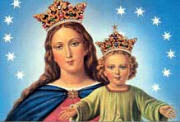
Prayer to Mary, Help of Christians: Mary, most powerful Virgin,
You are the mighty and glorious Protector of the Church.
You are the marvelous Help of Christians.
You are awe-inspiring as an army in battle array.
You have destroyed heresy in the world.
In the midst of our anguish, our struggle and our distress
defend us from the power of the enemy,
and at the hour of our death receive our soul into heaven. Amen.
(By St. John Bosco)
Today the Church remembers Saint Andre Bessette. His story is a remarkable one and he is a great example of faith and devotion that we might imitate today!
Alfred Bessette was born in Canada on August 9, 1845. He entered the Congregation of Holy Cross in 1870, taking the name of Brother Andre. He was assigned to be doorkeeper at the community's high school in Montreal. There he fostered devotion to Saint Joseph among the sick and otherwise afflicted and soon became known as the "Miracle Man" of Montreal.
With ever bigger crowds of the poor and needy gathering in front of the school. it soon brought protests from the students' parents and some community members. Bro. Andre, aware of this problem, asked in 1904 to build a small chapel on the hill beyond the school. This was the small beginning of the Oratory of St. Joseph that now stands there.
Bro. Andre died on January 6, 1937. His burial had to be postponed for several days until the last of more than three million people were able to pass by his bier and pay him homage. He was beatified by Pope John Paul II on May 23, 1982. To learn more about Blessed Andre please look here!
Today's special Feast was originally set on the third Sunday of September. Now it has a date of its own, that being September 15 th.
In 1239, five years after having established themselves, the seven founders of the Servite Order took up the sorrows of Mary who stood under the Cross as the main devotion of their religious Order.
On June 9 th and September 15 th, 1668, the Feast of the "Seven Dolors of Mary" was granted to the Servites with the object of commemorating the sorrows of Mary.
This Feast was extended to Spain in 1735 and to Tuscany in 1807. On September 18, 1814, after returning from his exile in France, Pope Pius VII extended this Feast to the whole Latin Church.
The other Feast of the Seven Sorrows of the Blessed Virgin Mary, held on Friday before Palm Sunday, was originally kept on the Friday after the third Sunday after Easter. Known under the title of, "Commemoratio angustix et doloris B. Marix V," this Feast commemorated the sorrows of Mary during the Passion and death of Christ. Instituted in 1413 by the provincial synod of Cologne, its object was to expiate for the crimes of the iconoclat Hussites.
On April 22, 1727, Pope Benedict XIII extended this Feast to the entire Latin Church under the title of "Septem dolorum B.M.V." This last Feast did not have originate through the Servite Order.
Today's Feast of Our Lady of Sorrows draws our hearts towards the Blessed Virgin Mary in compassion for the motherly sufferings that she endured during the life of Jesus on earth. Early in the life of Jesus, Simeon prophesied that the soul of Mary would be pierced by a sword. [Lk. 2:35] Many may view the statement of Simeon as a horrible thing to say to a young mother. But others view this as the first step to prepare Mary for what was to come.
After all, not long after the visit to the Temple, having been warned by an angel in a dream, Mary and Joseph had to escape to Egypt to protect Jesus from king Herod who massacred all the children under the age of two. [Mt. 2:13-18]
This event parallels what is going on in many countries that are torn by civil war. How many families are living in refugee camps or had to immigrate to foreign countries to escape those who are kidnapping and murdering the fathers, the mothers and even the children? How many families had to escape from their homeland to protect their daughters from being raped by mercenaries and soldiers who have no morals whatsoever? These families can associate with the sorrows of the Blessed Virgin Mary.
It was not until about ten years later that Mary suffered her next greatest sorrow. Returning home after participating in the festival of the Passover in Jerusalem, Mary and Joseph realized that Jesus was not with the group of travellers. They had to return to Jerusalem and look for Him. [Lk. 2:41-52]
Many parents can associate with this frightening experience. How many parents have lost their child in a supermarket, at a campground or even experienced an incident where their child wondered away from the back yard and could not be found for a few hours? How many parents have experienced the loss of a child due to a messy separation and custody battle? How many parents have permanently lost their child, not knowing his or her whereabouts? Such traumatic events truly pieces the soul of the person involved. This is something that many cannot perceive unless they personally experience it.
Over and over the aforementioned, the soul of Mary was pierced when she saw the condition of Jesus on the road to Calvary, when He was crucified, when she stood at the foot of the Holy Cross, when the body of Jesus was taken down from the Cross and when Jesus was buried.
These events remind many parents of their personal family experiences. Some parents have seen their son or daughter beaten so badly that his or her face could no longer be recognized. Some had to identify the body of their child who was murdered in a random shooting. Many parents in war ridden countries had to care for their sons after they had been kidnapped, beaten and even mutilated. How great is the suffering of these parents. How much greater was the suffering of the Blessed Virgin Mary. For she who enjoyed the fullness of her immaculate state could never conceive doing such deplorable crimes.
Through life experiences, many have compassion for Mary, being able to associate with her life sufferings that resembles a spiritual martyrdom. How many times can one pierce the soul of a person without leaving eternal scars? Only once! Yet, the soul of the Blessed Virgin Mary was pierced seven times!
During the remaining of the day, let us reflect upon the sufferings of the Mother of God. For those who continue to endure similar sufferings, let us pray that they may receive from God the strength that they desperately need to continue to carry their spiritual crosses.
The following is from American Catholic: This feast is a counterpart to the Feast of the Holy Name of Jesus (January 3); both have the possibility of uniting people easily divided on other matters.
The feast of the Most Holy Name of Mary began in Spain in 1513 and in 1671 was extended to all of Spain and the Kingdom of Naples. In 1683, John Sobieski, king of Poland, brought an army to the outskirts of Vienna to stop the advance of Muslim armies loyal to Mohammed IV in Constantinople. After Sobieski entrusted himself to the Blessed Virgin Mary, he and his soldiers thoroughly defeated the Muslims. Pope Innocent XI extended this feast to the entire Church.
Comment:
Mary always points us to God, reminding us of God's infinite goodness. She helps us to open our hearts to God's ways, wherever those may lead us. Honored under the title “Queen of Peace,” Mary encourages us to cooperate with Jesus in building a peace based on justice, a peace that respects the fundamental human rights (including religious rights) of all peoples.
Quote:
“Lord our God, when your Son was dying on the altar of the cross, he gave us as our mother the one he had chosen to be his own mother, the Blessed Virgin Mary; grant that we who call upon the holy name of Mary, our mother, with confidence in her protection may receive strength and comfort in all our needs” (Marian Sacramentary, Mass for the Holy Name of the Blessed Virgin Mary).
Charles was the son of Count Gilbert Borromeo and Margaret Medici, sister of Pope Pius IV. He was born at the family castle of Arona on Lake Maggiore, Italy on October 2. He received the clerical tonsure when he was twelve and was sent to the Benedictine abbey of SS. Gratian and Felinus at Arona for his education.
In 1559 his uncle was elected Pope Pius IV and the following year, named him his Secretary of State and created him a cardinal and administrator of the see of Milan. He served as Pius' legate on numerous diplomatic missions and in 1562, was instrumental in having Pius reconvene the Council of Trent, which had been suspended in 1552. Charles played a leading role in guiding and in fashioning the decrees of the third and last group of sessions. He refused the headship of the Borromeo family on the death of Count Frederick Borromeo, was ordained a priest in 1563, and was consecrated bishop of Milan the same year. Before being allowed to take possession of his see, he oversaw the catechism, missal, and breviary called for by the Council of Trent. When he finally did arrive at Trent (which had been without a resident bishop for eighty years) in 1556, he instituted radical reforms despite great opposition, with such effectiveness that it became a model see. He put into effect, measures to improve the morals and manners of the clergy and laity, raised the effectiveness of the diocesan operation, established seminaries for the education of the clergy, founded a Confraternity of Christian Doctrine for the religious instruction of children and encouraged the Jesuits in his see. He increased the systems to the poor and the needy, was most generous in his help to the English college at Douai, and during his bishopric held eleven diocesan synods and six provincial councils. He founded a society of secular priests, Oblates of St. Ambrose (now Oblates of St. Charles) in 1578, and was active in preaching, resisting the inroads of protestantism, and bringing back lapsed Catholics to the Church. He encountered opposition from many sources in his efforts to reform people and institutions.
He died at Milan on the night of November 3-4, and was canonized in 1610. He was one of the towering figures of the Catholic Reformation, a patron of learning and the arts, and though he achieved a position of great power, he used it with humility, personal sanctity, and unselfishness to reform the Church, of the evils and abuses so prevalent among the clergy and the nobles of the times. His feast day is November 4th.
Today is the feast of St. Bernard of Clairvaux! a Cistercian and founder of the abbey at Clairvaux. The following is from the Ecole Glossary:
St. Bernard of Clairvaux (1090-1153 AD) was born into nobility in Burgundy, France and was educated at the school of secular canons in the town of Chatillon-sur-Seine. At the age of twenty-three, he entered the Cistercian abbey of Citeaux near Dijon. Bernard spent a short time at Citeaux before being asked to found the monastery of Clairvaux and become its abbot. His success at Clairvaux prompted Pope Innocent II to call on him to intervene in a conflict between Innocent and the antipope Anacletus in 1133 and 1137. Once again successful, Bernard was drawn further from the cloister into the public life of the Church. He spent the next fifteen years condemning heretics and instituting religious reform until 1147 when Pope Eugenius III asked him to organize the Second Crusade. He lived to see the crusade fail and died shortly thereafter in 1153 at Clairvaux. Bernard wrote many spiritual treatises, including the celebrated On Loving God.
Today in the Catholic Church we remember Edith Stein (St. Teresa Benedicta of the Cross). The following comes from EWTN:Edith Stein, saintly Carmelite, profound philosopher and brilliant writer, had a great influence on the women of her time, and is having a growing influence in the intellectual and philosophical circles of today’s Germany and of the whole world. She is an inspiration to all Christians whose heritage is the Cross, and her life was offered for her own Jewish people in their sufferings and persecutions.
Born on October 12, 1891, of Jewish parents, Siegried Stein and Auguste Courant, in Breslau, Germany, Edith Stein from her earliest years showed a great aptitude for learning, and by the time of the outbreak of World War I, she had studied philology and philosophy at the universities of Breslau and Goettingen.
After the war, she resumed her higher studies at the University of Freiburg and was awarded her doctorate in philosophy Suma Cum Laude. She later became the assistant and collaborator of Professor Husserl, the famous founder of phenomenology, who greatly appreciated her brilliant mind.
In the midst of all her studies, Edith Stein was searching not only for the truth, but for Truth itself and she found both in the Catholic Church, after reading the autobiography of Saint Teresa of Avila. She was baptized on New Year’s Day, 1922.
After her conversion, Edith spent her days teaching, lecturing, writing and translating, and she soon became known as a celebrated philosopher and author, but her own great longing was for the solitude and contemplation of Carmel, in which she could offer herself to God for her people. It was not until the Nazi persecution of the Jews brought her public activities and her influence in the Catholic world to a sudden close that her Benedictine spiritual director gave his approval to her entering the Discalced Carmelie Nuns’ cloistered community at Cologne-Lindenthal on 14 October 1933. The following April, Edith received the Habit of Carmel and the religious name of "Teresia Benedicta ac Cruce," and on Easter Sunday, 21 April 1935, she made her Profession of Vows.
Today we celebrate the feast of St John Mary Vianney, who, all these years after his death, is still called the Curé (or Parish Priest) of Ars. This in itself is remarkable – as one writer puts it, ‘his name disappeared in his function’. He was a priest with the cure of souls first; everything else followed.
On paper, it seemed as if the Curé d’Ars' pastoral ministry would not be very fruitful. He only narrowly got through seminary and, because of his poor knowledge of theology, wasn’t even allowed to hear confessions at first! Once in the parish, he often yearned to join a monastery and made plans to run away on two occasions. ‘I should not like to die a Curé’, he once said, and he often noted how few canonised saints have been parish priests. Moreover, he faced many trials. In 1830 a group of parishioners tried to get him removed because he was ‘too strict’ and he even faced rumours of sexual scandal.
However, this simple, semi-illiterate pastor is the patron of parish priests. He won such fame as an insightful confessor, able to read souls, that special trains started running to Ars. He was a man of deep prayer who spent long hours in the Church and, on a number of occasions, had physical encounters with the devil. Whenever he was praised for his holiness and his special gifts, he always tried to detract from himself and focus people’s devotion on his favourite saint, the recently discovered martyr of the catacombs: St Philomena. He inspired his flock with his unsophisticated, accessible sermons. ‘It is all there, my children’, he once said pointing to the tabernacle, ‘What is Our Lord doing in the tabernacle? He is waiting for us’.
Today we pray that the priests of the twenty-first century will follow in the footsteps of the 'Saint Curé', seeking above all else the salvation and cure of souls. May their name – and with it their personal desires – disappear in their function. And, with this in mind, please pray especially for your own Curé - your parish priest.
The following comes from the American Catholic site: Moral theology, Vatican II said, should be more thoroughly nourished by Scripture, and show the nobility of the Christian vocation of the faithful and their obligation to bring forth fruit in charity for the life of the world. Alphonsus, declared patron of moral theologians by Pius XII in 1950, would rejoice in that statement.
In his day, Alphonsus fought for the liberation of moral theology from the rigidity of Jansenism. His moral theology, which went through 60 editions in the century following him, concentrated on the practical and concrete problems of pastors and confessors. If a certain legalism and minimalism crept into moral theology, it should not be attributed to this model of moderation and gentleness.
At the University of Naples he received, at the age of 16, a doctorate in both canon and civil law by acclamation, but soon gave up the practice of law for apostolic activity. He was ordained a priest and concentrated his pastoral efforts on popular (parish) missions, hearing confessions, forming Christian groups.
He founded the Redemptorist congregation in 1732. It was an association of priests and brothers living a common life, dedicated to the imitation of Christ, and working mainly in popular missions for peasants in rural areas. Almost as an omen of what was to come later, he found himself deserted, after a while, by all his original companions except one lay brother. But the congregation managed to survive and was formally approved 17 years later, though its troubles were not over.
Alphonsus’ great pastoral reforms were in the pulpit and confessional—replacing the pompous oratory of the time with simplicity, and the rigorism of Jansenism with kindness. His great fame as a writer has somewhat eclipsed the fact that for 26 years he traveled up and down the Kingdom of Naples, preaching popular missions.
He was made bishop (after trying to reject the honor) at 66 and at once instituted a thorough reform of his diocese.
His greatest sorrow came toward the end of his life. The Redemptorists, precariously continuing after the suppression of the Jesuits in 1773, had difficulty in getting their Rule approved by the Kingdom of Naples. Alphonsus acceded to the condition that they possess no property in common, but a royal official, with the connivance of a high Redemptorist official, changed the Rule substantially. Alphonsus, old, crippled and with very bad sight, signed the document, unaware that he had been betrayed. The Redemptorists in the Papal States then put themselves under the pope, who withdrew those in Naples from the jurisdiction of Alphonsus. It was only after his death that the branches were united.
At 71 he was afflicted with rheumatic pains which left incurable bending of his neck; until it was straightened a little, the pressure of his chin caused a raw wound on his chest. He suffered a final 18 months of “dark night” scruples, fears, temptations against every article of faith and every virtue, interspersed with intervals of light and relief, when ecstasies were frequent.
Alphonsus is best known for his moral theology, but he also wrote well in the field of spiritual and dogmatic theology. His Glories of Mary is one of the great works on that subject, and his book Visits to the Blessed Sacrament went through 40 editions in his lifetime, greatly influencing the practice of this devotion in the Church.
Today is the Feast of St. Ignatius of Loyola! For information on his life please check out the Patron Saints Index!
Born Inigo Lopez de Loyola in 1491, the man known as Ignatius of Loyola entered the world in Loiola, Spain. At the time, the name of the village was spelled "Loyola," hence the discrepancy. Inigo came of age in Azpeitia, in northern Spain. Loyola is a small village at the southern end of Azpeitia.
Inigio was the youngest of thirteen children. His mother died when he was just seven, and he was then raised by Maria de Garin, who was the wife of a blacksmith. His last name, "Loyola" was taken from the village of his birth.
Despite the misfortune of losing his mother he was still a member of the local aristocracy and was raised accordingly. Inigio was an ambitious young man who had dreams of becoming a great leader. He was influenced by stories such as The Song of Roland and El Cid.
At the age of sixteen, he began a short period of employment working for Juan Velazquez, the treasurer of Castile. By the time he was eighteen, he became a soldier and would fight for Antonio Manrique de Lara, Duke of Nájera and Viceroy of Navarre.
Seeking wider acclaim, he began referring to himself as Ignatius. Ignatius was a variant of Inigio. The young Ignatius also gained a reputation as a duelist. According to one story, he killed a Moor with whom he argued about the divinity of Jesus.
Ignatius fought in several battles under the leadership of the Duke of Najera. He had a talent for emerging unscathed, despite participating in many battles. His talent earned him promotions and soon he commanded his own troops.
In 1521, while defending the town of Pamplona against French attack, Ignatius was struck by a cannonball in the legs. One leg was merely broken, but the other was badly mangled. To save his life and possibly his legs, doctors performed several surgeries. There were no anesthetics during this time, so each surgery was painful. Despite their best efforts, Ignatius' condition deteriorated. After suffering for a month, his doctors warned him to prepare for death.
On June 29, 1521, on the feast of Saints Peter and Paul, Ignatius began to improve. As soon as he was healthy enough to bear it, part of one leg was amputated which while painful, sped his recovery.
During this time of bodily improvement, Ignatius began to read whatever books he could find. Most of the books he obtained were about the lives of the saints and Christ. These stories had a profound impact on him, and he became more devout.
One story in particular influenced him, "De Vita Christi" (The life of Christ). The story offers commentary on the life of Christ and suggested a spiritual exercise that required visualizing oneself in the presence of Christ during the episodes of His life. The book would inspire Ignatius' own spiritual exercises.
As he lay bedridden, Ignatius developed a desire to become a working servant of Christ. He especially wanted to convert non-Christians.
Among his profound realizations, was that some thoughts brought him happiness and others sorrow. When he considered the differences between these thoughts, he recognized that two powerful forces were acting upon him. Evil brought him unpleasant thoughts while God brought him happiness. Ignatius discerned God's call, and began a new way of life, following God instead of men.
By the spring of 1522, Ignatius had recovered enough to leave bed. On March 25, 1522, he entered the Benedictine monastery, Santa Maria de Montserrat. Before an image of the Black Madonna, he laid down his military garments. He gave his other clothes away to a poor man.
He then walked to a hospital in the town of Manresa. In exchange for a place to live, he performed work around the hospital. He begged for his food. When he was not working or begging, he would go into a cave and practice spiritual exercises.
His time in prayer and contemplation helped him to understand himself better. He also gained a better understanding of God and God's plan for him.
The ten months he spent between the hospital and the cavern were difficult for Ignatius. He suffered from doubts, anxiety and depression. But he also recognized that these were not from God.
Ignatius began recording his thoughts and experiences in a journal. This journal would be useful later for developing new spiritual exercises for the tens of thousands of people who would follow him. Those exercises remain invaluable today and are still widely practiced by religious and laity alike.
The next year, in 1523, Ignatius made a pilgrimage to the Holy Land. His goal was to live there and convert non-believers. However, the Holy Land was a troubled place and Church officials did not want Ignatius to complicate things further. They asked him to return after just a fortnight.
Ignatius realized he needed to obtain a complete education if he wanted to convert people. Returning to Barcelona, Ignatius attended a grammar school, filled with children, to learn Latin and other beginning subjects. He was blessed with a great teacher during this time, Master Jeronimo Ardevol.
After completing his primary education, Ignatius traveled to Alcala, then Salamanca, where he studied at universities. In addition to studying, Ignatius often engaged others in lengthy conversations about spiritual matters.
These conversations attracted the attention of the Inquisition.
In Spain, the Inquisition was responsible for ferreting out religious dissent and combating heresy. The Inquisition was not as it has long been depicted in the media.
The Inquisition accused Ignatius of preaching without any formal education in theology. Without this training, it was likely that Ignatius could introduce heresy by way of conversation and misunderstanding.
Ignatius was questioned three times by the Inquisition, but he was always exonerated.
Ignatius eventually decided he needed more education, so he traveled north, seeking better schools and teachers. He was 38 years old when he entered the College of Saint Barbe of the University of Paris. This education was very structured and formalized. Later, Ignatius would be inspired to copy this model when establishing schools. The ideas of prerequisites and class levels would arise from the Jesuit schools, which here heavily inspired by Ignatius' experience in Paris.
Ignatius earned a master's degree at the age of 44. When he subsequently applied for his doctorate, he was passed over because of his age. He also suffered from ailments, which the school was concerned could impact his studies.
While at school in Paris, Ignatius roomed with Peter Faber and Francis Xavier. Faber was French and Xavier was Basque. The men became friends and Ignatius led them in his spiritual exercises. Other men soon joined their exercises and became followers of Ignatius. The group began to refer to themselves as "Friends in the Lord," an apt description.
The circle of friends, shared Ignatius' dream of traveling to the Holy Land, but conflict between Venice and the Turks made such a journey impossible. Denied the opportunity to travel there, the group then decided to visit Rome. There, they resolved to present themselves to the Pope and to serve at his pleasure.
Pope Paul III received the group and approved them as an official religious order in 1540. The band attempted to elect Ignatius as their first leader, but he declined, saying he had not lived a worthy life in his youth. He also believed others were more experienced theologically.
The group insisted however, and Ignatius accepted the role as their first leader. They called themselves the Society of Jesus. Some people who did not appreciate their efforts dubbed them "Jesuits" in an attempt to disparage them. While the name stuck, by virtue of their good work the label lost its negative connotation.
Ignatius imposed a strict, almost military rule on his order. This was natural for a man who spent his youth as a soldier. It might be expected that such rigor would dissuade people from joining, but it had the opposite effect. The order grew.
The Society of Jesus soon found its niche in education. Before Ignatius died in 1556, his order established 35 schools and boasted 1,000 members. The order was responsible for much of the work of stopping the spread of the Protestant Reformation. The Society advocated the use of reason to persuade others and combat heresy.
Today, the Society of Jesus is known for its work in educating the youth around the world. Several universities have been founded in the name of Ignatius and in the traditional Jesuit spirit. The Jesuits also perform many other important works around the globe.
Ignatius' passed away on July 31, 1556, at the age of 64. He was beatified by Pope Paul V on July 27, 1609 and canonized on March 12, 1622. His feast day is July 31. He is the patron saint of the Society of Jesus, soldiers, educators and education.
The Saint of today is Sharbel Makhlouf. This great monastic saint is a wonderful patron for the Church of the Middle East. He is one of the wonder workers of the 20th century! Here is the story from CNA:
Yussef Antoun Makhloof --later and forever after known as Sharbel-- was of humble birth.
Yet Sharbel belongs to more than his village, monastery, church or country. He belongs to the Universal Church and all Christians. When he was beatified on December 5, 1965, His Holiness Pope Paul VI announced that Saint Sharbel is "a new, eminent member of monastic sanctity [who] through his example and his intercession is enriching the entire Christian people." (Saint Sharbel: The Hermit of Lebanon 1977: 27)
Yussef, who later took the name Sharbel, was the youngest of five children born to Antoun Zaarour Makhlouf and Brigitta Elias al-Shediyaq. His father died when he was three years old. Like many of the Christians from the Lebanese Mountain, his father had been taken away from his family [by the Turks] and forced into hard labor.
Yussef studied at the parish school and tended the family cow. He spent a great deal of time outdoors in the fields and pastures near his village and he meditated amid the inspiring views of boundless valleys and proud mountains.
From early childhood, Yussef showed that he loved prayer and solitude. In 1851, without informing anyone, he left home. Tanious, his uncle and guardian, wanted Yussef to continue working with him. His mother wanted him to marry the young woman who loved him. (Daher 1952: 18-19; Sfeir 1995: 72-75)
When Yussef became Brother Sharbel, he was filled with determination and walked all the way to his new home, "the monastery," his new family, "the Lebanese Maronite Order," and his new bride, "the Church." He followed in the footsteps of his maternal uncles, who were already hermits at the hermitage of Mar Boula (Saint Paul) in the Holy Valley of Qadisha, across from the Monastery of Our Lady of Qannobine. (Daher 1993:48-49)
The Lebanese Maronite Order of monks is the embodiment of the ancient eastern monasticism, which since early Christian times existed and thrived within widely dispersed, independent monasteries.
At Mass on November 1, 1853, Sharbel took the monastic vows. Neither the monk's family nor the public were allowed to attend this solemn occasion.
After his ordination, Father Sharbel returned to the Monastery of St. Maron. During his 19 years there, Sharbel performed his priestly ministry and monastic duties in an edifying way. He dedicated himself totally to Christ to live, work and pray in silence.
As he worked the land and performed manual labor at the monastery, he continued a life of purity, obedience and humility that has yet to be surpassed. In 1875, because he showed "supernatural power," he was granted permission to live as a hermit at the Hermitage of Saints Peter and Paul, which is near the monastery.
It was in this secluded sanctuary that the monk Sharbel spent the remaining twenty-three years of his life practicing severe mortification.
Father Sharbel suffered a stroke on December 16, 1898 while he was reciting the prayer of the Holy Liturgy:
His tomb has been a site for pilgrimages ever since the day he died. Hundreds of miracles were performed through the intercession of Saint Sharbel in 'Annaya, Lebanon, and throughout the world.
At the closing of the Second Vatican Council, on December 5, 1965, Sharbel was beatified by Pope Paul VI who said: "Great is the gladness in heaven and earth today for the beatification of Sharbel Makhlouf, monk and hermit of the Lebanese Maronite Order. Great is the joy of the East and West for this son of Lebanon, admirable flower of sanctity blooming on the stem of the ancient monastic traditions of the East, and venerated today by the Church of Rome.
Today is the feast of St. Benedict of Nursia! Here is some good info on him! I got most of it from the Monastery of Christ in the Desert website. This is a really beatiful monastery that I have visited for a retreat. Enjoy!
Saint Benedict was born around the year 480 in the district of Nursia (present-day Norcia), in Umbria, central Italy. He is regarded as the "Father of Western Monasticism" and is "Co-patron of Europe" along with Saints Cyril and Methodius.
As a young man, Benedict was sent to Rome for studies but left after a short stay, desiring to dedicate his life to God. He went to live in an isolated place near Subiaco, not far from the ruins of Emperor Nero's summer villa, about fifty miles from Rome. Today the cave is the celebrated shrine called "Sacro Speco" (The Holy Cave) and is one of Europe's most beautiful sanctuaries. At Subiaco, Benedict lived a life of solitude and prayer for about three years with the support from a monk named Romanus. Benedict's time as a hermit was interupted for a short period when he became the superior of a group of unruly monks. Ultimately unhappy with his guidance, they tried to poison him. He then withdrew to the cave at Subiaco once again.
Eventually, Benedict's sanctity attracted disciples and in time, twelve small monasteries were established around Subiaco, with Benedict as the spiritual father of them all.
Around the year 530 Benedict left Subiaco with some of his sisciples for Monte Cassino, halfway between Rome and Naples, where he began a single, close-knit community on a mountain top. There he remained until his death around the year 547. Is was at Monte Cassino that Benedict completed his "Rule for Monks," basing it on earlier monastic literature as well as his own original material. Today, the "Rule of Saint Benedict," as it is commonly called, is considered one of the most important factors in the development of Christian Europe. In time, the Rule became the norm for all monks and nuns in the West. During his lifetime, the monastery at Monte Cassino grew and a foundation was made south of Rome, at Terracina. The monasteries at Subiaco continued as well.
Benedict had a sister, Scolastica, who was consecrated to God from her youth and died shortly before her saintly brother. Both of them were buried at Monte Cassino in the oratory dedicated to Saint John the Baptist. Saint Scholastica's feast day is on February 10th and Saint Benedict's is on March 21st and July 11th. The March date is generally considered to be the date on which he died.
The life of Saint Benedict is found in "The Dialogues" written by Pope St. Gregory the Great some forty years after Benedict's death. It is not a biography as we know the genre today, but the details supply us with a basic outline of the life and times of Saint Benedict. Among the titles given to Saint Benedict over the centuries are the following: "Messenger of Peace, Architect of Unity, Teacher of Culture and Civilization, Father of Western Monasticism, Herald of the Christian Faith, and Father of the Whole of Europe." Today, Benedict's disciples, both men and women, can be found on every inhabited continent of the world, leading lives dedicated to "Prayer and Work," as the holy father Benedict taught in his rule and by his life.
The above videos are from Kibeho, Rwanda. The first was taken during the time of the visions and the second is present day. It was 14 years ago that the Bishops of Rwanda approved the Kibeho visions as worthy of belief. Kibeho is a small town in south Rwanda, that became famous for reports of apparitions of the Virgin Mary and Jesus between 1981 and 1989.
The Blessed Virgin Mary and Our Lord reportedly appeared to teenagers. These visions were accompanied by crying, tremors, and even comas. On August 19, 1982 the visionaries reported horrible sights (including rivers of blood) which many regard as an ominous foreshadowing of the Rwandan Genocide of 1994.
Here is another bit of the interview with Cardinal Zen from his visit with us!
Also, here is more Our Lady and her presence to the people of China from this site:
Our Lady appears in China In 1900, China reported three apparitions: One in Beijing in which Our Lady was accompanied by St. Michael the archangel who, in turn, was surrounded by multitudes of angels. A second apparition involved a weeping statue of Our Lady in the village of Santai during the Boxer Rebellion. The third apparition occurred in Donglu. Donglu is about 40 kilometres from Baoding in Hebei province, and it is one of the strongholds of the unofficial Catholic Church in China.
Witnesses recount that a beautiful lady, recognised as Mary, appeared in the skies. The Catholics implored Our Lady to save them from their enemies and their city from destruction. In thanksgiving for Our Lady’s protection over the city of Donglu during the Boxer Rebellion, a beautiful church was built in her honour. It was meant to serve as a constant reminder to the people of Mary’s loving and motherly protection. The pastor, at the time, secured a painting of the Dowager Empress Ci Xi dressed in imperial robes. He commissioned an artist to use it as the background for the image of Our Lady holding the Christ Child. The picture was hung in the Church of Donglu, which eventually became a famous place of pilgrimage.
The shrine at Donglu People began coming to the shrine in Donglu in 1924, but the first official pilgrimage took place in 1929. By 1932, the location became such a popular pilgrimage site that Pope Pius XI approved it as an official Marian shrine. Since 1929 tens of thousands of pilgrims have made their way up the hill to the shrine, especially in May. The Miracle Of The Sun 23 May 1995 On 23 May 1995, pilgrims witnessed another phenomenon. Over 30,000 Catholics from the unofficial Church had gathered for Mass at the Donglu shrine. It was the vigil of the Feast of Our Lady, Mary Help of Christians, a favourite of Chinese Catholics. There were four bishops of the unofficial Church concelebrating the Mass and nearly 100 unofficial priests standing in the open field, all eager to honour Our Lady in a special way during her special month. Suddenly, during the opening prayer and again during the consecration, the people observed the sun spinning from right to left. Light rays of various shades emanated from the sky. The people, mesmerised by the phenomenon, could look directly at it without blinking. Suddenly from the centre of the sun people saw what they later described as an apparition. Some beheld the Cross; others said they had seen the Holy Family. Still others had seen Our Lady holding the Infant Jesus while others claimed they had seen the Sacred Host. People, overwhelmed by the vision, suddenly became conscious of their sinfulness and began to cry out, “Holy Mother, forgive me my sins,” or “Holy Virgin Mary, have pity on us your children.” The phenomenon of the sun changing colours, approaching and then retreating while radiating various hues, lasted for about 20 minutes. The government’s response Needless to say, the government has not been terribly enthusiastic about having thousands upon thousands of people gather anywhere. This is all the more threatening when the gathering involves religion and people of the unofficial Church. The Public Security Bureau, the agency in charge of keeping watch over the unofficial Catholic community, periodically flexes its muscles to prevent anyone from going on pilgrimage to Donglu. In 1995, when tens of thousands of pilgrims flocked to Donglu for the Feast of Mary Help of Christians on May 24, the Public Security barred all pilgrims from joining anyone on the hill. The police forced people back into buses and trains without offering any explanation. Still, thousands successfully reached the area by finding alternative ways to get there. As many as 100,000 participated in the celebration. Again in 1996, an official announcement forbade anyone from going to the Donglu shrine. This time two reasons were given for the prohibition: it was an illegal gathering and it was bad for social stability. Teams of Public Security agents as large as 500 strong were dispatched to all the villages surrounding the Donglu area and to towns all over Hebei Province. As they travelled around, they tried to force the members of the unofficial community to join the Patriotic Association and to do away with unrecognised religious premises such as Donglu. Priests in the towns and villages were ordered not to leave their residences and were forbidden to preach from May 13 until further notice. Lay people were also forbidden to leave their villages. Parents were not allowed to take their children to church or to wear any religious objects.
Against all odds It seems no amount of pressure can dull the enthusiam of Catholics intent on honouring Our Lady at the Donglu shrine. Every May, regardless of prohibitions, tens of thousands of pilgrims make their way up the steep hill, either in silence or reciting the rosary or singing hymns to praise one who is truly their mother and protector.
The shrine at Sheshan In June 1989, Pope John Paul II prayed that the Virgin of Sheshan Help of Christians, would look kindly on “the beloved Chinese people.” This remark by Our Holy Father indicates the importance of this shrine as a symbol of Christian renewal in China. Sheshan, with its “nine peaks above the clouds” is situated about 35 kilometres from Shanghai city. Its forest of bamboo, its scenic winding paths and running brooks are a fitting location for communing with God and Our Lady. The mountain, according to legend, gets its name from a hermit named She who centuries ago, lived atop the mountain.
In 1866, the Church in Shanghai built a hexagonal pavilion and placed within it an altar and a statue of Our Lady. Five years later, the Jesuits built a church at the summit of the mountain and dedicated it to Our Lady Help of Christians, opening it in 1873.
In 1924, the bishops of China consecrated the nation to Our Lady and following the consecration they made a pilgrimage to Sheshan. Work on a basilica began in 1925 and was completed 10 years later. This church was the first basilica in all of the Far East and it became China’s favourite pilgrimage site.
During the Cultural Revolution the beautiful bronze statue of Our Lady at the pinnacle of the basilica disappeared and other religious symbols, including the altar and the stained glass window were all virtually destroyed. A replica of the bronze statue of Mary holding up the Christ Child was finally re-installed on top of the tower in the year 2000. Some 10,000 believers paid for it. Pilgrimages to the shrine resumed in 1979.
Every year since then, pilgrims by the thousands have flocked to Sheshan. In 1990, the first pilgrimage of the decade saw 30,000 Catholics coming to Sheshan for Our Lady’s feast. The elderly and the young made the long steep climb from the foothills of the mountain to the summit as a testimony of their love and devotion to Our Lady. One large group of pilgrims are the fisherfolk of Jiangnan who, from earliest times, sailed up the Yangtze, carefully steering their craft through the canals surrounding the foothills of the mountain.
Every year, they come, moor their boats and spend three days and nights at Sheshan to implore Our Lady’s help for the future and to thank her for favours received. But they are only a small group compared to the thousands from all over China who come to pay tribute to their heavenly mother in whom they place so much of their trust.
Welcome to the Blog! I am a Catholic Priest and was ordained to the priesthood on August 26, 2000. I hope this site is a place of interest for you where you will find ideas and information on the Catholic faith and the Church.
 Today is the Feast of Our Lady of Mount Carmel! Let's pray today for all the Carmelites throughout the world and especially for those who are cloistered and praying for the world!