Q: I received a Miraculous Medal for Confirmation. Where does this come from and what does this mean?
The story of the Miraculous Medal arises from the apparitions of our Blessed Mother to St. Catherine Laboure, a novice at the motherhouse of the Daughters of Charity in Paris (where it still stands today at 140 Rue du Bac). St. Catherine (1806-1876; canonized 1947) was the daughter of a farmer, and was the ninth of 11 children. When she was eight years old, St. Catherine lost her mother.
Even at that tender age, St. Catherine showed a special love for the Blessed Mother: Upon her mother’s death, St. Catherine climbed a chair to reach the statue of the Blessed Mother in their home. Clasping it to her chest, she said, “Now, dear Blessed Mother, you will be my mother.” She was called upon to care for the family, thereby depriving her of any formal education at school. (Her youngest sibling was an invalid and needed constant care.) On January 22, 1830, at the age of 24, St. Catherine joined the Daughters of Charity, who had been founded by St. Vincent de Paul.
On the night of July 18, 1830, St. Catherine saw our Blessed Mother seated in the choir of the motherhouse chapel. St. Catherine herself recorded the incident, which she entitled, “July Conversation with the Most Blessed Virgin, from 11:30 in the evening of the 18th until 1:30 in the morning of the 19th, St. Vincent’s Day.” During this time, the Blessed Mother spoke to her and made several predictions which would later come to pass. The Blessed Mother said, “My child, the good God wishes to charge you with a mission. You will have much to suffer, but you will rise above these sufferings by reflecting that what you do is for the glory of God. You will know what the good God wants. You will be tormented until you have told him who is charged with directing you. You will be contradicted but, do not fear, you will have grace. Tell with confidence all that passes within you; tell it with simplicity. Have confidence. Do not be afraid.”
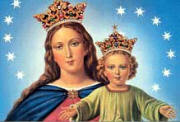
On November 27, 1830, the Blessed Mother again appeared to St. Catherine at about 5:30PM, while she was making her meditation with the community. St. Catherine described what she saw: “The Virgin was standing. She was of medium height, and clothed all in white. Her dress was of the whiteness of the dawn, made in the style called à la vierge, that is, high neck and plain sleeves. A white veil covered her head and fell on either side to her feet. Under the veil, her hair, in coils, was bound with a fillet ornamented with lace, about three centimeters in height or of two fingers’ breadth, without pleats, and resting lightly on the hair. Her face was sufficiently exposed, indeed exposed very well, and so beautiful that it seems to me impossible to express her ravishing beauty. Her feet rested on a white globe, that is to say half a globe, or at least I saw only half. There was also a serpent, green in color with yellow spots. The hands were raised to the height of the stomach and held, in a very relaxed manner and as if offering it to God, a golden ball surmounted with a little golden cross, which represented the world. Her eyes were now raised to heaven, now lowered. Her face was of such beauty that I could not describe it. All at once, I saw rings on her fingers, three rings to each finger, the largest one near the base of the finger, one of medium size in the middle, the smallest one at the tip. Each ring was set with gems, some more beautiful than others; the larger gems emitted greater rays and the smaller gems, smaller rays; the rays bursting from all sides flooded the base, so that I could no longer see the feet of the Blessed Virgin.”
The Blessed Mother then explained to St. Catherine the symbolism involved in her appearance: “This ball that you see represents the whole world, especially France, and each person in particular. [The dazzling rays] are the symbols of graces I shed upon those who ask for them. The gems from which the rays do not fall are the graces for which souls forget to ask.” A slightly oval frame surrounded the Blessed Mother upon which were the words written in gold: “O Mary, conceived without sin, pray for us who have recourse to thee.” This image clearly identified the Blessed Mother as the Immaculate Conception and the Mediatrix of graces. (In 1854, Blessed Pope Pius IX solemnly pronounced the dogma of the Immaculate Conception, that “the most Blessed Virgin Mary was, from the first moment of her conception, by a singular grace and privilege of Almighty God and in view of the merits of Christ Jesus the Savior of the human race, preserved immune from all stain of original sin…” (Ineffabilis Deus).)
The Blessed Mother then instructed St. Catherine to have a medal struck after this image. On the reverse side there was to be a large M surmounted by a bar and a cross; beneath the M were to be the heart of Jesus, crowned with thorns, and the heart of Mary, pierced with a sword. The Blessed Mother also said, “All who wear it will receive great graces; they should wear it around the neck. Graces will abound for those who wear it with confidence.” With the approval of Archbishop de Quelen of Paris, the first 1,500 medals were struck on June 30, 1832. Because of the numerous favors received by the faithful, the medal was soon known as “miraculous.” After a canonical inquiry at Paris (1836) regarding the apparitions, the medal was declared of supernatural origin.
One of the most famous miraculous favors surrounding the medal was the instantaneous conversion of Alphonse Ratisbonne, a non-practicing Jew who was an atheist. Ratisbonne was the son and heir of a wealthy aristocratic family of bankers in Strasbourg, France. After his older brother converted to Catholicism and became a priest, and the family disinherited him, Ratisbonne held a deep hostility toward Catholicism. When in Rome, Ratisbonne met with the Baron de Bussieres, the brother of one of his best friends. The baron, a devout Catholic, dared Ratisbonne to wear a Miraculous Medal and recite a short daily prayer to Mary; if nothing happened, then indeed there would be nothing to such “detestable superstitions,” as Ratisbonne called them. He agreed to the wager.
On January 20, 1842, the last day of his stay in Rome, the baron and Ratisbonne stopped in the Church of St. Andrea delle Fratte. Immediately, Ratisbonne felt in spiritual turmoil. He saw a bright light that filled the chapel of St. Michael the Archangel. He said: “I saw someone standing on the altar, a lofty shining figure, all majesty and sweetness, the Virgin Mary just as she looks on this medal. Some irresistible force drew me towards her. She motioned to me to kneel down and when I did so, she seemed to approve. Though she never said a word, I understood her perfectly…. I was there, on my knees, in tears…. I took the medal…and kissed passionately the image of the Virgin radiant with grace. It was she!” Shortly thereafter, he was baptized, and then later ordained as a priest. The instantaneous conversion of this prominent figure helped move the Holy See to grant official papal approval for the medal.