Showing posts with label St. Juan Diego. Show all posts

Friday, December 13, 2019

St. Juan Diego and the Miraculous Proof

The following comes from Word on Fire:
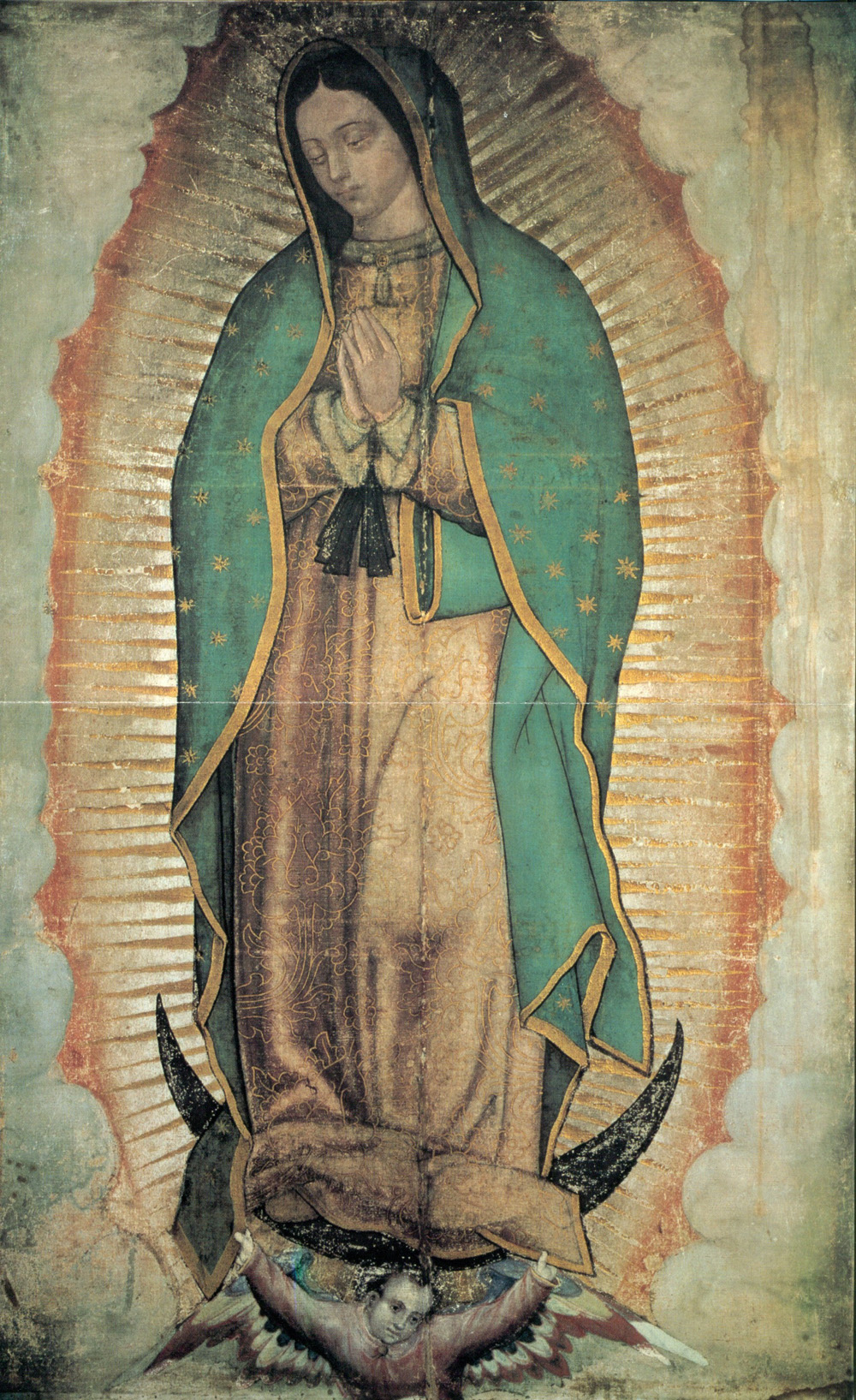
One of the ways to prove the Catholic claim is through miracles.  Catholicism, unique amongst all the faiths on Earth, has colorable claims of miraculous events with evidence.  One of these miraculous events is Our Lady's appearance to St. Juan Diego from December 9th to the 12th of 1531. You can find the full story here. And here's Her image on the tilma of St. Juan Diego.
 Now, there have been serious questions about whether this apparition is real.  I firmly believe it is, and the Church canonized St. Juan Diego, suggesting She does as well.  The arguments against the apparition become less compelling when you try and piece them together.  For example, it's claimed that since the Spanish didn't write about this event for over a decade (which is apparently true: the first existent writing we have from the Spanish is from 1548), then it didn't exist.  But given that the Spanish were often clueless about Aztec life, and didn't speak the Nahuatl language, this isn't a particularly troubling occurrence. There's little question that this was a devotion popular amongst Aztec converts, rather than Spanish cradle Catholics.  And while the Spanish don't write about the apparition (at first), there is plenty of historical evidence that after 1531, the number of Aztecs seeking Baptism jumps through the roof: As Called to Communion explains:

"This miracle precipitated the greatest flood of conversions in the whole history of Christianity. In the seven years following this miracle, approximately eight million Aztecs converted to Christianity [...]
Prior to this event, the Aztecs were offering thousands of human sacrifices per year in central Mexico, including child sacrifice. The conversion of the Aztecs to Christianity ended the brutal practice of human sacrifice, and helped bring Central and South America to Christianity."
Then there's also the fact that Santa Maria de Guadalupe is a religious devotion amongst the Spanish, leading other critics to claim that the Spanish made this myth up to convert the Aztecs.  This theory makes the most sense of the critical ones, but it doesn't hold water.  As we just established, the Spanish seemed unaware of the devotion in its early days.  Surely, if they were the ones spreading it, we'd see some documentation that they were - something in a diary about how they were explaining the Virgin of Guadalupe to the Aztecs.  There's nothing of the sort.  Instead, many of the earliest Spanish writings are skeptical, while it's the Aztecs themselves who are the believers. Besides this, fiber testing shows that this tilma isn't Spanish in origin, but is made from Mexican hemp.
 The picture that emerges is a fascinating one.  It seems too Mexican to be Spanish, and too Spanish to be Mexican.  And it's far too Christian to be a warmed-over Aztec goddess cult, one of the other theories.  Called to Communion notes:
"The image shows Mary as a humble but royal maiden. Under her feet is the Moon, which for the Aztecs represented the devil. In this way the image depicts Mary as crushing the head of the serpent, and corresponds to the description of the woman described in Revelation 12."
Consider this for a moment: Mary and Her Seed, Christ, are depicted stepping on the head of Satan in Genesis 3:15.  Later, She's depicted as pregnant with Jesus stepping on the moon in Revelation 12:1. Neither the Spanish nor the Aztecs made these accounts up.  They're from separate Books of Scripture, and each predate the apparitions by well over a millenia.  Yet given the Aztec symbology, with its curious identification of the moon with the devil, this image served as beautiful exegesis explaining Mary's Biblical role in salvation.  As an added twist, the Nahuatl word Coatlaxopeuh, which is pronounced like Guadalupe, means something like "One who crushes serpents" [Coa(serpent), tla (the), xopeuh (crush, stamp out)], again supporting that the one who appeared to St. Juan Diego was truly Mary, and not something sinister.

Wednesday, December 9, 2015

St. Juan Diego and the Merciful Mother

The following comes from the Catholic Exchange:

Four hundred and eighty-four years ago on this day, the Mother of God appeared in Mexico to the one she loved and whom she called her dearest and youngest son, Juan Diego.
The Nican Mopohua, written in the Aztec language by the Indian scholar Antonio Valeriano around the middle of the sixteenth century, tells how it happened:
On a Saturday just before dawn, he was on his way to pursue divine worship…As he reached the base of the hill known as Tepeyac, came the break of day, and he heard singing atop the hill, resembling singing of varied beautiful birds…He was looking toward the east, on top of the mound, from whence came the precious celestial chant; and then it suddenly ceased and there was silence. He then heard a voice from above the mount saying to him: “Juanito, Juan Dieguito.” Then he ventured and went to where he was called. He was not frightened in the least; on the contrary, overjoyed.
Then he climbed the hill, to see from where he was being called. When he reached the summit, he saw a Lady, who was standing there and told him to come hither. Approaching her presence, he marveled greatly at her superhuman grandeur; her garments were shining like the sun; the cliff where she rested her feet, pierced with glitter, resembling an anklet of precious stones, and the earth sparkled like the rainbow. The mezquites, nopales, and other different weeds, which grow there, appeared like emeralds, their foliage like turquoise, and their branches and thorns glistened like gold. He bowed before her and heard her word, tender and courteous, like someone who charms and esteems you highly.
She speaks to him, and unlike in the apparitions later at Lourdes and Fatima, Our Lady is clear about her identity from the beginning.
She said: “Juanito, the most humble of my sons, where are you going?” He replied: “My Lady and Child, I have to reach your church in Mexico, Tlatilolco, to pursue things divine…” She then spoke to him: “Know for certain, dearest of my sons, that I am the perfect and ever-Virgin Mary, Mother of the true God, the Lord of all things and Master of Heaven and Earth. I ardently desire a temple to be built here, where I will show and offer all my love, compassion, help, and protection to the people and those who look for me. I am your merciful Mother, the Mother of all who live in this land and of all mankind. I will hear the weeping and sorrows of those who love me, cry to me, and have confidence in me, and I will give them consolation and relief. Therefore, so that my designs might be fulfilled, go to the house of the Bishop of Mexico City and tell him that I sent you, and that it is my desire to have a temple built in this place.”
Juan made it to the Bishop’s house, and eventually saw the Bishop, but like any Bishop worth his salt, this one didn’t immediately congratulate the seer on his good fortune at meeting the Blessed Mother—he said he’d take the matter under consideration, and Juan went away sad. He returned to Our Lady for his second visit with her that day and told her of the Bishop’s rebuff.
“I perfectly understood by the manner he replied that he believes it to be an invention of mine…for which I exceedingly beg, Lady and my Child, that you entrust the delivery of your message to someone of importance, well known, respected, and esteemed, so that they may believe in him; because I am a nobody, I am a small rope, a tiny ladder, the tail end, a leaf, and you, my Child, the least of my children, my Lady, you send me to a place where I never visit nor repose. Please excuse the great unpleasantness and let not fretfulness befall, my Lady and my All.”
No wonder Our Lady loved Juanito: he’s meek as Moses, yet poetic as David. He is a tail end, a leaf—and she, who at her first appearance as the Mother of God rejoiced that the Almighty would exalt the lowly, had certainly found a lowly son in Juan. Needless to say, she wouldn’t let him off the hook, and he promised to go on the morrow to see the Bishop again.
The rest of the history can briefly told: the next day, December 10, 1531, Juan returned to the Bishop and the Bishop asked for a sign. Our Lady promised Juan to give him the Bishop’s sign the next day, but that next day, December 11, Juan didn’t come for the sign—he was caring for his uncle, whom he’d found gravely ill at home.
December 12 dawned and Juan set out to get the priest to administer the last sacraments to his dying uncle. And in the rush to help his uncle, Juan did what any of us would have done—he avoided the Blessed Mother, because he didn’t want to be rude, but he had important things to accomplish.
He went round the other side of the hill “so he could not be seen by her who sees well everywhere,” but because she does see well everywhere, she didn’t wait for him, but approached and asked where he was going. Explaining his concern for his uncle, he promised to return soon, the next day for certain.
And then, just as we must thank the Bishop for demanding a sign which yielded us a miraculous image of Our Lady, so we must thank St. Juan for avoiding Our Lady – thus prompting, in his worry and fear, words of Our Lady—to us, through him—as lovely as her unfading image:
Hear and let it penetrate your heart, my dear little one:
Let nothing discourage you, nothing depress you.
Let nothing alter your heart or your countenance.
Am I not here who am your Mother?
Are you not under my shadow and protection?
Am I not your fountain of life?
Are you not in the folds of my mantle?
In the crossing of my arms?
Is there anything else that you need?
Do not fear any illness or vexation, anxiety or pain.
Do not be afflicted by the illness of your uncle, who will not die now of it. Be assured that he is now cured.”

Thursday, November 19, 2015

Plan Out A New Life in Christ

The following comes from the Catholic Exchange:


As a result of Original Sin we all experience disorder in our lives. Emotional disorders, dysfunctional families or family disorder, mental disorder, social disorders, economic disorders, personal disorders, work disorders, and finally the most serious of all disorders are moral and spiritual disorders which springs from Original Sin and personal or actual sin.
Saint Ignatius of Loyola in the Spiritual Exercises invites us through prayer, meditation, contemplation and Examination of Conscience to work on overcoming the disorder in our life so as to know God’s will and to carry it out faithfully. This will give us great peace of heart, mind, and soul. For this reason the Augustinian definition for peace hits the mark:  “Peace is the tranquility of order.” That is to say a prerequisite for peace is interior and even exterior order—a well-ordered life.
The Holy Spirit, being the Third Person of the Blessed Trinity, is a God of order. He wants to help us to order our lives. Now is the time! When Our Lady appeared to Saint Juan Diego in Mexico Dec. 12th, 1531, she told him to climb the hill and to cut and gather the roses and then to put them in his tilma. Obedient to her, she beckoned Juan Diego to come close to her and with her own hands she ordered the roses that were simply cast in a disarrayed fashion in his tilma. Devotion and prayer to Our Lady can be a sure and efficacious means to overcoming the moral disorders in our lives and experiencing a deep peace of soul.
This presentation will suggest ten specific areas in our personal, family and professional life that we can examine closely and honestly and see if we can make some modification so as to order and improve our lives.  If done well and offered as a gift in prayer to Jesus through the hands of Mary, this plan can be a powerful motivation to grow in our spiritual lives and pursue a pathway that leads to sanctity. Jesus commands us: “Be holy as your heavenly Father is holy.”
These then will be ten areas in our lives that we can look at, examine and see what we can do to improve, so as to order the disordered and thereby achieve true peace of heart, mind and soul.
1. “It is necessary to pray always without giving up,” (Lk. 18:1). Examine your prayer life with objectivity. Now, it’s a good time to write down at least one concrete way that you can improve your prayer life after each point.
2. “Unless you do penance you will perish,” (Lk. 13: 5).  For an eagle to soar to the heights of the highest mountains, he must have two strong and health wings. For a follower of Jesus to be faithful he needs the two wings: prayer and penance, which will give power, patience, perseverance and ultimate peace of presence in a painfully morally poor planet!
3. “Be reconciled to God,” (II Cor. 5:20). Confession! We are all sinners and have fallen short of the honor and glory of God. Thanks be to God that Jesus instituted a Sacrament in which we can always filled with hope start again—that is the Sacrament of Penance or Reconciliation. Make better confessions and work on a better preparation.
4. “I am the Bread of life. Whoever eats the bread I give will have everlasting life and I will raise him up on the last day,” (Jn. 6: 22- 71—The  Bread of Life discourse). Make better Holy Communions. Starting now, receive Holy Communion as if it were your first, last, only and on which you will be judged for all eternity.
5. “Love one another as I have loved you,”(Jn. 13:34).  Rewind the film on your social relations. Maybe some relations are harmful more than they are helpful. Get the axe and cut. Sometimes better to sever rather than cultivate.  True friends should help us to get closer to God.
6. “Be slow to quick to listen and slow to speak.” (Read entire chapter of James 3) The saints teach us this principal with respect to speech, speak on three occasions:
  • 1) to praise God
  • 2) to accuse yourself (of your own shortcomings)
  • 3) to edify your neighbor—using words to build up rather than tear down
7. “You are the light of the world… let your light shine before men so that by seeing your works they may give glory to your Father who is in heaven,” (Mt 5: 13-16—Sermon on the Mount). Permanent Formation.  It is incumbent upon all followers of Christ, who is the Light of the world, to work assiduously and constantly on their own permanent formation in the faith.  The more we fill ourselves with the knowledge and love of Christ the more we can give to others.