Showing posts with label poverty. Show all posts

Friday, October 4, 2019

The Poor Man of Assisi


The following comes from Fr. Steve Grunow at Word on Fire:

Evangelical poverty. St. Francis of Assisi embodied this way of being "poor" in order to radically live out the Gospel. Father Steve Grunow explains what it means on this, St. Francis' Feast Day.

St. Francis of Assisi was born in the year 1182 and his early life was spent in an atmosphere of privilege and wealth. Francis was the son of a well-to-do family of merchants.
Yet a life of material comfort did not satisfy Francis, and through his acceptance of an extraordinary offer of grace he set about a mission of personal transformation that he believed would lead to the reform and renewal of the Church. The means by which this transformation would happen would be a commitment to a radical witness of evangelical poverty.
Francis would eschew material resources and make himself a poor man. However, the poverty he would embrace would not be the crushing burden of poverty that is imposed by human callousness and social inequities. Francis accepted as his way of life evangelical poverty.
Evangelical poverty is about more than just having a lack of material possessions. It is a way of life, freely chosen, in which one intentionally seeks to represent Christ, who emptied himself of glory and power and, as the scriptures testify, “took the form of a slave.” Further, evangelical poverty is an invitation to an experience of freedom that happens as a result of detachment from material things. The purpose of this freedom is that without the constraining desires of material possessions one can more readily give oneself over to the demands of the Gospel without distraction.
Evangelical poverty also manifests a deepened faith in God’s Providence. It is an act of trust that God will provide us with what is necessary for our mission, and it witnesses to the idea that it is unseemly for a Christian to live in a constant state of anxiety and fear about the status of one’s material resources. 
St. Francis embodied the truth of evangelical poverty in a way that was not simply inspiring, but off-putting. He owned nothing that the world considered to be of value and understood that he was always entitled to less that what he needed. This disposition should have made him miserable, but he apparently exuded uncanny qualities of joy and peace which were contagious. A small band of brothers soon accompanied him in his mission and the Lord soon worked through St. Francis to gather into communion large numbers of men and women who still witness to the mission of St. Francis to this very day.
St. Francis demonstrated that a heightened sense of compassion can emerge from personal sacrifice, and sufferings accepted as having within them redemptive possibilities have the power to make us ever more like Christ. For St. Francis, likeness to Christ in his poverty and suffering became so complete that he literally bore in his body the wounds of Christ. Mystical union with Christ’s Passion was displayed physically in the strange gift of the stigmata.
Few of us are called to live the holy poverty of St. Francis, but we can learn from him that the purpose and meaning of our existence will never be disclosed simply in relation to what we can own or accumulate. We may not be called to give up all of our material possessions, but if we are to follow Christ, we must accept that detachment and sacrifice are not options- they are essential to our salvation.
On this feast of holy Francis, the rich young man who made himself a poor man, the saint who rejected worldly treasures so that he might have treasure in heaven, may we choose to have less so that someone else might have more. May we find in God’s providence the remedy for our anxiety and fear. May we reverence Christ poor, finding in them the presence of the Lord and may we pray to become ourselves more like the poor man, St. Francis.
Father Steve Grunow is the Assistant Director of Word on Fire Catholic Ministries. 

Thursday, September 19, 2019

Mother Teresa on Kinds of Poverty

"We think sometimes that poverty is only being hungry, naked and homeless.  The poverty of being unwanted, unloved and uncared for is the greatest poverty.  We must start in our own homes to remedy this kind of poverty."    
                               Bl. Mother Teresa

Saturday, January 30, 2016

A Church in the Streets

I prefer a Church which is bruised, hurting and dirty because it has been out on the streets, rather than a Church which is unhealthy from being confined and from clinging to its own security.

—POPE FRANCIS, Evangelii Gaudium

Friday, January 29, 2016

Pope Francis on a Church in the Streets

“I prefer a Church which is bruised, hurting and dirty because it has been out on the streets, rather than a Church which is unhealthy from being confined and from clinging to its own security. I do not want a Church concerned with being at the centre and then ends by being caught up in a web of obsessions and procedures. If something should rightly disturb us and trouble our consciences, it is the fact that so many of our brothers and sisters are living without the strength, light and consolation born of friendship with Jesus Christ, without a community of faith to support them, without meaning and a goal in life. More than by fear of going astray, my hope is that we will be moved by the fear of remaining shut up within structures which give us a false sense of security, within rules which make us harsh judges, within habits which make us feel safe, while at our door people are starving and Jesus does not tire of saying to us: “Give them something to eat” (Mk 6:37).” 

            Pope Francis (Joy of the Gospel)

Friday, July 17, 2015

Fr. Robert Barron on the Prophetic Papacy of Pope Francis

The following comes from Fr. Robert Barron:


In the wake of the publication of Pope Francis’s encyclical letter Laudato Si’ and of the Pope’s recent speeches in Latin America, many supporters of the capitalist economy in the West might be forgiven for thinking that His Holiness has something against them. Again and again, Pope Francis excoriates an economy based on materialism and greed, and with prophetic urgency, he speaks out against a new colonialism that exploits the labor of those in poorer countries. With startling bluntness, he characterizes the dominant economic form in the developed world as “an economy that kills.” Moreover, in a speech delivered in Bolivia, a country under the command of a socialist president, the Pope seemed, almost in a Marxist vein, to be calling on the poor to seize power from the wealthy and take command of their own lives. What do we make of this?

Well, a contextualization is in order. Pope Francis’s remarks, though strong, even a bit exaggerated, in the prophetic manner, are best understood in the framework of Catholic social teaching. One of the most significant constants in that tradition is a suspicion of socialism, understood as an economic system that denies the legitimacy of private property, undermines the free market, and fosters a class struggle between the rich and the poor, or if I can use the more classical language, between capital and labor. The modern popes, from Leo XIII to Benedict XVI, have all spoken clearly against such systems, and it is hard to deny that experience has borne them out. Economies in the radically socialist or communist mode have proven to be, at best, inefficient and, at worst, brutally oppressive. Robert Sirico, Michael Novak, Arthur Brooks, and many others are therefore right in suggesting that Catholic Social Teaching does not represent a tertium quid beyond capitalism and socialism; rather, it clearly aligns itself against socialistic arrangements and clearly for the market economy. John Paul II appreciated the free market as the economic concomitant of a democratic polity, since both rest upon the dignity of the individual and his right to self-determination. 

But this valorization of the market by no means implies that the Church advocates an unfettered capitalism. The modern Popes have consistently taught that the market functions properly only when it is circumscribed both politically and morally—and it is precisely in this context that Pope Francis’s remarks should be understood. Let us look first at the political circumscription. Pope Leo XIII and his successors have deeply felt the suffering of those who have been exploited by the market or who have not been given adequate access to its benefits. And this is why they have supported political/legal reforms, including child labor laws, minimum wage requirements, anti-trust provisions, work day restrictions, the right of workers to unionize, etc. All of these legal constraints, they have taught, should not be construed as erosions of the market, but rather as attempts to make it more humane, more just, and more widely accessible. To be sure, people of intelligence and good will can and do disagree regarding the precise application of these principles, debating for example just how high the minimum wage should be fixed, just how stringently anti-trust laws should be interpreted, just how the rights of labor and capital should be balanced, etc. And neither popes nor bishops nor priests should get into the nitty-gritty of those conversations, best leaving the details to those expert in the relevant disciplines. But popes, bishops, and priests can indeed call for political reforms if a market has become exploitative and hence self-destructive. 

Read the rest here.


Wednesday, April 30, 2014

Pope's Morning Homily: 3 Marks of a People Reborn

The following comes from Zenit:

During the homily of his morning Mass at his residence today, Pope Francis proposed three marks of a "people reborn," which characterized the early Christian community.

At Casa Santa Marta, the Holy Father said the Christian community should be characterized by interior unity, witness of Christ, and care of its members.

He spoke of the "rebirth from on high" in the Holy Spirit, who gave life to the first group of "new Christians" when "they still didn’t have that name."

"They had one heart and mind," the Pope said. "Peace. A community in peace. This means that in this community there was no room for gossip, envy, calumnies, defamation. Peace. Forgiveness: 'Love covered everything.'"

Francis stressed the importance of Christians' attitudes: "Are they meek, humble? Do they vie for power between each other in that community? Are there envious quarrels? Is there gossip? [Then] they are not on the path of Jesus Christ. This feature is so important, so important, because the devil always tries to divide us. He is the father of division."

Pope Francis recognized that problems existed even for the first Christians.

He recalled "the infighting, the doctrinal struggles, power struggles."

As an example of this he pointed to the widows who complained of a lack of assistance so that the Apostles "had to create deacons."

Pope Francis proposed a reflection for today's Christian communities: "Does this community give witness to the Resurrection of Jesus Christ? Does this parish, this community, this diocese really believe that Jesus Christ is Risen?"

The Bishop of Rome said the third characteristic from which we can measure the life of a Christian community is "the poor."

"First, what's your attitude or the attitude of this community toward the poor?" he asked. "Second, is this community poor? Poor in heart, poor in spirit? Or does it place its trust in riches? In power?"

"Harmony, witness, poverty and care for the poor. This is what Jesus explained to Nicodemus: This comes from above. Because the only one who can do this is the Holy Spirit," the Pope concluded. "This is the work of the Spirit. The Church is built up by the Spirit. The Spirit creates unity. The Spirit leads us to witness. The Spirit makes us poor, because He is our wealth and leads us to care for the poor."

Monday, March 3, 2014

Pope Francis: Heart full of desire for possessions is 'empty of God'

Crowds filled a rainy St. Peter’s Square today to hear Pope Francis’ Angelus message, which focused on the importance of seeking God above all else, especially earthly goods.

“A heart occupied by the desire to posses is full of this desire to possess (things), but empty of God,” said the Pope on Sunday, March 2.

“In a heart possessed by riches, there is not much space for faith. Everything is occupied by riches: there is no place for faith. If instead one allows God his rightful place, that is, first, then his love also leads to sharing the wealth, putting riches at the service of charitable and development projects, as evidenced by many examples, even recent ones, in the history of the Church.”

The Pontiff explained that for a Christian, wealth can never become a goal in itself. “We cannot serve two masters: God and wealth.”

“This is why Jesus repeated warned the rich, because the risk of placing their security in the goods of this world is strong for them. And security - definitive security - is in God,” he stressed.

A follower of Christ is part of the wider community of the Church, and therefore called to serve others, including by the use of his material possessions, the Pope explained.

“As long as everyone tries to accumulate for themselves, there will never be justice. If, however, trusting in the providence of God, we seek his kingdom together, then no one will lack what is necessary to live with dignity.”

In fact, he continued, “the providence of God passes through our service to others.” When people share their goods, and put them in the service of others, “the providence of God becomes a gesture of solidarity.”

But when a person who “accumulates only for himself,” is “called by God, he will not be able to bring his riches, because, as you know, the burial shroud does not have pockets!”

“It is better to share, because we bring to Heaven only that which we have shared with others,” he stressed.

Pope Francis led the crowds in the Angelus prayer and then asked for prayers for Ukraine, that “all the members of the country strive to overcome misunderstandings and build the future of the nation together.”

Ukraine has experienced several months of political unrest and violence. Recently, Russian troops have entered parts of the country, prompting deep concern from the international community.

Today the Pope asked “the international community that it might support any initiative in favor of dialogue and harmony.”

He then reminded everyone that as Lent begins this this week, Christians are called to “combat evil with the weapons of prayer, fasting, and mercy.”

“Humanity needs justice, reconciliation, (and) peace, and may only have them when it returns to God whole-heartedly,” the Pontiff said. “And we all need God’s forgiveness. We enter into Lent in a spirit of adoration of God, and fraternal solidarity with those who, in these times, are tested by poverty and violent conflict.”

Pope Francis concluded his Angelus by greeting the many pilgrim groups and wishing everyone a “good Sunday and good lunch.”

Tuesday, January 21, 2014

Pope Francis visits Sacred Heart Basilica; A Salesian Parish serving the young, poor and homeless of Rome

 Pope Francis, the Bishop of Rome, made a pastoral visit to one of his parishes Sunday, choosing one situated in an area filled with migrants, refugees, homeless persons, and itinerants.

During his Jan. 19 visit to Sacred Heart of Jesus at the Praetorian Barracks, Pope Francis said Mass in the evening and met with members of the parish, including the homeless who live near Rome’s large Termini train station.

While located in Rome's geographical center, three miles east of the Vatican, Sacred Heart is in an “existential periphery” of the city.

“Initially (Pope Francis) said, ‘I don’t want to go to a church in the center of Rome, but on the outskirts,’” the parish's pastor, Fr. Valerio Baresi, a Salesian, told CNA Jan. 20.

“Then he realized we, because we are in the center of Rome – we’re across from Termini station – that we live in the reality of an existential periphery, because here there are numerous poor people, looking to survive near the station.”

Termini is Rome's main railway station, connecting it to Europe and Italy's major cities; it is also a metro station, where the city's two main lines intersect.

Sacred Heart offers special outreach to the diverse populations who arrive at Termini, often living on the peripheries of society. Each Thursday the parish hosts a get-together with games, songs, reading the upcoming Sunday gospel together, as well as a dinner. On Friday, a group of young people bring dinner to the homeless at Termini station.

“It’s not just that we give them something to eat: above all, we create relationships,” explained Fr. Baresi.

The many activities are run by both the Salesian priests at the parish and a group of missionary sisters from Argentina. Together, they work “with the youth” rather than “for the youth” of the parish, forming the young people to be able to enter into the work of service with people from all over the world.

“It’s beautiful to see the young refugees together with the young Italians - mutual enrichment, one learning from the other, one teaching the other,” reflected Fr. Baresi.

Sacred Heart, which serves over 400 refugees every year, also offers Italian classes, education for a middle school diploma, and a driving school, “so that they can find it easier to enter into the world of work.”

During his homily for Mass, Pope Francis preached on Christ as the “lamb of God,” taking on the “weakness” of humanity.

Christ “takes away many sins with love,” preached the Bishop of Rome. He “is full of love, close to the small, close to the poor: he was there among the people.”

The city's bishop also emphasized the profundity of God's forgiveness.

“Maybe we have torment in the heart, darkness in the heart, maybe one feels sad for a sin… but (Jesus) came to take on all the sins … this is the salvation of Jesus.”

Jesus came to bring “peace in the world, but first in the heart,” he said.

“We must grow in faith in Jesus.”

Often we have faith in a doctor, or a brother or sister, to help us, and “it is good to have faith in humanity. But don’t forget to have faith in the Lord! This is the key to life.”

“Jesus never deludes, never, eh? Never – listen well, you young people who are starting life: Jesus never deludes!”

Pope Francis then led the congregation in an Ignatian-style meditation about Sunday’s gospel reading.

“I invite you to do something. Close your eyes. Let us imagine this scene. We arrive at the river. There is John the Baptist, and Jesus passes by. We hear the voice of John the Baptist, ‘behold the lamb of God’, and now we hear the voice of Jesus in each one of us, in the silence of our hearts.”

Following the Mass, a Ghanaian refugee, Steven, told CNA he appreciates Sacred Heart because “here they have respect for everyone – we are all like family here, we don’t have a difference between refugees or the people who live in Rome.”

Steven met Pope Francis during the pastoral visit, and said that when he asked the Pope to pray for him, he replied, “pray for me too.”

“One thing he said that was very interesting for me,” Steven added, is “he said that no one here can save us – only God will save us.”

Friday, October 4, 2013

Pope in Assisi: Christians must strip themselves of worldliness


(Vatican Radio)Christians and the Church must strip themselves of worldliness, said Pope Francis while addressing some of the poor in the Italian hill town of Assisi early Friday. The Pope offered this message in the same hall in which St. Francis, about 800 years ago, undressed himself and laid his fine clothes at his wealthy father’s feet, renouncing his riches and inheritance in favour of a life of poverty consecrated to God.


The Pope once again put aside his prepared speech and began his impromptu remarks by debunking a notion that had circulated in the press in recent days: that he would imitate St. Francis by divesting the bishops, the cardinals and himself, as well. However, he said, today serves as a good occasion to invite the Church to strip itself of worldliness.
All of the baptized comprise the Church and all have to follow Jesus, who stripped himself and chose to be a servant and to be humiliated on his way to the Cross. “And if we want to be Christians, there is no other way,” he said.

Without the Cross, without Jesus and without stripping ourselves of worldliness, he said, “we become pastry shop Christians… like nice sweet things but not real Christians.”
“We need to strip the Church,” he said. “We are in very grave danger. We are in danger of worldliness.”

The Christian cannot enter into the spirit of the world, which leads to vanity, arrogance and pride, he continued. And these lead to idolatry, which is the gravest sin.
The Church is not just the clergy, the hierarchy and religious, he said. “The Church is all of us and we all have to strip ourselves of this worldliness. Worldliness does us harm. It is so sad to find a worldly Christian.”

“Our Lord told us: We cannot serve two masters: either we serve money or we serve God.…We can’t cancel with one hand what we write with another,” he remarked. “The Gospel is the Gospel.”
The Pope acknowledged the local poor who were gathered with him, saying: “Many of you have been stripped by this savage world that does not give work, that does not help, that does not care if children die of hunger …, that does not care if many families do not have anything to eat or money to bring bread home.”

Referring to the hundreds of refugees who died in a shipwreck off the Italian island of Lampedusa Thursday , the Pope lamented the large numbers of people who die trying to escape dire conditions in their home countries.
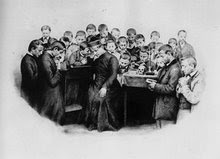
It is ridiculous that a Christian would want to follow a worldly path, he continued. “The worldly spirit kills; it kills people; it kills the Church.”

The Pope then asked the Lord to bestow upon Christians the courage to strip themselves of the spirit of the world, which he called “the leprosy, the cancer of society and the cancer of the revelation of God and the enemy of Jesus.”
He concluded: “I ask the Lord that he gives us all the grace to strip ourselves.”

Sunday, September 29, 2013

A Great Chasm: Scott Hahn Reflects on the Sunday Readings

The following comes from Scott Hahn:

Amos 6:1, 4-7
The rich and powerful are visited with woe and exile in today’s Liturgy - not for their wealth but for their refusal to share it; not for their power but for their indifference to the suffering at their door.
The complacent leaders in today’s First Reading feast on fine foods and wines, reveling while the house of Joseph, the kingdom of Israel (see Amos 5:6), collapses around them.
The rich man in today’s Gospel also lives like a king - dressed in royal purple and fine linen (see 1 Maccabees 8:14).
The rich man symbolizes Israel’s failure to keep the Old Covenant, to heed the commandments of Moses and the prophets. This is the sin of the rulers in today’s First Reading. Born to the nation God favored first, they could claim Abraham as their father. But for their failure to give - their inheritance is taken away.
The rulers are exiled from their homeland. The rich man is punished with an exile far greater - eternity with a “great chasm” fixed between himself and God.
In this world, the rich and powerful make a name for themselves (see Genesis 11:4) and dine sumptuously, while the poor remain anonymous, refused an invitation to their feasts.
But notice that the Lord today knows Lazarus by name, and Joseph in his sufferings - while the leaders and the rich man have no name.
Today’s Liturgy is a call to repentance - to heed the warning of One who was raised from the dead. To lay hold of the eternal life He promises, we must pursue righteousness, keep the commandment of love, as Paul exhorts in today’s Epistle.
“The Lord loves the just,” we sing in today’s Psalm.
And in this Eucharist we have a foretaste of the love that will be ours in the next life - when He will raise the lowly to the heavenly banquet with Abraham and the prophets (see Luke 13:28), where we too will rest our heads on the bosom of our Lord (see John 13:23).
‘Who is the Rich Man’
Very few of us can be numbered among the rich and the powerful who have the power to exploit the poor.
So how are we to apply to our own lives the readings for the 25th and 26th Sundays in Ordinary Time, which are so preoccupied with questions of social justice, wealth and poverty?
These readings remind us that the law of love (see John 15:12; Romans 13:8) means that each of us in some way will be judged by the mercy we show to the poor.
As the rich man learns in the parable of Lazarus - the distance between ourselves and God in the next life may be the distance we put between ourselves and the poor in this life (seeMatthew 25:31-46; James 2:8,14-17).
But we also need to hear these readings in context of the Gospel message in recent months. Recall that among the stories we’ve heard is that of the teacher who wanted to know, “Who is my neighbor?” (see Luke 10:25-37) and of the rich fool who tried to store up earthly treasures (see Luke 12:13-21).
We may not be “rich men” or exploiters of the poor, but each of us should take to heart the persistent message of the Liturgy - that what we have and desire to have can separate us from God and our neighbor; that our possessions can come to possess us; that true riches are to be found in sharing what we have with the poor; and that this will gain us what we truly desire - the inheritance of treasure in heaven.

Friday, September 6, 2013

Mother Teresa and Her Address to Harvard


The following comes from First Things:

Today the Catholic Church celebrates the Feast of Blessed Mother Teresa. A great work to revisit is her famous 1982 Harvard Class Day Address found here.
Yes, there is hunger. Maybe not the hunger for a piece of bread, but there is a terrible hunger for love. There is a terrible hunger for the word of God.
I never forget when we went to Mexico, and we went visiting very poor families. And those people we saw had scarcely anything in their homes, and yet nobody asked for anything. They all asked us: Teach us the word of God. Give us the word of God. “They were hungry for the word of God. Here, too, in the whole world there is a terrible hunger for God, among the young especially. And it is there that we must find Jesus and satisfy that hunger. Nakedness is not only for a piece of cloth. Nakedness is for the loss of that human dignity, the loss of that respect, the loss of that purity that was so beautiful, so great, the loss of that virginity that was the most beautiful thing that a young man and a young woman can give each other because they love each other, the loss of that presence, of what is beautiful, of what is great this is nakedness. Homelessness is not a lack of a home made of bricks, but the feeling of being rejected, being unwanted, having no one to call your own.
I never forget, one day, I was walking down the streets of London and I saw a man sitting there. He looked so sad, so lonely. So I went right up to him. I took his hand and I shook his hand and my hands are always very warm. And he looked up at me and he said: “Oooh, after such a long time I feel the warmth of a human hand.” It was so small that little action was so small and yet it brought a radiating smile on a face that had forgotten to smile, who had forgotten what is the warmth of a human hand. And this is what we have to find in our country, in all other countries around the world, everywhere.
Mother Teresa condemns abortion, speaks of purity and chastity as the greatest gifts young people can give to each other and emphasizes the importance of family in an individualistic world. Over and over, she forces one to consider if social justice can ever be separated from faith. But the best part of her speech is her invitation to contemplate upon the relationship between love and sacrifice, which leads one to holiness:
My prayer for you is that you grow in that love for each other. That you grow in that likeness of Christ, in that holiness of Christ. Holiness is not the luxury of the few; it is a simple duty for you and for me.
For a great piece in response to critics of Mother Teresa, see William Doino Jr.’s post from earlier this year here.

Landfill Harmonic

Thursday, September 5, 2013

The Holy Father’s upcoming encyclical: ‘Blessed Are the Poor’

The following comes from the NCR:


A new encyclical that is being written by Pope Francis will help address how to live out a vow of poverty in the modern world, according to one cardinal.

“How to define poverty is not easy today, because it’s not a question of radical poverty,” Cardinal Prosper Grech, an Augustinian friar, told CNA Sept. 3. “But an encyclical on poverty will help all religious orders to define how to really live poverty in our societies.”

In May, an Italian bishop revealed on his diocesan website that the Holy Father is working on an encyclical entitled “Blessed Are the Poor.”

The Pope’s first encyclical, Lumen Fidei (The Light of Faith), was released in July and drew extensively upon previous work from his predecessor, Benedict XVI.

Cardinal Grech, co-founder of the Institutum Patristicum Augustinianum in Rome, believes that an encyclical would help to “define our stance on poverty.”

The definition of poverty is different depending on where one lives, the 87-year-old friar explained.

“Poverty in Africa means one thing, and poverty in the United States or Europe means another,” he said. “It’s a question of proportion.” He added that a lack of private property is among the root causes of poverty.

Laity will also benefit from the document, he noted.

“We live in such a secularized society,” he explained. “Discos and nightclubs are not the best places to get vocations from.”

In March, Cardinal Grech led the meditation prayer for the conclave that elected Cardinal Jorge Bergoglio as Pope Francis.

After his election, Pope Francis jokingly told Cardinal Grech, “Well, you gave us a very good talk, but just see what has come out of it!”

“Well, we aren’t all infallible like yourself, you know,” Cardinal Grech replied. “We do make mistakes.”

Before his election to the papacy, Cardinal Bergoglio was known for his simple and humble lifestyle when he served as archbishop of Buenos Aires. He would take public transportation, visit the slums and lived in a simple apartment.

As Pope, he has chosen to live in an apartment in the St. Martha House, among Vatican workers, rather than the traditional papal apartments.

Saturday, July 27, 2013

Pope Francis among the urban poor

Monday, July 8, 2013

Pope Francis at Lampedusa: Don't give into the 'globalization of indifference'

The following comes from Rome Reports: 

Pope Francis celebrated Mass in Lampedusa. That's the Italian island, where  dozens of illegal immigrants, arrive every day. The altar itself, was very symbolic. The base was a boat, that was used by group of North African migrants, who fled their native land, inhopes of a better future. 

During his homily, Pope Francis said one should not get accustomed to the suffering of others. He also denounced the 'globalization of indifference.' 


FRANCIS “We see a person, on the brink of death, laying out on the street and we think 'poor man.' Yet we carry on with our day. We think: It's not my responsibility...and we feel justified by this notion.' Who has cried for these people who lost their lives on a boat? For the young mothers who  traveled with their children? For those men, who are looking for means to support their families? We are a society that has forgotten the experience of shedding tears, of suffering amid  the globalization of indifference.” 
The Pope wore his purple papal robes, to mark a penitential ceremony. He asked God for forgiveness in light of the indifference that has dominated this social issue. 

FRANCIS “Lord, we ask  forgiveness, for those who with their laws and decisions have created situations, that have led to these tragedies. Forgive us, Lord.”
Before leaving the Pope thanked the residents of the island. He described them as a light that the world must acknowledge. He also called on both individuals and worldwide leaders to show the same courage, the community of Lampedusa has shown, by welcoming immigrants who flee their countries in search of a better life. 

Thursday, May 23, 2013

Pope Francis praises Missionaries of Charity's 'beautiful' Vatican ministry

Pope Francis thanked the Missionaries of Charity for their work and described one of their houses located inside the Vatican “a beautiful reality” and “a school of charity.”

“I thank all those who in various ways support this beautiful reality of the Vatican,” said Pope Francis during a May 21 evening visit to celebrate the residence’s 25th anniversary.

“This house is a place that teaches charity, a school of charity, that teaches us to go out to every person, not for profit, but out of love,” he stated at the Gift of Mary House.

He noted that “at the border between the Vatican and Italy, it is a powerful reminder to all of us, to the Church, to the city of Rome, to always be more of a family, a home in which we are open to welcome, to attention, and to fraternity.”

Blessed John Paul II placed the house under the care of the sisters on May 21, 1998.

“How many people have you fed in these years, how many wounded, above all wounded spiritually, have you cared for!” he emphasized.

“My presence here tonight is to give first of all my heartfelt thanks to the Missionaries of Charity, founded by Blessed Teresa of Calcutta, working here for 25 years, with many volunteers, in favor of so many people in need of help, thank you!” he told them.

Around 25 homeless women are allowed to live in the residence, and the sisters feed around 60 people each day at the house.

“A home represents the most precious human wealth, that of encounter, that of the relationships between persons of different ages, cultures, and histories who live together and who, together, help one another to grow, and that is what this house has sought to be for 25 years,” said Pope Francis.

Archbishop Georg Gänswein, Prefect of the Papal Household, and Monsignor Alfred Xuereb, the Pope’s personal secretary, accompanied the pontiff on his 5:30 p.m. visit.

The meeting was held in the courtyard located between the Gift of Mary House, the Palace of the Holy Office and the Atrium of the Paul VI Hall.

Cardinal Angelo Comastri and the Mother General of the Missionaries of Charity, Sister Mary Prema Pierick, welcomed Pope Francis.

The sisters then placed a garland of flowers around the Pope’s neck, following Indian tradition.

Over 100 people were also at the house, including its patrons, employees, friends and guests as well as Missionaries of Charity from other different communities around Rome.

The Pope described the homeless women living at the house as its “gift” and “a gift to the Church.”

“You tell us that loving God and our neighbor is not something abstract but profoundly concrete,” he stated.

“It means seeing in every person the face of the Lord to serve and serving him concretely,” he added.

According to the Pope, people everywhere must recover the entire sense of gift, gratuity and solidarity.

“A savage capitalism has taught the logic of profit at any cost, give in order to get, exploitation without looking at persons, and we see the results in the crisis we are living through!” said the pontiff.

Pope Francis noted that another feature of the house is that it is “qualified as a gift of Mary” and she is an example of living charity towards our neighbor, “not out of social duty, but starting from God's love.”

Saturday, April 6, 2013

The message Bergoglio gave to Argentinians who taught catechism in slums