Showing posts with label Palm Sunday. Show all posts

Sunday, April 14, 2019

Passion Sunday: Scott Hahn Reflects on the Passion of the Christ

The following comes from Scott Hahn at the St. Paul Center for Biblical Theology:

What is written about Me is coming to fulfillment,” Jesus says in today’s Gospel (see Luke 22:37).
Indeed, we have reached the climax of the liturgical year, the highest peak of salvation history, when all that has been anticipated and promised is to be fulfilled.
By the close of today’s long Gospel, the work of our redemption will have been accomplished, the new covenant will be written in the blood of His broken body hanging on the cross at the place called the Skull.
In His Passion, Jesus is “counted among the wicked,” as Isaiah had foretold (see Isaiah 53:12). He is revealed definitively as the Suffering Servant the prophet announced, the long-awaited Messiah whose words of obedience and faith ring out in today’s First Reading and Psalm.
The taunts and torments we hear in these two readings punctuate the Gospel as Jesus is beaten and mocked (see Luke 22:63-65; 23:10-11,16), as His hands and feet are pierced (see Luke 23:33), as enemies gamble for His clothes ( see Luke 23:34), and as three times they dare Him to prove His divinity by saving Himself from suffering (see Luke 23:35,37,39)
He remains faithful to God’s will to the end, does not turn back in His trial. He gives Himself freely to His torturers, confident that, as He speaks in today’s First Reading: “The Lord God is My help…I shall not be put to shame.”
Destined to sin and death as children of Adam’s disobedience, we have been set free for holiness and life by Christ’s perfect obedience to the Father’s will (see Romans 5:12-14,17-19; Ephesians 2:2; 5:6).
This is why God greatly exalted Him. This is why we have salvation in His Name. Following His example of humble obedience in the trials and crosses of our lives, we know we will never be forsaken, that one day we too will be with Him in Paradise (see Luke 23:42). Seeing and Believing

Sunday, March 25, 2018

Palm Sunday: The Victory of Humility

The following comes from the The Crossroads Initiative: 

Palm Sunday -- When a conquering hero of the ancient world rode into town in triumph, it was in a regal chariot or on the back of a stately stallion.  Legions of soldiers accompanied him in the victory procession.  Triumphal arches, festooned with relief sculptures, were often erected to immortalize his valiant victory.

After driving out demons, healing the sick, and raising the dead, it was time for the King of Kings to enter the Holy City.  But to do so, he rode not on the back of a warhorse, but a donkey. His companions accompanied him brandishing not swords, but palm branches.  The monument to his victory, erected a week later, was not an arch, but a crucifix.

His earthly beginning was frightfully humble.  And his earthly end would be no different.  The wood of the manger prefigured the wood of the cross.

From beginning to end, the details are humiliating.  No room in the inn.  Born amidst the stench of a stable.  Hunted by Herod’s henchmen.  Growing up in a far-flung province of the Roman Empire--Galilee, the land where the country accent is so thick, you can cut it with a knife.  How it that the high priest’s servant-girl knew Peter was a disciple of Jesus?  His hillbilly accent gave him away (Matthew 26:73).  Jesus disciples were not cultured, learned men of ability.  They were drawn from the low-life of a backwater region…

When one of his closest companions offered to betray him, he did not require millions.  Jesus’ worth was reckoned to be no more than the Old Testament “book value” for a slave--thirty pieces of silver (Ex 21;32).  When he was finally handed over to the Romans, he was not given the punishment meted out to Roman citizens.  Beheading was the quick, dignified way to execute someone of any standing.  Instead Jesus was given punishments reserved only for slaves and rebellious members of subjugated peoples – flagellation and crucifixion.  These two penalties were not just about the pain, but about the humiliation.  In first century Palestine, men and women typically covered themselves from head to toe, even in the scorching heat.  A crucified man was stripped naked and put on display for all to see.

But this is not primary a story of violence and humiliation.  The events of Holy Week are much more about love and humility.

That’s why on Passion Sunday we read the powerful words of Paul’s letter from the Philippians (2:6-11).  Though the Divine Word was God, dwelling in the serene heights of heavenly glory, he freely plunged to the depths of human misery, joining himself to our frail nature, entering into our turbulent world.  As if this act of humility were not enough, he further humbled himself, accepting the status of a slave.  His act of stooping down to wash the feet of his disciples (Jn 13) was a parable of his whole human existence, for this act was regarded as so undignified that not even Israelite slaves could be compelled to do it.

But that’s just it.  Jesus was not compelled to do it.  He willingly lowered himself in his birth, in his ministry, in his death.  No one took his life from him.  He freely laid down his own life (Jn 10:18).  Others did not have the chance to humble him; he humbled himself.

It had to be so.  The Second Adam had to undo the damage caused by the first.  What was the sin our first parents?  They disobeyed because they wanted to know what God knew, to be like God, to exalt themselves over God (Gen 3).  They were bitten by the Serpent, and injected with the deadly venom of Pride.  The antidote, the anti-venom could only be humility.  The foot-washing, donkey-riding New Adam would crush the head of the deadly serpent by means of loving, humble obedience. 

The first-born of many brothers lowered himself to the dust from which the First Adam has been made–indeed humility comes from the word “humus.” But God responded to his humility by exalting him far above Caesars, kings, and even Hollywood stars.  And he invites us to share his glory with him.  But first we must walk on his road to glory, the royal road of the cross.

Wednesday, March 23, 2016

Fr. George Rutler: The Paradox of Christ's Passion

The following comes from Fr. George Rutler:

There is a moral difference between sight and perception, just as there is between height and stature. Someone with 20/20 vision may be blind to reality, and a very tall man may be a moral midget. There is also a difference between clock time, which measures days, and moral time which measures destiny. When Christ said, “The hour has come for the Son of Man to be glorified” (John 12:23), He was not looking at an hour glass but at the Cross. That is why he prayed, “Yet what should I say? ‘Father save me from this hour’? But it was for this purpose that I came to this hour” (John 12:27).


Time can drag when there is nothing to do, but it speeds by when there is a goal to be met. In His human nature, Christ was “troubled” because he could anticipate the physical pain ahead, and He knew that it would peak chronologically at High Noon on Friday, but his moral victory was already secured in another kind of time: “Now is the time of judgment on this world; now the ruler of this world will be driven out” (John 12:31). Satan, of whom He speaks, had tried to block this hour because he thinks only in terms of daily existence rather than eternal life.


From this perspective, our Lord meant more than physical distance when he spoke of going “up” to Jerusalem. The Sea of Galilee is about 700 feet below sea level, the lowest fresh-water lake in the world. Jerusalem is 2500 feet above sea level, and the “hill” of Calvary added a few more feet to that, and the Cross was high on top of that hill. But He would be lifted beyond measure: “And when I am lifted up from the earth, I will draw everyone to myself” (John 12:32).


The paradox of Christ's Passion is that he had to go down in order to go up: “Unless a grain of wheat falls to the ground and dies, it remains just a grain of wheat; but if it dies, it produces much fruit” (John 12:24). He spoke shockingly of losing our life if we love it and preserving it for eternal life if we hate it (cf. John 12:25). By hatred He meant neglect of the moral measure of what we are. To try to preserve existence and attain great heights without risking our lives and being humbled for the sake of love, is simply to shrivel up. In a spiritual journal that George Washington faithfully kept, he prayed for protection against “an unwillingness to depart this life” which would cast him “into a spiritual slumber.”


Our Lord entered Jerusalem to battle more than a human enemy, and on an immeasurable scale he won the greatest of all victories when the Hour came.

Sunday, March 20, 2016

Bishop Robert Barron on Palm Sunday

Sunday, March 29, 2015

Fr. Robert Barron: On Palm Sunday

Monday, April 14, 2014

Pope Francis on Palm Sunday: "Has my life fallen asleep?"

(Vatican Radio) Pope Francis celebrated Palm Sunday in a packed St. Peter's Square calling on the faithful to look into their own hearts to see how they are living their lives.

With the some 100,000 people present to be with the Pope and mark the beginning of Holy Week, the Pope listened to the Gospel account of how Jesus’s disciples fell asleep just before he was betrayed byJudas before his crucifixion and then said: “Has my life fallen asleep?'' “Am I like Pontius Pilate, who, when he sees the situation is difficult, washes my hands?''

And speaking off the cuff instead of following his prepared homily, Pope Francis asked: “Where is my heart?'' pinpointing it as the “question which accompanies us'' throughout Holy Week.

After the ceremony Pope Francis disrobed of his red vestments, chatted to those close to him, and posed for “selfies”' with young people from Rio de Janeiro who had carried a large cross in the square. 

For the occasion the Pope used a wooden pastoral staff carved by Italian prison inmates.

Sunday, March 24, 2013

Palm Sunday with Pope Francis


Sunday, April 1, 2012

Adsis mihi O Maria

Pope Benedict: Praise the Lord with Gratitude


The following comes from the CNA:

Christians should welcome Jesus by laying down their lives for him in the same way the people of Jerusalem once laid down their coats and palm branches, Pope Benedict XVI said in his Palm Sunday homily.

“Before Christ, we must spread out our lives, ourselves, in an attitude of gratitude and adoration,” he said April 1.

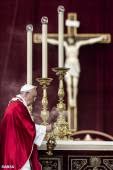
The Pope presided at Palm Sunday Mass in St. Peter’s Square. Tens of thousands of pilgrims joined him beneath a cloudy Roman sky to mark the beginning of Holy Week. The ceremonies opened with the traditional procession of cardinals carrying braided palms, followed by the Pope himself.

The Pope told the open-air congregation that the next seven days should call forth two sentiments: praise and thanksgiving. This is because “in this Holy Week the Lord Jesus will renew the greatest gift we could possibly imagine: he will give us his life, his body and his blood, his love.”

“But we must respond worthily to so great a gift” he said. Christians must respond “with the gift of ourselves, our time, our prayer, our entering into a profound communion of love with Christ who suffered, died and rose for us.”

The Pope explained why the “great multitude” who accompanied Christ’s arrival into Jerusalem on that first Palm Sunday reacted in the way they did.

Jesus, he said, arrived in Jerusalem from Bethphage and the Mount of Olives which was “the route by which the Messiah was supposed to come.” The crowd’s sense of expectation was raised further when Christ paused near Jericho to heal the blind beggar Bartimaeus, who acclaimed him as the “Son of David”.

“And so it was that, after this miraculous sign, accompanied by the cry ‘Son of David,’ a tremor of Messianic hope spread through the crowd, causing many of them to ask: this Jesus, going ahead of us towards Jerusalem, could he be the Messiah, the new David?”

Thus when Jesus reached Jerusalem the crowd tore branches from the trees and began to shout passages from Psalm 118. These “ancient pilgrim blessings” took on the character of messianic proclamation:

“Hosanna! Blessed is he who comes in the name of the Lord! Blessed is the kingdom of our father David that is coming! Hosanna in the highest!” the Pope summarized.

The Pope said this festive acclamation, which is recorded by all four Gospels, is “a cry of blessing, a hymn of exultation” which “expresses the unanimous conviction that, in Jesus, God has visited his people and the longed-for Messiah has finally come.”

In the person of Jesus Christ the cheering crowds saw the fulfillment of the ancient promise, given by God to Abraham, that “by you all the families of the earth shall bless themselves.”

“Thus, in the light of Christ, humanity sees itself profoundly united and, as it were, enfolded within the cloak of divine blessing, a blessing that permeates, sustains, redeems and sanctifies all things,” said Pope Benedict.

The “first great message” of Palm Sunday is an invitation to adopt a proper outlook on humanity and its different cultures and civilizations.

“The look that the believer receives from Christ is a look of blessing,” he said. It is a “wise and loving look, capable of grasping the world’s beauty and having compassion on its fragility.”

Quickly, however, the excitement of the Jerusalem crowd turned to disappointment as Jesus did not fit their own idea of how “the long-awaited King promised by the prophets should act.” And so, only a few days later, “instead of acclaiming Jesus, the Jerusalem crowd will cry out to Pilate: Crucify him!”

The Pope said that this question of Jesus’ identity is at the heart of today’s feast.

“What idea do we have of the Messiah, what idea do we have of God?” he asked. “It is a crucial question, one we cannot avoid, not least because during this very week we are called to follow our King who chooses the Cross as his throne.”

“We are called to follow a Messiah who promises us, not a facile earthly happiness, but the happiness of heaven, divine beatitude.”

Pope Benedict urged pilgrims, and particularly the young people present for today’s World Youth Day, to make the decision to “say yes to the Lord and to follow him all the way, the decision to make his Passover, his death and resurrection, the very focus of your Christian lives.”

He promised them that this decision is one that leads to “true joy.”

At the conclusion of Mass the Pope prayed the traditional midday Angelus with the gathered pilgrims and wished them well for the next seven days.

“This Holy Week, may we be moved again by Christ’s passion and death, put our sins behind us and, with God’s grace, choose a life of love and service to our brethren.”

As the dark clouds above St. Peter's Square turned to sunshine, he then made his way around St. Peter’s Square by Popemobile and blessed the cheering crowds as he went.

Pope Benedict Celebrates Palm Sunday


The following comes from the AP:

Pope Benedict XVI has kicked off the Catholic Church's Holy Week celebrations with Palm Sunday Mass in St. Peter's Square and good news from Cuba.

Cuba's communist government on Saturday agreed to Benedict's request to make Good Friday a holiday, a request made during his visit to the Caribbean island last week. The day, which is celebrated this Friday, marks the solemn commemoration of Christ's death.

On Sunday, Benedict traveled into St. Peter's Square on the back of a white jeep at the start of Palm Sunday Mass, which marks Jesus' arrival in Jerusalem and inaugurates Holy Week.

Benedict and the cardinals who proceeded him clutched ornately braided palm fronds, while ordinary faithful carried olive and palm branches to recreate the welcome Jesus received. St. Peter's was nearly full under cloudy, chilly skies.

The pope looked rested despite having just returned from an exhausting, six-day trip to Mexico and Cuba, where he met with former and present Cuban presidents, Fidel Castro and his brother, Raul.

It was during the meeting with Raul Castro that Benedict asked that Good Friday be made a holiday, even though it isn't celebrated as such in most of Europe and Latin America.

One of the aims of Benedict's trip was to help the local church, which has been sidelined during 30 years of official atheism that ended only in 1992.

After Pope John Paul II's historic 1998 visit to Cuba, the authorities agreed to make Christmas a holiday. Cuba said Saturday a decision on whether to make Good Friday a similarly permanent holiday would be made later.

The pope, who turns 85 in two weeks, has a busy Holy Week ahead of him, with public services Thursday through Easter Sunday.

Benedict directed his Palm Sunday homily to young people, urging them to welcome Christ into their lives as the people of Jerusalem welcomed him.

"May Palm Sunday be a day of decision for you, the decision to say yes to the Lord and to follow him all the way," he said.

Fr. Robert Barron on Palm Sunday