The following comes from the Salesian News Agency:
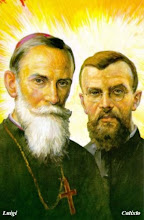
From the same village as Don Bosco, he was the third of four children. The last one, his Sister Marianna, would become the mother of Blessed Joseph Allamano, founder of the two branches of the Consolata Missionaries. He was born on 15 January 1811 in a nineteenth century Piedmont marked by serious social problems but also by so many saints who strove to remedy them. They were linked to one other by a total love for Christ and profound love for the poor: the grace of God knows how to sow and multiply the seeds of holiness.
Having entered the Convitto Ecclesiastico in Turin he remained there for the rest of his life, constantly engaged in the formation of priests and the teaching of moral theology, and exercising his ministry in the confessional and on behalf of the those least considered with a special regard for prisoners and those condemned to death.
From the very beginning he helped Don Bosco materially and spiritually: he was his spiritual director between 1841 and 1860, supporting and defending him with his moral authority. He died at 49 on 23 June 1860. In the funeral oration Don Bosco spoke of him as a model of priestly life, teacher of the clergy, sought-after guide, consoler of the afflicted, comforter of the dying, a friend to all.
On 23 June 1947 Pius XII declared him a saint.
This anniversary is particularly significant for all the Salesian Family in this year dedicated to the fostering and accompaniment of vocations, giving a special place to spiritual direction. Last year, celebrating the year of the priest, Pope Benedict XVI in his weekly catechesis on 30 June, spoke in this way about the relationship of spiritual guide between Don Cafasso and Don Bosco: “Among them as I have said emerges St John Bosco who had him as his spiritual director for a good 25 years, from 1835 to 1860: first as a seminarian, then as a priest and lastly as a Founder”.
“In all the fundamental decisions of his life St John Bosco had St Joseph Cafasso to advise him, but in a very specific way: Cafasso never sought to form Don Bosco as a disciple "in his own image and likeness", and Don Bosco did not copy Cafasso; he imitated Cafasso`s human and priestly virtues, certainly and described him as "a model of priestly life" but according to his own personal disposition and his own specific vocation; a sign of the wisdom of the spiritual teacher and of the intelligence of the disciple: the former did not impose himself on the latter but respected his personality and helped him to interpret God`s will for him.”
“Dear friends, this is a valuable lesson for all who are involved in the formation and education of the young generations and also a strong reminder of how important it is to have a spiritual guide in one`s life, who helps one to understand what God expects of each of us”.
Showing posts with label Don Bosco. Show all posts
Wednesday, June 23, 2021
Friday, January 31, 2020
Today the Church honors St. John Bosco's life of charity
The following comes from the CNA:
On Jan. 31, the Roman Catholic Church honors St. John Bosco (or “Don Bosco”), a 19th century Italian priest who reached out to young people to remedy their lack of education, opportunities, and faith.
John Bosco was born in August of 1815 into a family of peasant farmers in Castelnuovo d'Asti – a place which would one day be renamed in the saint's honor as “Castelnuovo Don Bosco.”
John's father died when he was two years old, but he drew strength from his mother Margherita's deep faith in God.
Margherita also taught her son the importance of charity, using portions of her own modest means to support those in even greater need. John desired to pass on to his own young friends the example of Christian discipleship that he learned from his mother.
At age nine, he had a prophetic dream in which a number of unruly young boys were uttering words of blasphemy. Jesus Christ and the Virgin Mary appeared to John in the dream, saying he would bring such youths to God through the virtues of humility and charity.
Later on, this dream would help John to discern his calling as a priest. But he also sought to follow the advice of Jesus and Mary while still a boy: he would entertain his peers with juggling, acrobatics, and magic tricks, before explaining a sermon he had heard, or leading them in praying the Rosary.
John's older brother Anthony opposed his plan to be a priest, and antagonized him so much that he left home to become a farm worker at age 12. After moving back home three years later, John worked in various trades and finished school in order to attend seminary.
In 1841, John Bosco was ordained a priest. From that time, John was known as “Don” Bosco, a traditional Italian title of honor for priests. In the city of Turin, he began ministering to boys and young men who lived on the streets, many of whom were without work or education.
The industrial revolution had drawn large numbers of people into the city to look for work that was frequently grueling and sometimes scarce. Don Bosco was shocked to see how many boys ended up in prison before the age of 18, left to starve spiritually and sometimes physically.
The priest was determined to save as many young people as he could from a life of degradation. He established a group known as the Oratory of St. Francis de Sales, and became a kindly spiritual father to boys in need. His aging mother helped support the project in its early years.
John's boyhood dream came to pass: he became a spiritual guide and provider along with his fellow Salesian priests and brothers, giving boys religious instruction, lodging, education, and work opportunities. He also helped Saint Mary Dominic Mazzarello form a similar group for girls.
This success did not come easily, as the priest struggled to find reliable accommodations and support for his ambitious apostolate. Italy's nationalist movement made life difficult for religious orders, and its anti-clerical attitudes even led to assassination attempts against Don Bosco.
But such hostility did not stop the Salesians from expanding in Europe and beyond. They were helping 130,000 children in 250 houses by the end of Don Bosco's life. “I have done nothing by myself,” he stated, saying it was “Our Lady who has done everything” through her intercession with God.
St. John Bosco died in the early hours of Jan. 31, 1888, after conveying a message: “Tell the boys that I shall be waiting for them all in Paradise.” He was canonized on Easter Sunday of 1934, and is a patron saint of young people, apprentices, and Catholic publishers and editors.
Wednesday, January 31, 2018
An Interview with Saint John Bosco
A unique event marks the year 1884 in the life of Don Bosco. He gives his first and only press interview to a French journalist writing for the Journal de Rome. An excerpt of this historic event is reproduced below:
"Reporter: By what miracle have you been able to found so many houses in so many different countries?
Don Bosco: I have done far more than I hoped, but I don't know how. The Blessed Virgin knows our needs, and She helps us.
Reporter: How does She help you?
Don Bosco: For instance. Once I received a letter from Rome saying that the building of the Sacred Heart needed 20,000 lire within a week. At that moment I had no money. I left the letter by the holy water stoop, fervently prayed to the Blessed Virgin and went to sleep, leaving the matter in Her hand Next morning I received a letter from an unknown person. "I had made a vow to Our Lady. In exchange for a certain favour I would give 20,000 lire." On another occasion I was in France. There I got the unpleasant news that one of my houses was in dire straits unless 70,000 lire were found at once. I could see no solution, so I prayed. I was about to go to bed at 10:00 pm when someone knocked. It was a friend of mine with a thick file in his hands. "Don Bosco, in my will I had assigned 70,000 lire for your works. But today it occurred to me that it is better not to wait for death in order to do good. I've brought it to you. Here is 70,000 lire."
Reporter: These are miracles. May I indiscreetly ask you whether you have performed miracles yourself?
Don Bosco: I have only thought of doing my duty. I have prayed and trusted in the Madonna.
Reporter: Don Bosco, could you comment on your educational philosophy and the methods you use in your schools that are so much admired? How do you manage to maintain discipline when dealing with so many boys?
Don Bosco: The Salesian way of educating the young is quite simple. Basically, I insist on letting boys be boys. Let them play and enjoy themselves as much as they want as long as God is not offended. But if I have a philosophy of education, it consists in discovering a boy’s best qualities and then exploiting them to his advantage. You must admit, sir, that any person is at his best when he is doing what he likes and does best. Children are the same. Promote their positive qualities and they will thrive. As for discipline—love and respect for the young is the answer. In the 46 years I have worked among children, never once have I had to resort to corporal punishment, which by the way is very much in vogue. And if I may say so, all those children who have come under my care have always continued to show me their love and respect.
Reporter: Let me ask about your mission work in foreign lands. How have you managed to reach such faraway places as Patagonia and Tierra del Fuego?
Don Bosco: Well, honestly, we got that far by taking one step at a time."
Reporter: What do you think of the present conditions of the Church in Europe and in Italy? How do you see the future?
Don Bosco: I'm no prophet. You journalists are, a bit. You should be asked that. Nobody but God knows the future. Nevertheless, humanly speaking, the future seems bleak. My forecast is very sad, but I'm not afraid. God will always save his Church, and our Lady, who visibly protects the contemporary world, will make redeemers arise.
(From Teresio Bosco's book "Don Bosco")
Thursday, December 7, 2017
Novena to the Immaculate Conception: Day 9
Don Bosco Credited all his achievements to the Blessed Virgin; in his sermons and talks he kept repeating that all the success of the Oratory and the Congregation was due to Mary's goodness. Throughout his life he never took an important step without first entrusting his plans to her protection.
Hail, Holy Queen, Mother of Mercy,
our Life, our Sweetness, and our Hope.
To Thee do we cry, poor banished children of Eve.
To Thee do we send up our sighs mourning
and weeping in this valley of tears.
Turn then, most gracious Advocate,
Thine Eyes of Mercy toward us,
and after this our exile show us the
Blessed Fruit of thy Womb, Jesus.
O clement, O loving, O sweet Virgin Mary.
O Mary, conceived without sin
Pray for us who have recourse to thee!
Wednesday, December 6, 2017
Novena to the Immaculate Conception: Day 8
The boys often said among themselves: "Don Bosco must be very influential with Our Lady because she obtains so many favors for him!"
Hail, Holy Queen, Mother of Mercy,
our Life, our Sweetness, and our Hope.
To Thee do we cry, poor banished children of Eve.
To Thee do we send up our sighs mourning
and weeping in this valley of tears.
Turn then, most gracious Advocate,
Thine Eyes of Mercy toward us,
and after this our exile show us the
Blessed Fruit of thy Womb, Jesus.
O clement, O loving, O sweet Virgin Mary.
our Life, our Sweetness, and our Hope.
To Thee do we cry, poor banished children of Eve.
To Thee do we send up our sighs mourning
and weeping in this valley of tears.
Turn then, most gracious Advocate,
Thine Eyes of Mercy toward us,
and after this our exile show us the
Blessed Fruit of thy Womb, Jesus.
O clement, O loving, O sweet Virgin Mary.
O Mary, conceived without sin
Pray for us who have recourse to thee!
Tuesday, December 5, 2017
Novena to the Immaculate Conception: Day 7
With his usual zeal, Dominic Savio selected several of hs most trusted friends and asked them to join him in founding a sodality to be called the Immaculate Conception Sodality. Its purpose was to seek the protection of the Mother of God in life and especially at the hour of death by promoting practices of piety in honor of Mary Immaculate as well as frequent communion. This initiative greatly consoled Don Bosco.
Hail, Holy Queen, Mother of Mercy,
our Life, our Sweetness, and our Hope.
To Thee do we cry, poor banished children of Eve.
To Thee do we send up our sighs mourning
and weeping in this valley of tears.
Turn then, most gracious Advocate,
Thine Eyes of Mercy toward us,
and after this our exile show us the
Blessed Fruit of thy Womb, Jesus.
O clement, O loving, O sweet Virgin Mary.
O Mary, conceived without sin
Pray for us who have recourse to thee!
Monday, December 4, 2017
Novena to the Immaculate Conception: Day 6
Once the plague (cholera) had completely spent itself in the city and its environs, Don Bosco wanted his boys to show their gratitude to God for having protected them so lovingly. As a day of thanksgiving, he chose December 8th, 1854, the Feast of the Immaculate Conception, the very day when Pope Pius IX would solemnly proclaim the dogma in St. Peter's Basilica!
Hail, Holy Queen, Mother of Mercy,
our Life, our Sweetness, and our Hope.
To Thee do we cry, poor banished children of Eve.
To Thee do we send up our sighs mourning
and weeping in this valley of tears.
Turn then, most gracious Advocate,
Thine Eyes of Mercy toward us,
and after this our exile show us the
Blessed Fruit of thy Womb, Jesus.
O clement, O loving, O sweet Virgin Mary.
O Mary, conceived without sin
Pray for us who have recourse to thee!
Sunday, December 3, 2017
Novena to The Immaculate Conception: Day 5
When giving his personal blessing Don Bosco invoked the powerful protection of Mary upon those present or far away. He claimed credit for nothing and kept repeating: "How good Our Lady is!"
Hail, Holy Queen, Mother of Mercy,
our Life, our Sweetness, and our Hope.
To Thee do we cry, poor banished children of Eve.
To Thee do we send up our sighs mourning
and weeping in this valley of tears.
Turn then, most gracious Advocate,
Thine Eyes of Mercy toward us,
and after this our exile show us the
Blessed Fruit of thy Womb, Jesus.
O clement, O loving, O sweet Virgin Mary.
O Mary, conceived without sin
Pray for us who have recourse to thee!
Saturday, December 2, 2017
Novena to The Immaculate Conception: Day 4
As a matter of policy, Don Bosco always began, pursued, and completed his undertakings by invoking her aid.
Hail, Holy Queen, Mother of Mercy,
our Life, our Sweetness, and our Hope.
To Thee do we cry, poor banished children of Eve.
To Thee do we send up our sighs mourning
and weeping in this valley of tears.
Turn then, most gracious Advocate,
Thine Eyes of Mercy toward us,
and after this our exile show us the
Blessed Fruit of thy Womb, Jesus.
O clement, O loving, O sweet Virgin Mary.
O Mary, conceived without sin
Pray for us who have recourse to thee!
Friday, December 1, 2017
Novena to The Immaculate Conception: Day 3
Don Bosco urged the festive oratory boys to say the rosary daily. Rather than have them omit it for lack of time he asked them to say it while at work or on their way to and from the shops. He maintained that the rosary was a wonderful means for acquiring the virtue of purity and a suer protection against the snares of the devil.
Hail, Holy Queen, Mother of Mercy,
our Life, our Sweetness, and our Hope.
To Thee do we cry, poor banished children of Eve.
To Thee do we send up our sighs mourning
and weeping in this valley of tears.
Turn then, most gracious Advocate,
Thine Eyes of Mercy toward us,
and after this our exile show us the
Blessed Fruit of thy Womb, Jesus.
O clement, O loving, O sweet Virgin Mary.
O Mary, conceived without sin
Pray for us who have recourse to thee!
Thursday, November 30, 2017
Novena to The Immaculate Conception: Day 2
No one could adequately describe Don Bosco's love for Our Lady. His devotion to her came second only to his devotion to the Blessed Sacrament and he continually fostered it with visible filial love, whether preaching, hearing confessions, or talking informally. He seemed to live only for her. He often visited her shrines, and he always had a supply of medals and holy pictures to give away especially to children. As they crowded about him, he urged them to wear the medals devoutly and pray every day to the Blessed Virgin.
Hail, Holy Queen, Mother of Mercy,
our Life, our Sweetness, and our Hope.
To Thee do we cry, poor banished children of Eve.
To Thee do we send up our sighs mourning
and weeping in this valley of tears.
Turn then, most gracious Advocate,
Thine Eyes of Mercy toward us,
and after this our exile show us the
Blessed Fruit of thy Womb, Jesus.
O clement, O loving, O sweet Virgin Mary.
O Mary, conceived without sin
Pray for us who have recourse to thee!
Wednesday, November 29, 2017
Novena to the Immaculate Conception: Day 1
For Don Bosco the promulgation of the dogma of the Immaculate Conception had been the answer to many prayers and Masses he had said to hasten this long awaited definition. Now he continued to pray to and thank the Lord for having so glorified the Queen of Angels and men. The Feast of the Immaculate Conception became his favorite feast!
Hail, Holy Queen, Mother of Mercy,
our Life, our Sweetness, and our Hope.
To Thee do we cry, poor banished children of Eve.
To Thee do we send up our sighs mourning
and weeping in this valley of tears.
Turn then, most gracious Advocate,
Thine Eyes of Mercy toward us,
and after this our exile show us the
Blessed Fruit of thy Womb, Jesus.
O clement, O loving, O sweet Virgin Mary.
O Mary, conceived without sin
Pray for us who have recourse to thee!
Sunday, October 2, 2016
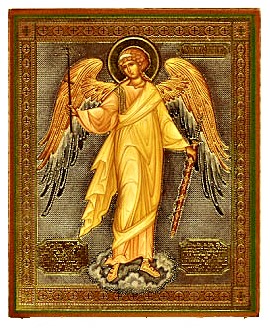
Don Bosco on Guardian Angels
If you should be in any danger,
of soul or body,
call on your Guardian Angel;
and I assure you that
he will help you and free you.
St. John Bosco
Tuesday, August 30, 2016
Pilgrimage to Turin, Rome and Assisi: Days 1 and 2
Greetings from Turin, Italy! I am currently finishing day 2 of my pilgrimage to Turin, Rome and Assisi and have had a full day. Fr. Steve Shafran and I arrived yesterday morning to Rome and flew to Turin in the afternoon. After arriving here in Valdocco we found our rooms inside the Basilica of Mary Help of Christians! I literally slept in a room in Don Bosco's great Basilica to Our Lady! I know this is a great blessing. We spent some time around the Basilica, and were able to have mass in the Pinardi Chapel. I was able to celebrate mass in that humble first home for Don Bosco's Oratory. After dinner with the community we walked in to town for an excellent gelato! On the way home we were hit with a storm. This storm felt more like a deluge and was accompanied by golfball sized hail! We arrived back to the Basilica soaking wet! Needless to say it was a great but tiring first day!
Today was another day filled with blessings! We began the day with a visit to Don Bosco's rooms and were able to have mass at one of the altars that Don Bosco used for many years in his mission to the young in Valdocco. It was the exact spot where some of the oratory boys witnessed Don Bosco levitate during his daily mass! What great devotion to the Holy Eucharist! After mass and lunch with the community we had an opportunity to join the director of the house on a walk to the Church of St. Francis of Assisi. This Church is of great importance to us Salesians! It is the sight of Don Bosco's first mass as a newly ordained priest! Also the site of the Convitto Ecclesiastico where Don Bosco studied pastoral ministry for 3 years as a student of St. Joseph Cafasso. Don Cafasso was Don Bosco's confessor and spiritual guide for almost 30 years! Don Cafasso spent almost all of his priesthood in this holy place and where he heard countless confessions. Don Cafasso literally taught Don Bosco how to be a priest in the Convitto located next to this church.
It was in the Sacristy of the Church of St. Francis of Assisi that Don Bosco met young Bartholomew Garelli and invited him to learn his catechism. He said one Hail Mary with him and from there Don Bosco began his work for poor youth and the Salesian Oratory! 30 days after the death of Don Cafasso, Don Bosco delivered the sermon reminding everyone of the great virtues of Don Cafasso.
After our visit to St. Francis of Assisi we visited the Sanctuary of Our Lady of Consolation (Consolata). This is the church where Don Bosco went to pray after the death of Mamma Margaret. He invited Our Lady to be his mother and assist him with the work of the oratory! St. Joseph Cafasso is buried here in this beautiful church.
Then we walked down to the Church of Divine Providence and the tomb of St. Joseph Cottolengo. St. Joseph founded 5 institutes to care for the needs of the poor and the sick. So many saints lived and worked in such close proximity to one another!
Fr. Steve and I joined the community again for prayers and dinner and made another pilgrimage for gelato! Needless to say we had a full and blessed day. I will try to keep you posted on the days events every day of the coming week! Thank God for the internet! Please continue to pray for us and know of my prayers for all of you! God is blessing us in this year of mercy!
Labels:
Don Bosco,
Salesians,
Turin,
Year of Mercy Pilgrimage
Location:
Torino, Italy
Sunday, August 21, 2016
Don Bosco's Popes: St. Pius X
The following comes from SDB.org:
Joseph Sarto was born at Riese (Treviso) on 2nd June 1835. He was elected Pope on 4th August 1903. He died on 20th August 1914 and was canonised on 29th May 1954. Not just as Pope, but also as priest, bishop and patriarch, he gave evidence of his good will towards the Salesian Society When he was a Canon, he met with the Founder in Turin on 15th August 1875; he sat at table with the Saint, was enrolled amongst the Salesian Cooperators and left much edified. A few days after he became Pope, he sent Don Rua a letter with a blessing on the Salesian Society. On 23rd July 1907 he signed the decree introducing the apostolic process for John Bosco, and on the 10th February 1914, did the same for Dominic Savio. In 1903 he promoted Bishop Cagliero as the titular Archbishop of Sebaste and in 1908 nominated him as Apostolic Delegate to Central America. He was the first Salesian Cooperator to be elevated to the honour of the Altars.
Tuesday, May 24, 2016
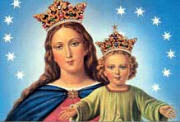
Feast of Mary, Help of Christians!
The following comes from the CNA:
The Feast of Mary Help of Christians is celebrated on May 24.
The tradition of this advocation goes back to 1571, when the whole of Christendom was saved by Mary Help of Christians when Catholics throughout Europe prayed the Rosary. The great battle of Lepanto occurred on October 7th 1571. For this reason this date has been chosen as the feast of the Holy Rosary. In 1573 Pope Pius V instituted the feast in thanksgiving for the decisive victory of Christianity over Islamism.
Near the end of the 17th century, Emperor Leopold I of Austria took refuge in the Shrine of Mary Help of Christians at Pasau, when 200,000 Ottoman Turks besieged the capital city of Vienna, but a great victory occurred thanks to Mary Help of Christians: on September 8th, Feast of Our Lady's Birthday, plans were drawn for the battle. On September 12, Feast of the Holy Name of Mary, Vienna was finally freed through the intercession of Mary Help of Christians. All Europe had joined with the Emperor crying out "Mary, Help!" and praying the Holy rosary.
In 1809, Napoleon's men entered the Vatican, arrested Pius VII and brought him in chains to Grenoble, and eventually Fontainbleau. His imprisonment lasted five years. The Holy Father vowed to God that , if he were restored to the Roman See, he would institute a special feast in honor of Mary. Military reverses forced Napoleon to release the Pope, and on May 24th 1814, Pius VII returned in triumph to Rome. Twelve months later, the Pope decreed that the feast of Mary Help of Christians, be kept on the 24th of May.
St. John Bosco (1815 - 1888) was a dynamic priest who founded the Salesian Order in the XIX century in Italy. His many prophetic dreams, beginning at age nine, guided his ministry and gave insights on future events.
On May 14, 1862, Don Bosco dreamed about the battles the Church would face in the latter days. In his dream, the Pope of those days anchors the 'ship' of the Church between two pillars, one with a statue of Mary (Auxilium Christianorum or 'Help of Christians') and the other with a large Eucharistic Host
St. John Bosco wrote about his congregation, the Salesians: "The principal objective is to promote veneration of the Blessed Sacrament and devotion to Mary Help of Christians. This title seems to please the august Queen of Heaven very much."
The Salesian Sisters of St John Bosco or Daughters of Mary Help of Christians, are the sister order of the Salesians of Don Bosco.
St. John Bosco, himself, on June 9 1868, dedicated to Our Lady Help of Christians, the mother church of his congregation at Turin (Italy). The Salesian Fathers and their Sisters have carried the devotion to their numerous establishments.
Thursday, April 21, 2016
DON BOSCO: IT’S ABOUT EVIL TREMBLING IN FRONT OF THE GOOD, & NOT THE OTHER WAY AROUND
DON BOSCO
NARRATES:
I was a lively and attentive boy who, with
Mom’s permission, went to the various festivals where there were acrobats and
magicians. I always put myself in the front row, eyes fixed on their movements
with which they tried to distract the audience. Little by little I could see
their tricks; returning home, I repeated them for hours. But often the moves
didn’t produce the desired effect. It wasn’t easy to walk on that blessed rope strung
between two trees. How many tumbles, how many skinned knees! And how many times
I was wanted to throw everything into the air! Then I’d start again, sweaty,
tired, sometimes even disappointed. Then, a little by little, I was able to get
it together; I could feel the soles of my bare feet clinging to the rope, which
seemed to become one with my footsteps, and I then did as I wanted, glad to
repeat and to invent other movements. That’s why, when I spoke to my boys in
later years, I’d said to them: “Let’s hold on to easy things, but let’s do them
with perseverance.” There you have it: my down-to-earth pedagogy, the result of
so many victories and as many defeats, with the stubbornness that was one of my
most marked characteristics.
That’s how my style came into being, to
educate without using big words, without any great ideological schemes, without
references to many famous authors. That’s how my pedagogy was born: I learned in
the meadows of Becchi, later in the streets of Chieri, later still in prisons,
in the streets, in the alleys of Valdocco. Mine is a pedagogy built in a
courtyard.
I dared to prove it a few years later when
I went to Chieri to continue my studies and was accepted by the teacher, in
front of the whole class, with a not very exciting sentence: “This fellow’s either a simpleton or a genius.”
It made me feel awkward in the extreme; I remember coping with these words: “Something in between. I just am a poor
young fellow who has the goodwill to do his work and get along in his studies.”
Then there was that blessed dream when I
was nine or ten years old (the dream which was repeated many more times!), which
came to torment me, and the desire to become a priest for the boys became
stronger. And then I did something that didn’t make a genius of me, but in
fact, achieved a beautiful victory in my character, a real breakthrough; I stretched
out my hand to ask for help, something just to realise my dream. I would admit much
later to a Salesian: “You don’t know how much this begging cost me.” With my
proud temperament, it was certainly not easy to be humble enough to ask. My
courage was empowered by a high level of trust in Providence; and also what I
had learned from my mother. At her school I had learned one rule that guided me
everywhere: “Whenever I am faced with difficulties, even grave ones, I do what
a hiker does in finding his trail blocked. If I can’t shove the obstacle out of
the way, I either go over it or around it.” (BM 7:271)
And I assure you: I found many large
boulders on my path. I shall briefly mention some of them: The year 1860, for
example, was typically difficult. Fr Cafasso, my friend, confessor, and
spiritual director had died. How much I missed his presence, his advice, and
his financial help.
Then, from the government side, I
encountered serious difficulties, authentic “boulders”: targeted searches which
were devastating to Valdocco, as if I were a criminal! My boys were living in
terror, while armed guards entered everywhere. The searches continued, creating
a climate of fear and uncertainty. I wrote to the Minister of the Interior,
Louis Farini, for an interview. I had the courage to tell him with humble
determination: “For my boys I demand
justice and restoration of honour so that they don’t lack the bread of life.” I
know that I was taking a great risk because these government officials were
anticlerical, but I didn’t lack the necessary courage. And so gradually the
searches stopped.
I never gave up! I said to the boys: “The courage of the wicked depends on the
fear in which others regard them. Be brave, and you’ll see how they wilt.” A
French benefactor from Lyons sent me a holy picture
with a phrase I’ve never forgotten because it served as a guide: “Be with God like the sparrow that feels the
branch shake but still continues to sing, knowing that it has wings.” It
wasn’t just a poetic expression, but an act of courageous confidence in the Lord’s
Providence, because he alone “is the
master of our hearts.”
When they were about to leave for summer
vacation, I used to say this to my boys: “Be
men and not branches! Lift your head high, walk straight in the service of God,
at home and outside, in the church and in the square. What is human respect? A papier-mâché
monster that doesn’t bite. What are the impertinent words of the wicked? Soap bubbles
that disappear in an instant. Let’s not
pay any attention to adversaries and their taunts. Remember that knowledge
without conscience is nothing but the ruin of the soul. ”And I used to add, “Nothing in the world
must frighten us. So behave today that tomorrow you’ll have nothing to be
ashamed of”.
I never got tired of instilling into their
little heads: “By your conduct give glory to God, consolation to your parents and your
superiors. On the other hand, a lazy, undisciplined youth will be a disgrace, a
burden to his parents, a burden to his superiors, and a burden for himself.”
From Valdocco would rise “good citizens
and honest Christians” of whom the world has much need.
Saturday, February 27, 2016
Don Bosco and Living a Joyful Life
The following comes from the Catholic Exchange:
If there’s one undeniable fact about human nature, it’s that we all want to be happy. We crave joy—infinite, endless joy.
The problem is, we often look for happiness in all the wrong places, leaving ourselves frustrated and miserable. The plethora of wildly popular self-help books shows that we are hungry for guidance on how to live well.
One man found the secret of true happiness. His name was St. John Bosco. He was a man who experienced many trials, but who also lived a life full of gladness and joy. St. John Bosco was so happy that he could hardly contain it. “Dear friend,” he wrote to an associate, “I am a man who loves joy and who therefore wishes to see you and everybody happy. If you do as I say, you will be joyful and glad in heart.”
So how did St. John Bosco find real happiness? Here’s his six recommendations for living a joyful life:
- Live for God alone – “Give God the greatest possible glory and honor Him with your whole soul. If you have a sin on your conscience, remove it as soon as possible by means of a good Confession.”
- Be a servant – “Never offend anyone. Above all, be willing to serve others. Be more demanding of yourself than of others.”
- Be careful in your associations – “Do not trust those who have no faith in God and who do not obey His precepts. Those who have no scruples in offending God and who do not give Him what they should will have many fewer scruples in offending you and even betraying you when it is convenient for them.”
- Spend carefully – “If you do not wish to be ruined, never spend more than you earn. You should bear this in mind and always measure your true possibilities accurately.”
- Be humble – “Be humble. Speak little of yourself and never praise yourself before anyone. He who praises himself, even if he has real merit, risks losing the good opinion of others. He who seeks only praise and honors is sure to have an empty head fed only by wind… will have no peace of soul and will be unreliable in his undertakings.”
- Carry your cross – “Carry your cross on your back and take is as it comes, small or large, whether from friends or enemies and of whatever wood it be made. The most intelligent and happiest of men is he who, knowing that he is doomed to carry the cross throughout life, willingly and resignedly accepts the one God sends him.”
Finding real happiness isn’t complicated. Anyone, even a child, could live by these simple rules.
Yet, these prescriptions are pretty counter-cultural aren’t they? They are the exact opposite of what society tells us will make us happy. You certainly won’t find them shared in a New York Times best-seller.
But the truth is, it doesn’t matter what society says. The most joyful of all people are the saints—men and women like St. John Bosco. They were truly and lastingly happy because they had discovered the secret that holiness is real happiness. And they want you to discover it too.
Monday, February 22, 2016
Don Bosco and the Power of Dreams
St. John Bosco was a man of dreams! He had dreams (visions) of heaven and hell as well as prophetic dreams. These prophetic dreams were meant for his times as well as our own! Many of his dreams were for all of us! This following dream was for his boys, his young Salesians as well as for all of us. It is a vision of heaven as he was guided by St. Dominic Savio! The following comes from the Catholic Herald:
Does God communicate with us through our dreams? St John Bosco thought so: he was shown God’s plan for his life in a dream when he was only nine years old. The vivid dream remained etched in his mind for his entire life.
The young John had dreamed that he was in a yard not far from his home in the hilly Italian countryside. The yard was full of poverty-stricken boys who were blaspheming and swearing. Wanting to stop them mouthing “these evil words”, John ran at them and struck them with his fists.
He was interrupted from throwing punches by a man in a white cloak whose face shone so much that young John could hardly look at him. The man said: “You will have to win these friends of yours not by blows but by gentleness and love… I want you to teach them the ugliness of sin.”
In the dream John admitted to the man that he was perplexed. He said he didn’t know how he could ever influence such a great number of boys and he told the man he didn’t know who he was talking to.
The man said: “I will give you a teacher, under her guidance you could become wise. Without her all ‘wisdom’ is foolishness… I am her Son… Ask my Mother what my name is.”
Suddenly Our Lady appeared, draped in a white mantle that seemed speckled with stars.
Our Lady took John’s hand and said: “Look!” Around them, in the place of the children were goats, dogs, cats and bears. Our Lady explained: “This is your work… What you will see happening to these wild animals is what you must do for my children.”
In the blink of an eye the wild beasts had turned into playful lambs frolicking around Our Lady and John. She assured the boy: “In good time you will understand everything.”
The dream revealed John’s vocation. When he grew up he dedicated his life to rescuing and educating abandoned children and young offenders.
Until his death on January 31, 1888, John continued to have dreams that were really masterclasses in divine instruction.
Many of John’s dreams concerned the boys he was teaching and the state of their souls. He dreamt that when the boys knelt in the confessional they came under the influence of certain bad angels and began holding back sins when they made their confessions.
Following these dreams, St John Bosco warned the children in his care that if they were going to go to Confession, they either had to make thorough ones or not confess at all.
Mother Angelica made a programme in which she described a dream where John was escorted by St Dominic Savio to a supremely beautiful, heavenly place, which was not in fact heaven. St Dominic showed John hordes of boys in white whose souls had gone there because they had been his charges.
Initially, John was delighted that his efforts had brought so many souls to the heavenly realm. But St Dominic had something hard to say to him: “There would be many, many more still if only you had greater faith and confidence in God.”
Believing that God can use dreams as a means of communicating with us flies in the face of Freudian psychology, which teaches that dreams are simply products of our subconscious minds. As Catholics, we can accept that explanation for the vast majority of dreams, but we should still be open to having the kinds of dream that John experienced.
True, most of us will never have such vivid and divinely inspired dreams as John. But today, on his feast day, it would be a good idea to pray for edification during our dreams and for the sort of instruction that will help us lead better lives.
Saturday, January 30, 2016
Don Bosco's Dream (Prophecy of The 200 Day March)
The following is a from a dream or prophecy of St. John Bosco. This occurred between May 24 - June 24, 1873. The vision is related from the tenth volume of the Biographical Memoirs:
It was a dark night, and men could no longer find their way back to their own countries. Suddenly a most brilliant light (faith in God and in His power) shone in the sky, illuminating their way as at high noon. At that moment from the Vatican came forth, as in procession, a multitude of men and women, young children, monks, nuns, and priests, and at their head was the Pope. (It seems to allude to the suppression of monasteries and schools run by religious and to the Pope's exile.)
But a furious storm broke out, somewhat dimming that light, as if light and darkness were locked in battle. (Perhaps this means a battle between truth and error, or else a bloody war.) Meanwhile the long procession reached a small square littered with dead and wounded, many of whom cried for help.
The ranks of the procession thinned considerably. After a two-hundred day march, all realized that they were no longer in Rome. In dismay they swarmed about the Pontiff to protect him and minister to him in his needs.
At that moment two angels appeared, bearing a banner which they presented to the Supreme Pontiff, saying: "Take the banner of Her who battles and routs the most powerful armies on earth. Your enemies have vanished: with tears and sighs your children plead for your return."
One side of the banner bore the inscription: Regina sine labe concepta [Queen conceived without sine],and the other side read: Auxilium Christianorum [Help of Christians].
The Pontiff accepted the banner gladly, but he became distressed to see how few were his followers.
But the two angels went on: "Go now, comfort your children. Write to your brothers scattered throughout the world that men must reform their lives. This cannot be achieved unless the bread of the Divine Word is broken among the peoples. Teach children their catechism and preach detachment from earthly things. The time has come," the two angles concluded, "when the poor will evangelize the world. Priests shall be sought among those who wield the hoe, the spade, and the hammer, as David prophesied: 'God lifted the poor man from the fields to place him on the throne of His people.'"
On hearing this, the Pontiff moved on, and the ranks began to swell. Upon reaching the Holy City, the Pontiff wept at the sight of its desolate citizens, for many of them were no longer.He then entered St. Peter's and intoned the Te Deum, to which a chorus of angels responded, singing: Gloria in excelsis Deo et in terra pax hominibus bonae voluntatis [Glory to God in the highest, and peace on earth to men of good will.] When the song was over, all darkness vanished and a blazing sun shone. The population had declined greatly in the cities and in the countryside; the land was mangled as if by a hurricane and hailstorm, and people sought each other, deeply moved, and saying: Est Deus in Israel [There is a God in Israel].
From the start of the exile until the intoning of the Te Deum, the sun rose 200 times. All the events described covered a period of 400 days.
Subscribe to:
Posts (Atom)