Showing posts with label St. Benedict. Show all posts

Monday, July 11, 2016

The Benedict Option: What Does It Really Mean?

The following comes from R. Jared Staudt at Crisis:


 “Seeking his workman in a multitude of people, the Lord calls out to him and lifts his voice again: ‘Is there anyone here who yearns for life and desires to see good days?’” (Prologue of the Rule of St. Benedict, quoting Psalm 34:14-15).
The Benedict Option—what does it really mean? In my mind, it is quite simple: taking St. Benedict and his Rule as a model for the Christian life within the context of our culture.


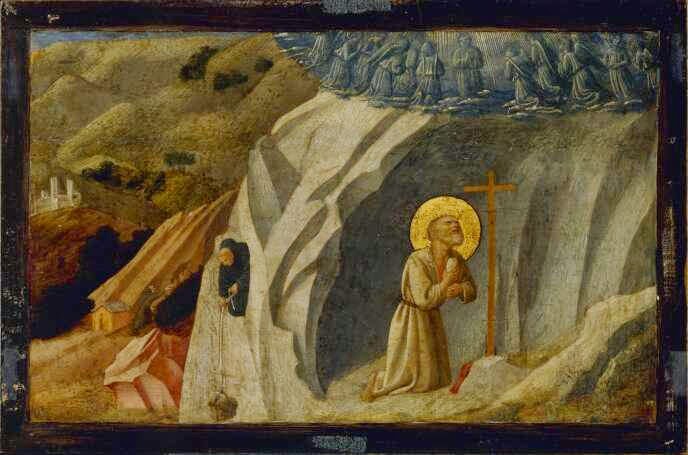
The term Benedict Option was coined recently by Rod Dreher. He initially defined it in somewhat negative terms as “pioneering forms of dropping out of a barbaric mainstream culture that has grown hostile to our fundamental values.” It is not surprising to think of St. Benedict in this light, as he himself withdrew in disgust from late fifth century Rome in favor of a cave in Subiaco. However, Benedict did not stay in isolation long, and quickly became an Abbot, gathering large numbers of men to himself.
Dreher points to a “community of Catholic laity” growing around Clear Creek Abbey in Oklahoma as an example of the Benedict Option. It is important to note, however, that there is not a formal lay community there. People simply want to live near the monastery, many have become oblates and participate in the liturgical life of the monastery, and they live in friendship and fellowship with one another.
Dreher’s articulation of the Benedict Option has recently been criticized by John Goerke on Crisis. He fundamentally questions the legitimacy of the term in relation to lay people seeking to emulate monastic life:
The question is: Is this the Benedict Option? The answer is: no. First and foremost there is the obvious point. The members of Clear Creek and Eagle River are not monks. Their lack of organized prayer life betrays this fact…. If taking the Benedict Option means a strict imitation of Benedict’s move to the wilderness, then it is an option to be taken only by monks.
Goerke then concludes that we need to look at Benedict more deeply in order to emulate his life andRule:
To find out what God wants, and to truly imitate St. Benedict, we must go to the substance and not the accidents of his life. The true Benedict Option is not a flight but a fight. It is a fight to be waged in the heart of every Catholic. It is a fight to undertake two strenuous tasks with humility and love: Ora et labora. Pray and work.
I think that Goerke’s argument is somewhat incongruous in that he claims that those who are striving to unite themselves to St. Benedict by associating with a monastery are not part of the Benedict option, but then argues that Benedict is nonetheless a model for us. Do we not need to soak in St. Benedict’s spirituality by learning from monks, precisely so that we can fight for Catholic culture?
Drehrer, in fact, says that Goerke has misunderstood him and explains the Benedict Option in more general terms:
When I talk about the Benedict Option, I don’t mean—or don’t mostly mean—a physical retreat to a quasi-monastic community, but rather an intentional and thoughtful retreat into narrativity, by which I mean a reclaiming of the church’s story, inculcating commitment to it within the lives of its members, in defiance of the narrative collapse around us. To achieve this, one must be aware of the conditions in which we live, and under which we are raising our children.
Nonetheless, this newer articulation does not clarify the Benedict Option. Rather, it somewhat makes it more elusive, as Drehrer himself admits: “People like to talk about the Benedict Option as a Christian response to our post-Christian culture, but nobody really knows what it means. I came up with the concept, and I’m not sure what it means.” Looking at the life of St. Benedict and his Rule, does it really need to be so confusing?
As a Benedictine oblate myself, I feel compelled to offer my own two cents about the relevancy of St. Benedict as a guide and model for our time. I would propose that the Benedict Option is something simple, which anyone can live, whether they have withdrawn to an enclave or not. There are a number of reasons why St. Benedict speaks so strongly to us today:
1. An Ordered Way of Life and StabilityThe life of the monastery is completely directed and ordered toward the glory of God. Monks live a balanced life of prayer, work, and sleep (in pretty equal proportions). This is a model of the Christian life as every one of our actions should be religious in the sense that they are ordered directly to God, for his glory and our sanctification. The monks also live a life of stability, committed to one monastery and the Rule. This counters our lack of a grounded identity and models how the faith should shape and govern our lives, rooting us in a constant and firm practice.
2. The Centrality of the LiturgyBenedictines live a life that is defined by the liturgy. It shapes and orders the day, week, and the year, and can even be said to be the reason for the life of the monastery. The monks traditionally pray the Divine Office eight times a day and seek to live a life of continual prayer. The prayer of the liturgy, and especially the Holy Sacrifice of the Mass, is heightened by the practice of Gregorian Chant, which draws out and embodies the meaning of the prayer. We are certainly undergoing a crisis of liturgical prayer in our age and the Benedictines model for us how to pray the liturgy. As St. Benedict directed: “Prefer nothing to the work of God.”
3. Hospitality and SimplicitySt. Benedict notes that a monastery will always have guests. It is somewhat ironic that the monastery, in its withdraw from the world, becomes a magnet for visitors, who are served as Christ. The monastery is a place of charity and its exercise of hospitality helps to shape the world, as those who leave it do so changed. The family and home are also meant to be a source of service and charity, a place of welcoming, a refuge in the world. Though the layman cannot hold with Benedict that private property is an “evil practice” (though it is for monks!), the monastery also witnesses to the need to live simply and detached, which helps us to make better use of earthly things for the glory of God and the service of others.

Thursday, October 15, 2015

The Benedictine Option for Today

The following comes from the Catholic Exchange:
If it wasn’t clear before that the culture of the West is opposed to the Gospel and the teachings of the Catholic Church, the recent decision to legalize “gay marriage” in the United States made it quite apparent. The decision was decades in the making and cannot solely be blamed on the homosexual agenda. It goes back to contraception and no fault divorce, both of which have eroded marriage in profound ways over the decades. For Catholics, much of it is due to dissent from Humanae Vitae by clergy and laity, as well as an abandonment of moral teaching. The question for Catholics today is: Where do we go from here? The reason we need to ask this question is because there is little doubt that we will be pushed to the fringes in the coming decades. Our moral understanding and focus on Christ means that we are in opposition to the world. Christ told us:
“I come not to bring peace, but to bring a sword…” Matthew 10:34
The world has always been in opposition to the Good News. The world crucified God. The Church has been set against the world since her founding by Our Lord, and that was no different during the life of St. Benedict whose feast day we celebrate on Saturday, July 11.
St. Benedict is most widely known for his rule and as the “Father of Western Monasticism”. He lived circa 480-560 and his influence on the world was great. Even though his rule was not the first, it was the most widely used in the west for centuries. St. Benedict’s rule was comprised of several rules which could be applied to a variety of monasteries and locations. His rule’s primary emphasis was on: moderation, the integration of prayer and work, and the socialization of the monastic life.
Once monasticism was introduced to the west by St. Athanasius, it spread quickly. By the time St. Benedict composed his rule, monasteries were in Africa, France, and even Ireland. Monasticism preserved much of Europe during the Dark Ages when there was much tumult and chaos. It was through monasticism that manuscripts were preserved, as well as art, architecture, and music were developed. It was here that culture survived and lived for many years. St. Benedict could not have known how great of an impact his rule would be on the west. Blessed John Henry Newman said of him:
“St. Benedict found the world, physical and social, in ruins, and his mission was to restore it in the way not of science, but of nature, not as if setting about to do it, not professing to do it by any set time, or by any rare specific, or by any series of strokes, but so quietly, patiently, gradually, that often till the work was done, it was not known to be doing…Silent men were observed about the country, or discovered in the forest, digging, clearing and building; and other silent men, not seen, were sitting in the cold cloister, tiring their eyes and keeping their attention on the stretch, while they painfully copied and recopied the manuscripts which they could have saved. There was no one who contended or cried out, or drew attention to what was going on, but by degrees, the woody swamp became a hermitage, a religious house, a farm, and abbey, a village, a seminary, a school of learning and a city.”
St. Benedict found himself in a world of decay and difficulty. The Roman Empire had collapsed and Barbarians were wreaking havoc throughout Europe. In response, he chose to establish small cultural centers that would profoundly impact the culture when the Zeitgeist proved to be receptive. He did not know the exact changes it would bring at the time, but slowly and deliberately, by living holy lives, the culture was changed. How devastating was the collapse of the Roman Empire? Rod Dreher points out:
Rome’s collapse meant staggering loss. People forgot how to read, how to farm, how to govern themselves, how to build houses, how to trade, and even what it had once meant to be a human being. Behind monastery walls, though, in their chapels, scriptoriums, and refectories, Benedict’s monks built lives of peace, order, and learning and spread their network throughout Western Europe.

Today

It is here that we shift to today. Once again the Church is looking at a culture in a state of decay, moral confusion, and nihilism. The West is falling into ruin once more. The societies of Europe and North America have largely abandoned Christianity in favor of secularism and now we live in a post-Christian age. As Catholics, how can we look to St. Benedict as a guide in such times? The answer is what is called the Benedict Option, which has come into usage through the work of Alisdair MacIntyre and Rod Dreher.
According to Columbia University professor, Russell Hittinge, St. Benedict taught the world of the Dark Ages: “How to live life as a whole. Not a life of worldly success so much as one of human success.” This is where our call as Catholics now lies. People have given themselves over to this age and to the pursuit of worldly success and pleasures, in doing so, they have forgotten what it means to be fully human. The culture has become so confused that even matters of nature are no longer accepted as truth. Alisdair MacIntyre paints a grim picture of the culture in his book After Virtue. Rod Dreher summarizes MacIntyre’s view:
“For MacIntyre, we too are living through a Fall of Rome-like catastrophe, one that is concealed by our liberty and prosperity. In his influential 1981 book After Virtue, MacIntyre argued that the Enlightenment’s failure to replace an expiring Christianity caused Western civilization to lose its moral coherence. Like the early medievals, we too have been cut off from our roots, and a shadow of cultural amnesia is falling across the land. The Great Forgetting is taking a particular toll on American Christianity, which is losing its young in dramatic numbers. Those who remain within churches often succumb to a potent form of feel-good relativism that sociologists have called “moralistic therapeutic deism,” which is dissolving historic Christian moral and theological orthodoxy.”
MacIntyre insists that we are now called to build, “new forms of community within which the moral life could be sustained”. How is this accomplished?

Close-knit Christian Communities

We must abandon the wrong-headed rugged individualism of our age. This is especially true for Americans. The call to radical individualism and self-determination is diametrically opposed to the Gospel and the communion we enter into upon our Baptism. The Mystical Body of Christ is an organism in which we are all intimately connected with the head, who is Christ Himself. As the culture begins to more aggressively attack the Church, we need to come together in close-knit communities all focused on the same goal in Christ. Does this sound familiar?
Most of us cannot become monks. We are members of the laity and we have to provide for our families, but that does not mean that we cannot live in a quasi-communal state where we can help one another. This communal state will vary depending on the area you live and the infrastructure in place. This will become essential when people lose jobs for their faith or struggle to make ends meet. This is the call to live in authentic Christian love and community, not as separate people who just happen to come to Mass together each Sunday. Priests and laity need to be involved. In fact, priests will need to take a direct role as spiritual leaders of these communities. Yes, priest are already stretched thin, but as the Church moves to the fringes, the unfortunate by-product will be more people falling away from the Faith. The Church will get smaller for a time.
Many of the people who have already begun living the Benedict Option live in close proximity to their church or even a monastery where they can pray, attend the Liturgy, and live where a religious community is established.  Some become Oblates or Lay members, but many do not. Lay Orders are no guarantee of this community either. There must be an intentional establishment and way of life within these communities. A life that is devoted to prayer, work, humility, evangelization, and holiness in a community, rather than solely as individuals or families.
What is certain is that people will need to band together in ways they have never considered before in our lifetime. We will need to focus our days on prayer, virtue, and work as we go out into the world. Rod Dreher admits when he coined the Benedict Option through the influence of Alisdair MacIntyre’s work that he did not have a clear definition. What is obvious, however, is that we Christians need to live holy lives in community as we take the onslaught that will grow in momentum over the coming decades. We must be willing to sacrifice and take care of one another as we live and serve Christ.

Holiness

In my mind, the Benedict Option is essentially a call to holiness. It is a call to deep prayer, virtue, regular reception of the Sacraments, and self-sacrifice in a community setting. That is what St. Benedict was asking of his monks and that is just as true today for monks or members of the laity. Holiness is what the Church is calling us to and we can no longer do it in isolation. Close-knit Christian communities are nothing new and find their greatest model in the Early Church. We need to learn to live together, faults and all that we may serve Christ in hard times; that we may become holy and perfect as Our Heavenly Father is perfect. In fact, communal life can help us greatly on the path to holiness. Holiness is the whole point of the Christian life.
So, whether it is Rod Dreher’s suggestion or another, it is time for us to come together as Christians and live The Way, instead of in isolation and mediocrity. We will need one another in the coming decades. It will be through our witness and striving for holiness that others will be evangelized. The Benedict Option cannot be seen as an abandonment of the Church’s mission to bring the world to Christ. The most powerful witness is a person fully alive who is living a saintly life. St. Benedict, ora pro nobis.
“The age of casual Catholicism is over, the age of heroic Catholicism has begun. We can no longer be Catholics by accident, but instead be Catholics by conviction.”  
Fr. Terence Henry, TOR, president of Franciscan University.

Wednesday, May 27, 2015

Fr. Longenecker: Is It Time to Hunker Down?

The following comes from Fr. Dwight Lonenecker:
As Ireland votes overwhelmingly for same sex marriage and the rest of the Western world, it seems, can’t wait to follow their example, is it time to throw in the towel in the cultural slugfest?
As radical Islam advances giving us nightmares and as the economic “recovery” looks increasingly shaky is it time to hunker down?
Over at The Week Damon Linker analyzes what Rod Dreher calls “The Benedict Option”.
This is the idea that the church will follow the pattern of St Benedict. To understand what this means we have to understand the social conditions in Benedict’s day.
It was the end of the fifth century. The once mighty Roman Empire was collapsing. Economic decline was forcing a retreat of the Roman armies across the empire. Famine and plague decimated the population. Moral decay ate away at the family and robbed the population of energy and ambition. In the vacuum the barbarians were invading from the North and the East.
Benedict headed for the hills.
He established small monastic communities of prayer, work and study to survive the social upheaval.
These Christian communities went on to become little havens of peace and lighthouses in the storm. Before long they became the only centers of education, health care, social justice and learning. They preserved the remnants of the earlier classical civilizations and went on to be the kernels of what would be medieval Christendom.
The Benedict Option is the idea that this is where we are headed. It’s not a new idea. T.S.Eliot predicted the continued decay and disintegration of Western civilization and that a new monastic movement would arise and carry the flame and become the nexus of a new Christendom. Cardinal George’s famous prophecy considered the same.
I expect to die in bed, my successor will die in prison and his successor will die a martyr in the public square. His successor will pick up the shards of a ruined society and slowly help rebuild civilization, as the church has done so often in human history.”
The classic novel, Canticle for Lebowitz is set in a future where this has already happened.
The Benedict Option has a double meaning because it can also connect with the prophecy of Pope Benedict XVI who, as Joseph Ratzinger…

Friday, October 18, 2013

God in the Quiet


The following comes from the Catholic Exchange:

Give me thy grace, good Lord,
To set the world at nought’,
To set my mind fast upon thee.
And not to hang upon the blast of men’s mouths.
~ St. Thomas More, A Godly Meditation (1534)
Thomas More wrote the above when he was in the slammer—the Tower of London, to be exact, and pretty much cut off from the rest of the world.
Nevertheless, he was asking for God’s grace to focus more on Him, and to eschew the “blast of men’s mouths.” Blast of men’s mouths? I’m guessing the only mouthy blast More endured in the Tower was halitosis of his warden and a guard or two.
So, if Thomas More, awaiting trial and a death sentence in a jail cell can be concerned about noise and distraction, how much more so those of us in a world full of blasting mouths. No need to go to jail, though, to focus my mind on the things of God. All I have to do is hit the “off” switch—maybe a dozen times or more. Whatever it takes.
Allan Ripp brought this home to me in his WSJ article about BlackBerry and smart phones. Ripp wistfully recalls his Motorola flip phone days, before he succumbed and gave in to the smart phone juggernaut:
Being partially incommunicado had its virtues, until inevitably one too many clients sent an email with nothing more than a lone question mark—or five—the universal sign of “Where the hell are you and why haven’t you responded to this mother-of-all demands I sent all of 30 seconds ago?”
We all live this life these days, regardless of the devices we’ve incorporated into our lives. Cell phones, smart phones, tablets, or whatever (including blogs!), we’re rarely far from being connected and “on.”
Perhaps there are some who relish the connected life—probably the same folks who wear those Bluetooth things in their ears no matter where they go. But I’m guessing there are plenty of people like me who paused a moment when they heard the NPR story last week about the National Radio Quiet Zone in West Virginia—thousands of square miles surrounding the National Radio Astronomy Observatory completely devoid of cell phone service.
Yes. Completely. A veritable paradise of unconnectedness.
But then, you don’t need a federally enforced Quiet Zone for that. Just ask the monks.
St. Benedict wrote about silence in his Rule way back in the sixth century:
Let us do what the Prophet saith: “I said, I will take heed of my ways, that I sin not with my tongue:I have set a guard to my mouth, I was dumb, and was humbled, and kept silence even from good things” (Ps 38[39]:2-3).
And the silence was supposed to go both ways in the monastery—i.e., the monks kept quiet themselves, but they also expected to coexist in quiet. In fact, keeping quiet was considered a matter of justice according to Benedict:
When the Work of God is finished, let all go out with the deepest silence, and let reverence be shown to God; that a brother who perhaps desireth to pray especially by himself is not prevented by another’s misconduct (52).
That the noisy world we ourselves inhabit hungers for this kind of calm and quiet is evident from the popularity of the 2005 film Into Great Silence, or even the more recent Of Gods and Men (2011). What is it about monks and their separateness that we find so fascinating?
Maybe we get a clue from the Carthusians and their Statutes:
The primary application of our vocation is to give ourselves to the silence and solitude of the cell. It is holy ground, the area where God and his servant hold frequent conversations, as between friends.
The silence and solitude aren’t ends in and of themselves and it’s not just to guard against being polluted by the outside world.
Instead, it’s about finding the space to have a relationship with the Almighty, and like any relationship, it requires focus on the other. No distractions. No beeps and buzzes and ring tones and vibrates. Just quiet and focus, and room for conversation with God.
Thomas More, a mover and shaker, and definitely a player, actually lived with the Carthusians of London for a few years during his law school days, so it’s no wonder he had a different perspective on what constitutes blasty mouths than we do. Despite his place in the world, he knew what really fed him and sustained him, and yet even in the solitude of his cell, it somehow escaped him.
In any case, I don’t need to go to jail to focus my mind on God. All I have to do is hit the “off” switch—maybe a dozen times or more. Whatever it takes.