Showing posts with label miracles. Show all posts

Monday, July 5, 2021

The Miraculous Conversion of Alessandro Serenelli

The following comes from MariaGoretti.org:

Maria Goretti's heroic story of love and forgiveness would not be complete without one of its first miraculous fruits: the conversion of Alessandro Serenelli, Maria's murderer.

Immediately after his brutal assault on young Maria Goretti, Alessandro was imprisoned temporarily in Nettuno and then transferred to Regina Coeli prison in Rometo stand trial. After vehemently denying his guilt, he finally broke down in the face of overwhelming testimony. Since he was a minor, he was sentenced to only thirty years hard labor.

A priest came to see him soon afterward, and he turned on the cleric in rage, howling like a maniac and lunging at him.

In the days which followed, Alessandro lost his appetite and grew nervous. After six years of prison, he was near the brink of despair. Then one night, Maria appeared to him in his cell. She smiled at Alessandro and was surrounded by lilies, the flower symbolic of purity.

From that moment, peace invaded Alessandro's heart, and he began to live a constructive life.

After serving his sentence, Alessandro took up residence at a Capuchin monastery, working in the garden as a tertiary. He asked pardon of Maria's mother and accompanied her to Christmas Mass in the parish church where he spoke before the hushed congregation, acknowledging his sin and asking God's forgiveness and the pardon of the community.

Forty years later, on June 24, 1950, Maria was canonized at St. Peter's basilica in Rome, with Alessandro's heart now firmly converted to the Lord. A miraculous fruit of Maria's life, indeed!

Alessandro Serenelli died on May 6th, 1970 in the Capuchin convent of Macerata. He left the following testimony, dated May 5, 1961, as his spiritual legacy:


"I'm nearly 80 years old. I'm about to depart.
"Looking back at my past, I can see that in my early youth, I chose a bad path which led me to ruin myself.
 
"My behavior was influenced by print, mass-media and bad examples which are followed by the majority of young people without even thinking. And I did the same. I was not worried. 
"There were a lot of generous and devoted people who surrounded me, but I paid no attention to them because a violent force blinded me and pushed me toward a wrong way of life. 
"When I was 20 years-old, I committed a crime of passion. Now, that memory represents something horrible for me. Maria Goretti, now a Saint, was my good Angel, sent to me through Providence to guide and save me. I still have impressed upon my heart her words of rebuke and of pardon. She prayed for me, she interceded for her murderer. Thirty years of prison followed.
"If I had been of age, I would have spent all my life in prison. I accepted to be condemned because it was my own fault. 
"Little Maria was really my light, my protectress; with her help, I behaved well during the 27 years of prison and tried to live honestly when I was again accepted among the members of society. The Brothers of St. Francis, Capuchins from Marche, welcomed me with angelic charity into their monastery as a brother, not as a servant. I've been living with their community for 24 years, and now I am serenely waiting to witness the vision of God, to hug my loved ones again, and to be next to my Guardian Angel and her dear mother, Assunta. 
"I hope this letter that I wrote can teach others the happy lesson of avoiding evil and of always following the right path, like little children. I feel that religion with its precepts is not something we can live without, but rather it is the real comfort, the real strength in life and the only safe way in every circumstance, even the most painful ones of life."
 Signature, Alessandro Serenelli


Friday, July 2, 2021

Blessed Alexandria Maria da Costa: Victim Soul of Fatima

The following comes from Unity Publishing: 


There are many stories of Fatima and for everything to be told would be like an Encyclopaedia.  One of these stories will be better known on April 25, 2004 when Pope John Paul II declares Alexandrina blessed.  If you do not know her story, you can get a great book from Tan Book and Publishers called "Alexandrina, The Agony and The Glory" by Francis Johnson.   

Some of the pilgrimages which go to Fatima visit the town of Balasar north of Fatima.  It became famous in 1832 when the earth changed to form the appearance of a large cross which you can still see today inside a chapel which has been built over it.  Almost exactly 100 years later in the same town, Alexandrina Maria da Costa started suffering the passion of Jesus in answer to the request of Our Lady of Fatima.  She ended her life living on the Eucharist alone for the last thirteen years.  

Alexandrina was born in April 1904.  In 1918, the year after the apparitions of Fatima, Alexandrina and her sister Deolinda and another girl were home when three men knocked at the door, one of whom had previously tried to molest Alexandrina.  They broke into the house.  Alexandrina (to preserve her chastity) jumped from an upstairs window.  The men fled but Alexandrina’s spine had been irreparably injured and she had to remain in bed for the rest of her life.  The slightest movement caused her intense pain.  She began to grow closer and closer to the Lord and realised that she was suffering in a special way for the salvation of souls.  She received Holy Communion every day and her thoughts frequently turned to Jesus in the tabernacle.  

She went into her first ecstasy in 1931 when she heard Jesus say to her, “Love, suffer and make reparation.”  She saw her vocation to be that of a victim soul, to make reparation for all of us.  Under the order of her spiritual director she was dictating her life’s story to her sister but many times the devil threatened her not to write any more.  In 1936 Our Lord asked her to spread the message of Fatima and to urge the consecration of the world to the Immaculate Heart and she offered herself as a victim soul for this. 

In one of her ecstasies Jesus said to her,

“Keep me company in the Blessed Sacrament.  I remain in the tabernacle night and day, waiting to give my love and grace to all who would visit me.  But so few come.  I am so abandoned, so lonely, so offended…. Many…do not believe in my existence; they do not believe that I live in the tabernacle.  They curse me.  Others believe, but do not love me and do not visit me; they live as if I were not there… You have chosen to love me in the tabernacles where you can contemplate me, not with the eyes of the body, but those of the soul.  I am truly present there as in Heaven, Body, Blood, Soul and Divinity.” 

From October 1938 Alexandrina began to suffer the passion of Jesus every Friday.  She suffered the passion of Jesus 180 times.  Until 1942 she was suffering in silence without fame but after a report appeared in a newspaper from then on she was besieged by pilgrims asking for prayer.  During the Holy Week the same year Jesus said to her,

“You will not take food again on earth.  Your food will be my Flesh; your drink will be my Divine Blood …”

So on Good Friday 1942 she began an absolute fast which lasted for the more than thirteen years until her death.  The only nourishment which her body filled with pain received was Jesus in Holy Communion every morning.  News of her fast spread and the crowds became even bigger.  Some people had doubts and suspicions about her fast and accused her, her sister and mother of fraud.  Therefore she agreed to medical observation.  The doctor asked her, “Why do you not eat?”  She replied, “I do not eat because I cannot.  I feel full.  I do not need it.  However, I have a longing for food.”  It was decided that she should be admitted to a nearby hospital for a thirty day observation of her fast.  While she was in the hospital some tried to persuade her to take food.  The doctor in charge of the examination was nasty to her and at the end of the thirty days said the nurses watching her must have been deceived and decided she was to remain there for a further ten days.  They even showed her tasty food to entice her to eat.  When the test was finally over the doctor said to her he would visit her at home not as a doctor-spy but as a friend who esteems her.  Part of the medical report reads as follows:

“Her abstinence from solids and liquids was absolute during all that time.  We testify also that she retained her weight, and her temperature, breathing, blood pressure, pulse and blood were normal while her mental faculties were constant and lucid and she had not, during these forty days, any natural necessities…The laws of physiology and biochemistry cannot account for the survival of this sick woman…”

While medical science could not explain, the explanation was simple.  Jesus had said to Alexandrina,

“You are living by the Eucharist alone because I want to prove to the world the power of the Eucharist and the power of my life in souls.”

She died on 13th October 1955, having received nourishment only from Holy Communion for more than thirteen years.  Some of the pilgrimages to Fatima visit her town Balasar and you can visit her house, see her room and visit the local Church where she is buried to the left of the altar.

Friday, December 13, 2019

St. Juan Diego and the Miraculous Proof

The following comes from Word on Fire:
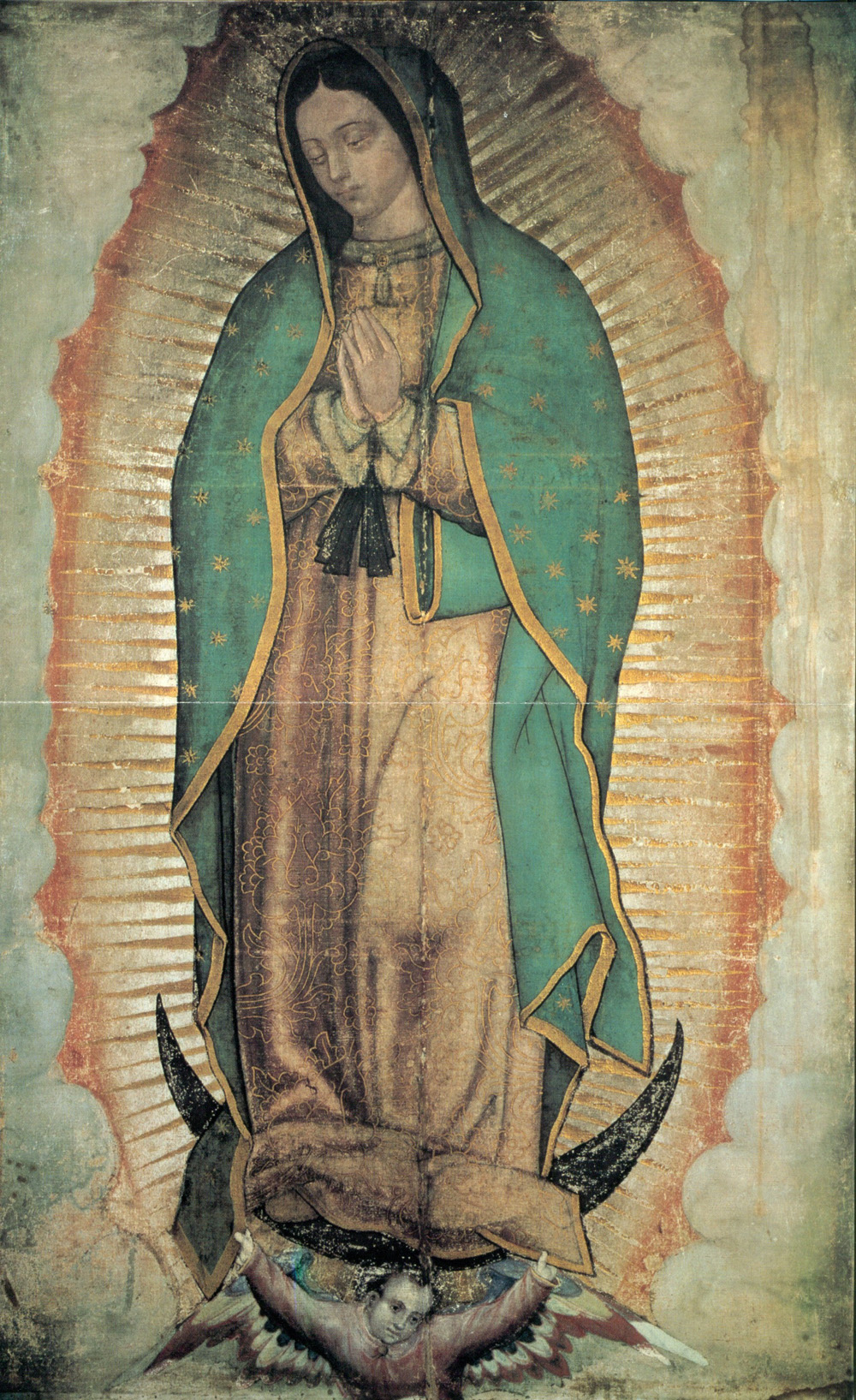
One of the ways to prove the Catholic claim is through miracles.  Catholicism, unique amongst all the faiths on Earth, has colorable claims of miraculous events with evidence.  One of these miraculous events is Our Lady's appearance to St. Juan Diego from December 9th to the 12th of 1531. You can find the full story here. And here's Her image on the tilma of St. Juan Diego.
 Now, there have been serious questions about whether this apparition is real.  I firmly believe it is, and the Church canonized St. Juan Diego, suggesting She does as well.  The arguments against the apparition become less compelling when you try and piece them together.  For example, it's claimed that since the Spanish didn't write about this event for over a decade (which is apparently true: the first existent writing we have from the Spanish is from 1548), then it didn't exist.  But given that the Spanish were often clueless about Aztec life, and didn't speak the Nahuatl language, this isn't a particularly troubling occurrence. There's little question that this was a devotion popular amongst Aztec converts, rather than Spanish cradle Catholics.  And while the Spanish don't write about the apparition (at first), there is plenty of historical evidence that after 1531, the number of Aztecs seeking Baptism jumps through the roof: As Called to Communion explains:

"This miracle precipitated the greatest flood of conversions in the whole history of Christianity. In the seven years following this miracle, approximately eight million Aztecs converted to Christianity [...]
Prior to this event, the Aztecs were offering thousands of human sacrifices per year in central Mexico, including child sacrifice. The conversion of the Aztecs to Christianity ended the brutal practice of human sacrifice, and helped bring Central and South America to Christianity."
Then there's also the fact that Santa Maria de Guadalupe is a religious devotion amongst the Spanish, leading other critics to claim that the Spanish made this myth up to convert the Aztecs.  This theory makes the most sense of the critical ones, but it doesn't hold water.  As we just established, the Spanish seemed unaware of the devotion in its early days.  Surely, if they were the ones spreading it, we'd see some documentation that they were - something in a diary about how they were explaining the Virgin of Guadalupe to the Aztecs.  There's nothing of the sort.  Instead, many of the earliest Spanish writings are skeptical, while it's the Aztecs themselves who are the believers. Besides this, fiber testing shows that this tilma isn't Spanish in origin, but is made from Mexican hemp.
 The picture that emerges is a fascinating one.  It seems too Mexican to be Spanish, and too Spanish to be Mexican.  And it's far too Christian to be a warmed-over Aztec goddess cult, one of the other theories.  Called to Communion notes:
"The image shows Mary as a humble but royal maiden. Under her feet is the Moon, which for the Aztecs represented the devil. In this way the image depicts Mary as crushing the head of the serpent, and corresponds to the description of the woman described in Revelation 12."
Consider this for a moment: Mary and Her Seed, Christ, are depicted stepping on the head of Satan in Genesis 3:15.  Later, She's depicted as pregnant with Jesus stepping on the moon in Revelation 12:1. Neither the Spanish nor the Aztecs made these accounts up.  They're from separate Books of Scripture, and each predate the apparitions by well over a millenia.  Yet given the Aztec symbology, with its curious identification of the moon with the devil, this image served as beautiful exegesis explaining Mary's Biblical role in salvation.  As an added twist, the Nahuatl word Coatlaxopeuh, which is pronounced like Guadalupe, means something like "One who crushes serpents" [Coa(serpent), tla (the), xopeuh (crush, stamp out)], again supporting that the one who appeared to St. Juan Diego was truly Mary, and not something sinister.

Tuesday, October 15, 2019

Fr. Barron on St. Theresa of Avila


Today is the feast day of St. Theresa of Avila.  She was a great reformer, mystic and spiritual writer and is recognized as a Doctor of the Church.  The following comes from the Vatican News:

The daughter of a Jewish convert and his second wife, Saint Teresa of Avila, was born on March 28, 1515. She had a happy childhood with her brothers and cousins, and was fascinated by novels that told tales of chivalry. After the death of her elder brother, John, in 1524 and the loss of her mother, Beatrice, the young woman was sent to study at the Augustinian Monastery of Our Lady of Grace, where she was struck by a first existential crisis. After serious illness, she returned to her father’s home, and witnessed the departure of her beloved brother Rodrigo for the Spanish colonies overseas. In 1536, she was hit by the so-called “great crisis” and came to the firm decision to enter the Carmelite monastery of the Incarnation at Avila. Her father, however, was  opposed, and Teresa fled home. Accepted by the nuns, she made her profession on 3 November, 1537.


“I felt shaken to the core”

Teresa’s health once again failed her. Despite the consequent return to the family, her case is deemed hopeless, and Teresa is returned to the convent, where the nuns begin to prepare her funeral. Inexplicably, however, the gravely ill Teresa returns to life and health. Partially released from the commitments of cloistered life owing to her convalescence, cheerful of character, a lover of music, poetry, reading and writing, Teresa would weave a dense fabric of friendships, drawing to her person various people eager to meet her. She would quickly come to feel these encounters a distraction from the principal task of prayer, and experience her “second conversion”: “My eyes fell on a picture ... It was our Lord covered with sorrows. As soon as I looked at Him I felt completely shaken ... I threw myself before His feet and shed tears, and I begged Him to give me strength not to offend Him anymore.”

Portrayed by Bernini
The most mysterious and interesting parts of Saint Teresa of Avila’s life, are her visions and ecstasies. In her Autobiography (written on the order of the bishop), and in other texts and letters, Teresa describes the various stages of divine, visual and auditory manifestations. She is seen to levitating, falling into disarray, and laying still as death (as Bernini depicts her around 1650, in the statue in the church of Our Lady of Victory in Rome). These events corresponded to a great spiritual growth, which Teresa, who had a natural gift for the literary, would pour into her mystical texts, which are among the clearest, most powerful poetics ever written.
Her intense spirituality did not always meet with understanding. Some of her confessors would even consider her a victim of demonic illusions. She was supported by the Jesuit, St. Francis Borgia, and the Franciscan friar, St. Pietro d'Alcántara, who dissipated the doubts of her accusers.
Read more here.

Sunday, October 13, 2019

The Miracle of the Sun in Fatima October 13, 1917


The following comes from the Catholic Herald:

The Miracle of the Sun at Fatima, which took place exactly a century ago, on October 13, 1917, was one of the most stupendous, if not the most stupendous event of the 20th century. And yet it is hardly known outside the Church, and not well enough known within it. 
The people who braved the terrible rainstorm which struck Fatima that day had gone there because of the promise of a miracle. Exactly what sort of miracle they didn’t know, but they knew that something exceptional was going to happen. Many sceptics and unbelievers were also drawn there in the expectation of a fiasco in which the Church would be turned into a laughing stock.The previous July, Our Lady had told the three Fatima children that she would perform a miracle in October, and this sensational report spread throughout Portugal, ensuring that a huge crowd was present on October 13, despite the appalling weather.At noon, Our Lady appeared to the children, and after repeating her requests for the daily rosary, and promising that World War I would soon end, she said to them plaintively and sadly: “Do not offend the Lord our God any more, because He is already so much offended.” 
Then, while the three seers saw visions of the Holy Family, the crowd of at least 70,000 people were mesmerised as the Miracle of the Sun unfolded. What happened was so incredible that even non-believers couldn’t deny it, as this report, which appeared in the secular Lisbon paper O Dia, indicates: 
The silver sun … was seen to whirl and turn in the circle of broken clouds. A cry went up from every mouth and the people fell on their knees on the muddy ground. … The light turned a beautiful blue as if it had come through the stained-glass windows of a cathedral and spread itself over the people who knelt with outstretched hands. The blue faded slowly and then the light seemed to pass through yellow glass. … People wept and prayed with uncovered heads in the presence of the miracle they had awaited. The seconds seemed like hours, so vivid were they.
Read the rest here.

Tuesday, July 9, 2019

The God of the Impossible

The following comes from In God's Company 2:

"Even if this should seem impossible in the eyes of the remnant of this people, shall it in those days be impossible in My eyes also, says the Lord of hosts?" -Zechariah 8:6

It seemed impossible that the Israelite nation would ever be restored, but "nothing is impossible with God" (Lk 1:37). Think of the most impossible situation in your life - a marriage that seems irreconcilable, a terminal illness, long-term compulsive behavior, a dead parish, mental illness, family breakdown, etc. What man considers impossible, the Lord sees as opportunities to manifest His almighty power. 


To strengthen your faith in the God of the impossible:


   * Read and pray God's Word. "Faith comes through hearing, and hearing by God's word" (Rm 10:17)
   * Ask others, including Saint Jude, to pray for you to see the most impossible situations in your life the way God sees them.
   * Go to Confession and repent of giving in to doubt.
   * Praise and thank the Lord for doing the impossible, even before He does it.
   * Share your faith in the God of the impossible by telling others about Him.

God will do more than we can ever ask for or imagine (Eph 3:20). He will do the impossible.

 Father, thank You for the hope that "will not leave us disappointed" (Rm 5:5).

"Whoever welcomes this little child on My account welcomes Me, and whoever welcomes Me welcomes Him Who sent Me; for the least one among you is the greatest." -Lk 9:48

Wednesday, January 31, 2018

An Interview with Saint John Bosco

A unique event marks the year 1884 in the life of Don Bosco. He gives his first and only press interview to a French journalist writing for the Journal de Rome. An excerpt of this historic event is reproduced below:


"Reporter: By what miracle have you been able to found so many houses in so many different countries?


Don Bosco: I have done far more than I hoped, but I don't know how.  The Blessed Virgin knows our needs, and She helps us.


Reporter: How does She help you?


Don Bosco:  For instance.  Once I received a letter from Rome saying that the building of the Sacred Heart needed 20,000 lire within a week.  At that moment I had no money.  I left the letter by the holy water stoop, fervently prayed to the Blessed Virgin and went to sleep, leaving the matter in Her hand  Next morning I received a letter from an unknown person.  "I had made a vow to Our Lady.  In exchange for a certain favour I would give 20,000 lire."  On another occasion I was in France.  There I got the unpleasant news that one of my houses was in dire straits unless 70,000 lire were found at once.  I could see no solution, so I prayed.  I was about to go to bed at 10:00 pm when someone knocked.  It was a friend of mine with a thick file in his hands.  "Don Bosco, in my will I had assigned 70,000 lire for your works.  But today it occurred to me that it is better not to wait for death in order to do good.  I've brought it to you. Here is 70,000 lire."


Reporter: These are miracles.  May I indiscreetly ask you whether you have performed miracles yourself?


Don Bosco: I have only thought of doing my duty.  I have prayed and trusted in the Madonna.


Reporter: Don Bosco, could you comment on your educational philosophy and the methods you use in your schools that are so much admired? How do you manage to maintain discipline when dealing with so many boys?

Don Bosco: The Salesian way of educating the young is quite simple. Basically, I insist on letting boys be boys. Let them play and enjoy themselves as much as they want as long as God is not offended. But if I have a philosophy of education, it consists in discovering a boy’s best qualities and then exploiting them to his advantage. You must admit, sir, that any person is at his best when he is doing what he likes and does best. Children are the same. Promote their positive qualities and they will thrive. As for discipline—love and respect for the young is the answer. In the 46 years I have worked among children, never once have I had to resort to corporal punishment, which by the way is very much in vogue. And if I may say so, all those children who have come under my care have always continued to show me their love and respect.

Reporter: Let me ask about your mission work in foreign lands. How have you managed to reach such faraway places as Patagonia and Tierra del Fuego?

Don Bosco: Well, honestly, we got that far by taking one step at a time."


Reporter: What do you think of the present conditions of the Church in Europe and in Italy?  How do you see the future?


Don Bosco:  I'm no prophet.  You journalists are, a bit.  You should be asked that.  Nobody but God knows the future.  Nevertheless, humanly speaking, the future seems bleak.  My forecast is very sad, but I'm not afraid.  God will always save his Church, and our Lady, who visibly protects the contemporary world, will make redeemers arise.


(From Teresio Bosco's book "Don Bosco")

Thursday, December 21, 2017

Pope Paul VI and a Miracle for Sainthood

Blessed Pope Paul VI may be on his way to canonization!  The following comes from La Stampa:

In a special issue entitled “It will be the year of Paul VI Saint”, the weekly magazine of the diocese of Brescia, La voce del popolo, writes that on 13 December, theologians of the Vatican Congregation for the Causes of Saints recognized a miracle attributed to the intercession of Pope Montini, after a first free go-ahead had been given by the medical consultation of the Vatican Congregation itself. At this point it is necessary that the cardinals of the Congregation and, finally, the Pope express themselves on the same miracle.  

The miracle regards the birth of a girl from Verona called Amanda, who in 2014 had survived for months despite the fact the placenta was broken.  
Pope Francis beatified his predecessor on 19 October 2014, concluding the extraordinary Synod of Bishops on the Family.  

“Rumors are so insistent and the next steps so fast to take, that everything indicates 2018 as Blessed Paul VI’s canonization year”, writes the diocesan newspaper of Brescia. The last official stage took place last December 13 in the theological commission. The miracle attributed to the intercession of John Baptist Montini about the healing of a fetus in prenatal age in 2014 was approved. The expectant mother native from Verona, at risk of miscarriage, a few days after the beatification of Montini in Brescia, went to the Sanctuary “delle Grazie”, to pray to the newly beatified Pope.  

Subsequently, a child in good health was born. After the doctors and theologians’ recognition, there are still a few more steps to be taken: the passage in the commission of cardinals, the final approval of the Pope and that of the Consistory with the official announcement and the definition of the date. But at this point, it is more than a hope. The month of October could be the right one. From 3 to 28 October in Rome, the 15th Ordinary Assembly of the Synod of Bishops on young people will be celebrated and will gather in the Vatican prelates from all over the world. What better opportunity to canonize in front of such a large portion of the College of Bishops, the other pontiff, after Saint John XXIII of the Second Vatican Ecumenical Council? It will most likely take place on one of the first three Sundays of October, even if the most accredited date today seems to be the 21. Indeed, sooner or later, in 2018 Paul VI will be Saint! We praise the Lord to Whom we entrust the year that will come”. 

Thursday, September 7, 2017

Myrrh Weeping Icons of Jesus and St. John the Baptist


An Orthodox church in Homer Glen is drawing pilgrims from across Chicagoland to witness what some are calling a miracle. An icon of St. John the Baptist has been oozing fragrant oil at Assumption Greek Orthodox Church. Parishioners believer the oil to be myrrh, and many claim that the myrrh has healed their health conditions.

I visited this Church last weekend and found that the Icon of Jesus the Teacher has also been weeping myrrh oil. The Jesus Icon is directly to the left of the Icon of St. John the Baptist and began weeping on December 31, 2016 from the left hand of Jesus. Just a few weeks ago the right hand also began to weep. The right hand is giving a blessing and is situated just over the heart of Jesus. The myrrh oil was clearly visible on both of the icons! It now seems appropriate that St. John the Baptist began weeping first so as to prepare the way for Jesus! These signs are an encouragement to all of us to pray and deepen our relationship with Christ!

Monday, November 7, 2016

A Time For Miracles (Medjugorje)

Saturday, August 13, 2016

Miracle in Medjugorje: Atheist Author Finds God

I recall reading Randall Sullivan's excellent book on Marian apparitions a few years ago.  It was really excellent!  It is a good introduction to those who may not be exposed to the miraculous nature of our faith.  I may read it again!
The following comes from the Mystic Post:
Randall Sullivan is a former agnostic, raised by atheists, an Ivy Leaguer, and was a  contributing editor to Rolling Stone for over twenty years. He is also the author of The Price of Experience, Labyrinth, and the great book about Medjugorje The Miracle Detective, the book that inspired a television show which he hosted on the Oprah Winfrey Network. 
Do miracles really exist? Or is there a logical explanation to the seemingly inexplicable?
Randall Sullivan is an author and journalist who, while travelling as a war correspondent in Bosnia, saw an inexplicable vision on Cross Mountain in Medjugirje during a violent thunder and lightning storm.  It changed his life, and he is convinced it was a miracle.  Mr. Sullivan took a moment out of his busy schedule to talk with Mystic Post about that “Inexplicable vision that changed his life”

Monday, June 13, 2016

St. Anthony and the Real Presence

The following comes from Catholic Pages:

A popular story springs up about St. Anthony, mention of it is made in the official Butler's lives of the Saints. It is the story of St. Anthony's encounter with an Jewish man. This man contested the "Real Presence of the Eucharist; so one day he approached St. Anthony publicly and after spelling out all of his reasons for not believing in such a "fable" as the Real Presence, he challenged Anthony to a contest. He bet that the Real Presence was a lie, and he proposed to "starve a donkey" for three days---no hay, and see if the donkey would choose to eat hay or preferred the Eucharist. St. Anthony, being publicly "put on the spot" accepted the challenge. So the wealthy merchant brought out his donkey, publicly hitched him to a post where he could be observed by all; and proceeding to "starve the donkey" for three days. Simultaneously, St. Anthony went into the forest and "fasted" for three days---taking no food. When the day of trial came, Anthony emerged from the forest and sought out a local Church where he took the Eucharist and returned to the spot where the donkey was tied. Meanwhile, the challenger had placed a large pile of hay about 20 ft away from the donkey. Anthony took out the Eucharist holding it in his hands; the merchant untied the donkey, who needless to say, made a "beeline" for the pile of hay. Just as the donkey was about to reach the hay, St. Anthony elevated the Eucharist and shouted in a loud voice: "Mule, in the Name of the Lord Our God, I command you to come here and adore your Creator ! " The donkey "reared up" on his hind legs as if someone had pulled him by a bridle; he spun around, and ran to St. Anthony, dropping to his forelegs--- hind legs still extended; and put his head down to the ground---in a "posture of adoration" before the Eucharist which St. Anthony continued to hold elevated. The Jewish merchant, stunned by what occurred begged St. Anthony's forgiveness, converted on the spot, and donated the money to build a new Catholic Church, his newfound faith. On the cornerstone of the Church, he had engraved a picture of St. Anthony holding the Eucharist aloft and the donkey, "kneeling on his forepaws" in adoration of the Body of Christ.

It's funny that nowadays, people find such things difficult to believe. We have become so sophisticated, so urban, so cosmopolitan. Yet, St. Louis de Montfort once said that when you hear these miraculous stories about the saints; believe them. The worldly find them difficult to believe, but to the faithful, it is not surprising that God does great things for those who truly follow Him.

Tuesday, June 7, 2016

A Quote from Archbishop Fulton Sheen

"The first miracle worked by our Lord on earth was performed while He was still in His Mother’s womb. He stirred the unborn John and brought consciousness of His presence to Elizabeth, the cousin of His Mother. Thus, long before Cana, our Lord shows that it is through His Mother that He works His unseen wonders in the heart and through her that He is brought into the souls of men. Yet at that moment, when Elizabeth is the first to call her the Mother of God, even before our Lord is born, Mary answers in her song that her greatness is due to Him, and that she was chosen because she was lowly." 

Archbishop Fulton Sheen (The Fifteen Mysteries of the Rosary)

Sunday, May 22, 2016

Saint of the day: Rita of Cascia


Today we remember St. Rita of Cascia; a patroness of hopeless causes! The following comes from Catholic Online:

Augustinian nun, also called Margarita. She was born in Roccaporena, near Spoleto, Italy, in 1381, and expressed from an early age the desire to become a nun. Her elderly parents insisted that she be married at the age of twelve to a man described in accounts of her life as cruel and harsh. She spent eighteen extremely unhappy years, had two sons, and was finally widowed when her husband was killed in a brawl. Both sons also died, and Rita, still anxious to become a nun, tried unsuccessfully to enter the Augustinians in their convent at Cascia. She was refused because she was a widow and because of the requirement that all sisters should be virgins. Finally, in 1413, the order gave her entry, and she earned fame for her austerity, devotion to prayer, and charity.


In the midst of chronic illnesses, she received visions and wounds on her forehead which resembled the crown of thorns. She died on May 22 at Cascia, and many miracles were reported instantly. Canonized in 1900, she is honored in Spain as La Santa de los Impossibles and elsewhere as a patron saint of hopeless causes.

Monday, May 9, 2016

A Padre Pio Miracle

The following comes from Patti Maguire Armstrong:

Paul Walsh was 17 years old when the car he was driving hit a tree on Chester Pike in suburban Piladelphia on an icy December night in 1983. One doctor described his head injuries as the equivalent of dropping an egg on a cement sidewalk. Not only was his skull shattered, every bone in his face was broken and there was a tear in his brain. Doctors at Crozier Chester Medical Center said he was irreversibly brain damaged and would never regain consciousness. But as the old saying goes, “never say never.”

On Saturday, May 14, 2005, Paul Walsh received a bachelors degree in liberal arts from Neumann College In Aston, PA. “I’d like to teach special ed,” said the 38-year-old graduate, who is employed as a full-time health care associate with Elwyn, Inc., a residential day program for the mentally disadvantaged. “I’d like to continue working with mentally disadvantaged persons.”

Paul’s recovery from massive head injuries in 1984 was “unexplained, on a purely medical and scientific basis” said one of the physicians who treated him, Michael Ryan, M.D. In a written statement, Dr. Ryan said: “It is my feeling that without the help of the supernatural influence, Paul would today be dead or continue to be in a comatose state.”

Although he recalls little of his four-month ordeal following the accident, his mother, Betty Walsh, remembers every detail, from the moment she got the phone call on the night of the accident. “The nurse told me to come to the hospital right away,” said the mother of ten from Ridley Park, PA. “It was hard to even recognize Paul. His face was so swollen, like a pumpkin, and totally wrapped in bandages. It didn’t look very good but he did recognize my voice because he moved when he heard me.”


After ten hours of surgery the following day, during which Paul lost four and half times the amount of blood in his body, he was transferred to Crozier-Chester Medical Center where his condition remained critical.

At first, he seemed to be improving and was even talking a little, but there was a suspicious fluid dripping out of his nose. Everyone thought he had a cold and a month went by before doctors discovered the fluid wasn’t from nasal congestion - it was spinal fluid. A cat scan revealed a tear in Paul’s brain.

“That’s when they realized he was worse off than they thought,” Betty said.

Doctors tried to repair the tear but the inside of Paul’s head was too shattered. They resorted to draining the fluid with spinal taps and then a catheter, but Paul’s condition continued to deteriorate. He began slipping in and out of consciousness.

Another cat scan revealed that he had hydrocephalus and the ventricles of his brain were filling with fluid. Doctors prepared him for emergency surgery to put a shunt in his head to drain the fluid when they discovered yet another serious complication - he had also developed spinal meningitis. “At this point, there was no hope,” Betty said. “The ventricles just kept filling with fluid and it flattened the frontal lobe of his brain which one doctor told me was his whole personality.”

Even though Paul was alive, in essence, he was gone.“They kept saying ‘you have to stop hoping. . . the way he is now is the way he’s going to be. He is permanently and irreversibly brain-damaged.’” But Betty was not about to give up on her son. Even though she had nine other children at home, she felt like the woman in the Bible who had ten coins but lost one and could not stop searching until she found it.

“We just decided Paul needed a miracle,” Betty said. “In the end, if Paul didn’t get better, I would accept it, but in the meantime, I was really going to believe I could have a miracle and I would at least pray with faith.”

A woman from St. Madeline’s in Ridley Park, gave her five prayer cards for people who were in the process of beatification and needed a miracle. Every day after Mass, she and her mother would go to the hospital and pray the rosary over Paul, then say the five prayers. “Whenever I came to the Padre Pio prayer, Paul blessed himself, even though he was totally unconscious,” Betty said.

Several people witnessed the phenomena, including a few nurses. Betty decided to call a local group of Padre Pio devotees and report what was happening. They decided to send someone to the hospital with one of the gloves worn by Padre Pio over the bloody stigmata wounds in his hands. On Monday, March 12, Paul was blessed with the relic and within days, one of his many serious ailments had miraculously vanished.

Betty called the group again and on April 6, 1984, the glove was once again brought to Paul and laid on his head. “I knew immediately something happened because it was like an electric shock went through him,” Betty said. “He opened his eyes and looked around the room, very clear-eyed. Then he fell back into the coma again but I just knew something had happened.”

She was right. The next day, when she returned to the hospital she was shocked to find her son sitting in a chair and watching television. He turned and said “Hi Mom.”

The nurse rushed in and told Betty: “He’s been talking all day!” When she called the neurosurgeon to tell him Paul Walsh was talking, the doctor said, “It’s not possible’ and hung up on her.”

But it was true. “They gave Paul another cat scan and all the doctor kept saying was, ‘I don’t believe this. I don’t’ believe this.’ The frontal lobe of his brain wasn’t smashed anymore.”
Even more inexplicable was what happened days later, on Easter Sunday morning, when Paul and his roommate woke up to find a man standing at the foot of Paul’s bed. Described as “an old priest in a brown robe,” Paul thought it was Betty’s brother, Charley, who bears a remarkable resemblance to Padre Pio.

“I remember being very certain that my Uncle Charley had been in to visit me,” Paul said. “I did see him. He was very happy and smiled at me. And then he left the room.”

Betty knew it couldn’t have been Charley because he lives in Boston. She folded up a picture of Padre Pio, hiding the name, and showed it to Paul. “That’s who visited me,” he said. “Isn’t that Uncle Charley?”

Weeks later, Paul Walsh walked out of Crozier Chester Medical Center, completely healed.

If there was any doubt in their minds that Padre Pio interceded in Paul’s healing, those doubts were put to rest a year after the accident when the family received an unexpected phone call from Bill Rose, who lived on the property where Paul hit the tree. Rose claimed he heard the crash the night of the accident and ran outside to find Paul laying on the ground with his face in a gutter. He knew the person was dying and while someone called for an ambulance, he held Paul’s head up out of the gutter and prayed for his soul.

“Within three to five minutes of your son’s accident,” he told Betty, “I dedicated him to Padre Pio.”

To this day, Paul admits he still wonders “why me?” But that doesn’t stop him from telling his story whenever he can. “I’m not doing this for myself,” Paul said. “I want to give other people hope.”

Friday, March 11, 2016

The Eucharistic Miracle of Buenos Aires

Sunday, March 6, 2016

St Thérèse of Lisieux’s ‘spiritual sister’ to be canonised

The following comes from the Catholic Herald:

Pope Francis has authorised the canonisation of Blessed Elizabeth of the Trinity, a writer and Carmelite nun described as the “sister in the Spirit” of St Thérèse of Lisieux.
The Vatican announced that a second miracle attributed to the prayers of Blessed Elizabeth had been approved by the Congregation for the Causes of Saints.
The miracle relates to a Belgian woman, Mary-Paul Stevens, who had been suffering from an untreatable disease, Sjögren syndrome.
Stevens was suddenly cured in 2002 after making a pilgrimage to the Carmel at Flaverignot-Dijon in order to give thanks to Blessed Elizabeth for help.
The cure was studied by the archdiocese, as is the norm, with the help of 40 witnesses, including a number of doctors, according to the British Province of Carmelite Friars. It was then submitted to the Congregation for the Causes of Saints.
Elizabeth was born in 1880 and died of Addison’s disease in 1906, five years after entering the Dijon Carmel. She was declared Blessed by Pope St John Paul II in 1984.
She said: “I find Him everywhere, while doing the washing as well as while praying.”
Her everyday spirituality led to frequent comparisons to her fellow Carmelite St Thérèse of Lisieux. The theologian Hans Urs von Balthasar wrote a book-length comparison of the two, Two Sisters in the Spirit: Thérèse of Lisieux and Elizabeth of the Trinity.
Blessed Elizabeth is well-known for her writings on the Trinity and for her prayer “Holy Trinity, Whom I Adore”.
Her spirituality is profoundly contemplative. She wrote: “We shall not be purified by looking at our miseries, but by gazing on him who is all purity and holiness.”
The Congregation for the Causes of Saints also approved a second miracle attributed to Blessed Emmanuel González García, Bishop of Palencia (1877-1940).
The Congregation approved miracles linked to the intercession by two Venerables, Marie-Eugene of the Child Jesus (1894-1967), also a Carmelite, and Antonia Maria of St Joseph (1730-99), paving the way to beatification.
Eight Servants of God were declared to have “heroic virtues”, meaning that they will gain the title Venerable.
Blessed Elizabeth is likely to be canonised later in the year. A date is expected to be announced on March 15.

Wednesday, March 2, 2016

Miracles of St. Kateri Tekakwitha

The following comes from Fr. Pierre Cholenec’s Catherine Tekakwitha: Her Life via The Anishinabe Spiritual Center:
Numerous heavenly favours have been attributed to Kateri.   Many are healings.   There have also been apparitions.
Kateri’s face had been scarred and made swarthy from the small pox she had had when she was four years old.   About fifteen minutes after her death, the scarring faded and her face became clear and fair. 
Kateri’s life and death sanctified the mission.  Widows renounced remarriage.  Penance and devotions were practiced.  A woman spent the entire night of Good Friday rolling around on pine needles just as Kateri had done. 
On the sixth day following Kateri’s death–Easter Monday–at four in the morning, an individual was at prayer when Kateri appeared surrounded in glory, looking up into heaven as in an ecstasy. The vision lasted two hours.  Other prophetic images accompanied this image.  On Kateri’s right side, there was an image of a church upside down, and nearby to the left, a native person was attached to a post and being burned alive.  This apparition occurred in April of 1680.
Kateri appeared to this same person twice more, in September of 1681 and in April of 1682.  In the vision, Kateri said, “Look closely and make it according to the example.”   Some images of Kateri were painted, and when they were placed on the head of a sick person, miraculous cures resulted.
Kateri appeared to Anastasie, her spiritual mother, eight days after her death.   In one of the visions, Kateri held a cross pouring forth light.  Kateri told Anastasia to look at the cross and counseled her to take up her own.   In another vision, Kateri reminded Anastasie of something blameworthy she had done and gave her some advice.
There was a priest who had been planning to publish Kateri’s virtues.   However, he had reservations due to some information he had received about her life.   In doubt as to whether or not to believe what he had heard, he was called to help a man who was dying.   The man was so sick he could barely make his Confession.   The priest suggested that they appeal to Kateri, and the dying man agreed.   The priest gave the man the crucifix that Kateri had had in her hands at her burial.  Soon after, the man had to leave his bed, so that the bedding could be changed.   Shortly after arising from bed, he collapsed to the floor, in the manner of one who would shortly die.   He was placed in bed once more and fell into a deep sleep.  When he awoke again, he found himself cured and no longer in any danger.
In January of 1681, a woman became seriously ill and was soon reduced to a critical condition.  She received the Last Sacraments from the hands of the same priest as in the first event, who then gave her the same crucifix that had served at the first cure.  He encouraged her to recommend herself to Catherine with confidence in her merits.
No sooner had she placed the crucifix on her neck than she was suddenly cured.   In the belief that she owed her cure to the crucifix, she refused to let it go.  The priest gave her some powder from the tomb of Kateri, which she placed on her neck in place of the crucifix.  Some time later, she felt perfectly cured and so removed the powder.   At that instant she again fell ill, and with such violence that she would have died if the powder that had cured her had not been immediately replaced on her neck.     
Two months later, the powder from Kateri’s tomb cured another man on the brink of death.  He was the very first native man to be cured by the intercession of Kateri.
Kateri also cured the souls of those whose bodies she cured.  She helped cure a woman of a physical malady, but also cured her soul of a gambling addiction.   Another man she helped to overcome a vice to which he had been prone for five years.
In January of 1684, a three-year old infant was choking on a shell.  The infant was saved as soon as its mother prayed to Catherine.   In the winter of 1693, Fr. Bruyas was stricken by paralysis of his right arm to the extent that he could not use it.  He was immediately taken to Montreal to find a remedy for his malady.  It was a Thursday morning when the priest arrived in Montreal.  He was so confident that Kateri would restore to him the use of his arm that he did not submit to medical aid.   On Friday, the priest got up at 4 A.M. and found his arm so well restored that he went to celebrate Mass, something he had not been able to do for eight days, to thank Our Lord and Kateri.        
This is only a very partial list of miracles and apparitions. The healings are too numerous to be kept on record.