Sunday, April 24, 2016


New For All Ages: Scott Hahn Reflects on the Fifth Sunday of Easter

Readings:
By God's goodness and compassion, the doors of His kingdom have been opened to all who have faith, Jew or Gentile.
That's the good news Paul and Barnabas proclaim in today's First Reading. With the coming of the Church - the new Jerusalem John sees in today's Second Reading - God is "making all things new."
In His Church, the "old order" of death is passing away and God for all time is making His dwelling with the human race, so that all peoples "will be His people and God Himself will always be with them." In this the promises made through His prophets are accomplished (see Ezekiel 37:27; Isaiah 25:8; 35:10).
The Church is "the kingdom for all ages" that we sing of in today's Psalm. That's why we see the Apostles, under the guidance of the Spirit, ordaining "presbyters" or priests (see 1 Timothy 4:14; Titus 1:5).
Anointed priests and bishops will be the Apostles' successors, ensuring that the Church's "dominion endures through all generations" (see Philippians 1:1, note that the New American Bible translates Episcopois, the Greek word for bishops, as "overseers").
Until the end of time, the Church will declare to the world God's mighty deeds, blessing His holy name and giving Him thanks, singing of the glories of His kingdom.
In His Church, we know ourselves as His "faithful ones," as those Jesus calls "My little children" in today's Gospel. We live by the new law, the "new commandment" that He gave in His final hours.
The love He commands of us is no human love but a supernatural love. We love each other as Jesus loved us in suffering and dying for us. We love in imitation of His love.
This kind of love is only made possible by the Spirit poured into our hearts at Baptism (see Romans 5:5), renewed in the sacrifice His priests offer in every Mass.
By our love we glorify the Father. And by our love all peoples will know that we are His people, that He is our God.
Saturday, April 23, 2016
Pope Francis' Prayer for the Extraordinary Jubilee Year of Mercy

You are the visible face of the invisible Father, of the God who manifests his power above all by forgiveness and mercy: let the Church be your visible face in the world, its Lord risen and glorified. You willed that your ministers would also be clothed in weakness in order that they may feel compassion for those in ignorance and error: let everyone who approaches them feel sought after, loved, and forgiven by God.
Send your Spirit and consecrate every one of us with its anointing, so that the Jubilee of Mercy may be a year of grace from the Lord, and your Church, with renewed enthusiasm, may bring good news to the poor, proclaim liberty to captives and the oppressed, and restore sight to the blind.
We ask this through the intercession of Mary, Mother of Mercy, you who live and reign with the Father and the Holy Spirit for ever and ever. Amen.
Friday, April 22, 2016
The Examen (St. Ignatius Loyola)

Daily Examination of Consciousness or “The Examen”
(This is a simplified version of the five-step Daily Examen that St. Ignatius practiced and required Jesuits to practice twice daily at noon and at the end of the day):
1. Become aware of God’s presence. Be still and know that God is present. Ask for the Holy Spirit to help you in reviewing your day, to direct your attention where it will be most useful.
2. Review the day with gratitude. Give thanks to God for all the gifts received and given.
3. Pay attention to your emotions. When we reflect on the times we did or did not act with God’s grace, we can be more sensitive to developing better habits.
4. Choose one feature of the day and pray from it. Express sorrow for the times you failed to follow God’s will and ask him to be with you the next time you encounter a similar situation. Give thanks to God for the grace that enabled you to follow his will freely.
5. Look toward tomorrow. Ask God to help you look toward tomorrow with hope and trust in Him. Resolve to cooperate with God’s loving guidance.
Thursday, April 21, 2016
DON BOSCO: IT’S ABOUT EVIL TREMBLING IN FRONT OF THE GOOD, & NOT THE OTHER WAY AROUND

DON BOSCO
NARRATES:
I was a lively and attentive boy who, with
Mom’s permission, went to the various festivals where there were acrobats and
magicians. I always put myself in the front row, eyes fixed on their movements
with which they tried to distract the audience. Little by little I could see
their tricks; returning home, I repeated them for hours. But often the moves
didn’t produce the desired effect. It wasn’t easy to walk on that blessed rope strung
between two trees. How many tumbles, how many skinned knees! And how many times
I was wanted to throw everything into the air! Then I’d start again, sweaty,
tired, sometimes even disappointed. Then, a little by little, I was able to get
it together; I could feel the soles of my bare feet clinging to the rope, which
seemed to become one with my footsteps, and I then did as I wanted, glad to
repeat and to invent other movements. That’s why, when I spoke to my boys in
later years, I’d said to them: “Let’s hold on to easy things, but let’s do them
with perseverance.” There you have it: my down-to-earth pedagogy, the result of
so many victories and as many defeats, with the stubbornness that was one of my
most marked characteristics.
That’s how my style came into being, to
educate without using big words, without any great ideological schemes, without
references to many famous authors. That’s how my pedagogy was born: I learned in
the meadows of Becchi, later in the streets of Chieri, later still in prisons,
in the streets, in the alleys of Valdocco. Mine is a pedagogy built in a
courtyard.
I dared to prove it a few years later when
I went to Chieri to continue my studies and was accepted by the teacher, in
front of the whole class, with a not very exciting sentence: “This fellow’s either a simpleton or a genius.”
It made me feel awkward in the extreme; I remember coping with these words: “Something in between. I just am a poor
young fellow who has the goodwill to do his work and get along in his studies.”
Then there was that blessed dream when I
was nine or ten years old (the dream which was repeated many more times!), which
came to torment me, and the desire to become a priest for the boys became
stronger. And then I did something that didn’t make a genius of me, but in
fact, achieved a beautiful victory in my character, a real breakthrough; I stretched
out my hand to ask for help, something just to realise my dream. I would admit much
later to a Salesian: “You don’t know how much this begging cost me.” With my
proud temperament, it was certainly not easy to be humble enough to ask. My
courage was empowered by a high level of trust in Providence; and also what I
had learned from my mother. At her school I had learned one rule that guided me
everywhere: “Whenever I am faced with difficulties, even grave ones, I do what
a hiker does in finding his trail blocked. If I can’t shove the obstacle out of
the way, I either go over it or around it.” (BM 7:271)
And I assure you: I found many large
boulders on my path. I shall briefly mention some of them: The year 1860, for
example, was typically difficult. Fr Cafasso, my friend, confessor, and
spiritual director had died. How much I missed his presence, his advice, and
his financial help.
Then, from the government side, I
encountered serious difficulties, authentic “boulders”: targeted searches which
were devastating to Valdocco, as if I were a criminal! My boys were living in
terror, while armed guards entered everywhere. The searches continued, creating
a climate of fear and uncertainty. I wrote to the Minister of the Interior,
Louis Farini, for an interview. I had the courage to tell him with humble
determination: “For my boys I demand
justice and restoration of honour so that they don’t lack the bread of life.” I
know that I was taking a great risk because these government officials were
anticlerical, but I didn’t lack the necessary courage. And so gradually the
searches stopped.
I never gave up! I said to the boys: “The courage of the wicked depends on the
fear in which others regard them. Be brave, and you’ll see how they wilt.” A
French benefactor from Lyons sent me a holy picture
with a phrase I’ve never forgotten because it served as a guide: “Be with God like the sparrow that feels the
branch shake but still continues to sing, knowing that it has wings.” It
wasn’t just a poetic expression, but an act of courageous confidence in the Lord’s
Providence, because he alone “is the
master of our hearts.”
When they were about to leave for summer
vacation, I used to say this to my boys: “Be
men and not branches! Lift your head high, walk straight in the service of God,
at home and outside, in the church and in the square. What is human respect? A papier-mâché
monster that doesn’t bite. What are the impertinent words of the wicked? Soap bubbles
that disappear in an instant. Let’s not
pay any attention to adversaries and their taunts. Remember that knowledge
without conscience is nothing but the ruin of the soul. ”And I used to add, “Nothing in the world
must frighten us. So behave today that tomorrow you’ll have nothing to be
ashamed of”.
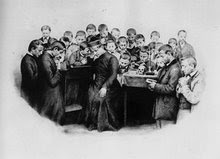
I never got tired of instilling into their
little heads: “By your conduct give glory to God, consolation to your parents and your
superiors. On the other hand, a lazy, undisciplined youth will be a disgrace, a
burden to his parents, a burden to his superiors, and a burden for himself.”
From Valdocco would rise “good citizens
and honest Christians” of whom the world has much need.
Wednesday, April 20, 2016
Subscribe to:
Posts (Atom)