The following comes from the Time Magazine blog:
Tuesday, July 19, 2011
Cardinal Zen on China's War Against the Catholic Church
The following comes from the Time Magazine blog:
Friday, March 7, 2008
Salesian Cardinal Zen prepares Stations for Pope Benedict

The following is a translation of Paolo Rodari's article that I found on wdtprs.com and was translated by Fr. Z. It is very intersting and says a lot about the concern that the Holy Father has for the Catholic Church in China. God bless our Salesian Cardinal Zen and all of the faithful in Hong Kong and China.
The Pope Realpolitick toward China passes to the Via Crucis at the Colosseum
Paolo Rodari
Facts support that Benedict XVI, with his hallmark political pragmatism, values especially relations with Beijing in an attempt to safeguard as much as possible the difficult lot of the Catholic Chinese.
Beyond sending, in May of last year, a historic letter to Catholics in that country, in which for the first time important openings were made by the Holy See to Beijing and to the Church taking the governments line (in addition to this Church, in China there lives in the midst of a thousand difficulties another, underground Church), it is foreseen for the upcoming Stations of the Cross on Good Friday at the Colosseum that Benedict XVI will send beyond the Great Wall another signal worthy of note.
To pen the meditations, in fact – and this choice is obviously entirely Ratzinger’s – will be the Bishop of Hong Kong, Joseph Zen Ze-Kiun, 76, born Yang King-pang in the Diocese of Shanghai.
Zen became bishop of the Diocese of Hong Kong in 2002, after being in Hong Kong as Coadjutor since September 1996, a year before the return of the city to Chinese mainland control.
And when, on 22 February 2006, Benedict XVI announced the surprising intention to give him the Cardinal’s biretta, it was well understood that the Pope was counting on the new Cardinal to work amidst the difficult relations between the Holy See and Beijing. Zen’s words after the announcement of the Pope, in fact, demonstrate this desire: "This nomination", the Chinese Cardinal said, "is a sign of good will and of the Pope’s affection for all of China. And if I accept it, I accept it for all China. I am already nearly 75 and I was thinking to retire. Now I don’t know what will happen to me. But we stand at attention and obey our orders. Perhaps the Pope will have need for advice once in a while. There is a great deal to be done regarding China."
It is beyond question too much to say that the choice of Zen to pen the Good Friday meditations is a hand extended by the Holy See to a country that, in all ways, seeks to show to the West a democratic face (included in this attempt is also the difficult organization of the Olympics).
Still, a Chinese bishop coming after the illustrious names of Angelo Comastri (2006) and Gianfranco Ravasi (2007) offers his own reflections for one of the papal events most closely followed by the world, remains a publicity opportunity that China can in some way play with on the level of image. [In other words, China has no choice but to ‘spin’ this in as positive light as possible.]
Still, on balance among Chinese prelates Zen is the one characterized by a line of greater realism regarding Beijing. A line, namely, that absolutely does not want to hide the sufferings of so-called underground Catholics. Zen, in fact, from the position of strength he has earned in this issue, has often chosen openly to criticize Beijing. Even though in Hong Kong Catholics are only 5 percent of the population, the Cardinal has often shown, as faithful son of St. John Bosco he is, a courageous social commitment, thanks to which he has become one of the most respected and influential figures – and even feared – in the city. It wasn’t by chance that in 2002 he was voted to be "person of the year", receiving in the newspapers the singular place of "the moral conscience" of Hong Kong.
Beijing is a government that tends to respect tough figures, intransigent in certain issues, like Zen. And even though the day in which he received the Cardinal’s red various observers saw in his controversial character an obstacle to relations with Beijing, Benedict XVI instead red precisely in the fine points of this not easy character that authority which Beijing requires from every interlocutor.
In was in 1999 that Zen’s line toward Beijing came to the fore in way evident to all. At that time there were arrested various exponents of a movement for "residence rights" for children of residents of Hong Kong born in China. Zen took a public position against these arrests and actually got to the point of encouraging hunger strikes and sit-in demonstrations. No religious leader had ever dared so much.
Zen has many times expressed his favor about the letter sent by the Pope to Chinese Catholics. In particular, he saw as positive the desire of Pope Benedict XVI to welcome, after long years of forced separation, the very large majority of bishops of the official Church into the one Catholic Church. "The Church in China", he said on the occasion of the 2005 Synod of Bishops, "apparently divide in two, one official recognize by the government and one clandestine which refuses to be independent from Rome, is in reality only one Church, because all want to be in unity with the Pope". It is hoped, then, that also Beijing will accept this desire for unity "even if" he said, "the ‘conservative’ elements in the official Church resisting it, for obvious motives of self-interest."
I find it really interesting that the Pope chose Card. Zen for this globally visible role on the even of the Beijing Olympics.
Rodari dismisses the idea that this choice is actually a positive extension of a hand to Beijing.
Having Zen in the spotlight at Good Friday, which underscores Christ’s suffering, will automatically also underscore suffering and human rights in China.
No matter what, China must put a positive spin on this choice, given the need to present the very best face to the West, including especially the Holy See, before the Summer Olympics.
Saturday, October 9, 2010
Salesian Cardinal Joseph Zen on the Church in China
The predicament of the Catholic Church in China is one of lights and shadows -- improvements in one area, run-ins with the government in others.
Cardinal Joseph Zen Ze-kiun is perhaps one of the most noteworthy spokesmen of this predicament. The 78-year-old cardinal was appointed the coadjutor bishop of Hong Kong in 1996, taking the reins of the diocese in 2002, until his retirement last year.
Cardinal Zen was in Germany last month for the 8th European Catholic China Colloquium, which brought together representatives of Catholic organizations and initiatives in Europe. The China Center in St. Augustine, near the former German capital Bonn, was charged with the organization this year.
ZENIT spoke with the cardinal at that conference, asking him about the current situation and the future of the Church in China.
ZENIT: What in your opinion is the precondition for true human development in China, including the special administrative regions like Hong Kong? And what is the role of Christians in achieving this?
Cardinal Zen: I think, if the development should be a real one it should be integral and comprehensive, as Archbishop [Reinhard] Marx [of Munich] has said here [at the colloquium] very well. And the Catholic Church can help on the spiritual side. Unfortunately too many people think development means only economic and technological progress. That is not enough. I think on the spiritual level many can contribute, not only Catholics, also for example, Confucianism as a very precious heritage of the Chinese people. But surely we Catholics, or Christians in general, have Jesus Christ as real model of human perfection.
ZENIT: How attractive is Christianity in mainland China nowadays?
Cardinal Zen: There is a little more legal relaxation for Catholic families to baptize their children. Before it was forbidden; you had to reach the age of 18 years. But now you are allowed to baptize your children, which is very good. Concerning the attractiveness for the people from outside, surely it exists. But I do not know how much, I am not informed about the details. But especially the university students, the intellectuals -- they come into contact with Christian doctrine through Western culture. And they are very much interested. I know that there are also academic exchanges between the West and China; that is very promising.
ZENIT: Does the regime try to control this development?
Cardinal Zen: Well, very strange, on the academic level many more freedoms are allowed. The priests are not allowed to preach there, but academic exchange is allowed.
ZENIT: But one day the regime will lose control over the intellectuals, won't it?
Cardinal Zen: It is [already].
ZENIT: Is this maybe the hope for the future?
Cardinal Zen Ze-kiun: Yes, I think so. When Chinese students come for exchange to Hong Kong, to the Hong Kong University, for example, they invite me and I go there and there is no objection because it is on the academic level.
ZENIT: You have recently warned again about the paternalism of the Catholic Patriotic Association. What has been the reason for this?
Cardinal Zen: For me the Patriotic Association, especially on the national level, is very powerful; the bishops have nothing to say and no power at all. This is obviously because the government uses the Patriotic Association to control the Church. Mr. Liu Bainian [vice president of the association] represents the government, to keep the Church and the bishops controlled by him. After so many years they are so powerful and they have so many advantages, so be sure they do not want to change. On the local level it is a very different situation because in some places the bishop has enough power so that the association has not so much power.
But it is obvious that the situation is not for the good of the country because everybody knows that the Church is not really free. They do not respect the Chinese government and they see that there is no freedom there. But unfortunately the association has so many friends in the government, so maybe there is some difficulty for the government to eliminate the Patriotic Association. But we really need a decision because if you keep the association nobody in China or outside will believe [there is] a real religious freedom.
ZENIT: Has the situation improved over all concerning the ordination of bishops and the cooperation between China and the Vatican?
Cardinal Zen: The improvement in these days is that there have been no illegitimate ordinations in the last few months. But is that truly very good? I doubt it, because, what do you mean when you say: "A bishop is accepted by both sides, by the Chinese government and by the Holy See." You can have many different possibilities. One possibility is, what we desire, that the Holy Father chooses bishops and the Chinese government says, "OK, we have no objection." That is the ideal. But is this the case? No. We see that many times the government says, "We want this bishop." Maybe he is not that good but the Holy See says, "In that diocese we want this bishop and if you agree in this case, we say OK in the other case." So it is bargaining and sometimes you get more advantage and sometimes less; sometimes you make more concessions, which is very dangerous. Certainly it is not true that the Chinese government willingly accepts all the candidates of the Holy See.
ZENIT: How long will it take until the Holy See exchanges ambassadors with Beijing?
Cardinal Zen: Actually, all the commentators say it is not very likely because now Beijing and Taiwan are in a better relationship. So, in some way, Beijing allows Taipei to keep diplomatic relations with several small countries and among them the Holy See. If Beijing would accept diplomatic relations with the Vatican, the Vatican would have to abandon Taiwan and so, indirectly Beijing would offend Taiwan. So they may not be in a hurry to have diplomatic relations. But that is not the question. Even without diplomatic relations you must understand that the improvement of the situation, the normalization, is good.
Thursday, September 24, 2009
Cardinal Zen challenges China to free Catholic Bishops from prison
Our Salesian Cardinal Joseph Zen is in the news again. He is challenging the Chinese government to free the imprisoned Catholic Bishops on the anniversary of the founding of the People's Republic. Let's pray for the Cardinal and for the Church in China and especially for all those who continue to suffer in prisons. The following comes from the Asian News site:In a message for the 60th anniversary of the founding of the People’s Republic of China, Card Joseph Zen, the bishop emeritus of Honk Kong called on Chinese President Hu Jintao to free all Catholic bishops in prison.In his message, which was made public yesterday on the website of the Diocese of Hong Kong, Cardinal Zen said: “After 60 years since the founding of the People’s Republic of China, the time has come for its leaders to be courageous and correct past mistakes by releasing religious leaders who were deprived of their freedom (from Su Zhimin [bishop of Baoding (Hebei)], seized decades ago to Mgr Jia Zhi Guo [bishop of Zhengding], detained last March). This is the time for leaders to step down from their high places and directly engage our bishops in dialogue because they are the real heads of the Church.”For the prelate, the government in Beijing should “sit down at the [negotiation] table with the Holy See and with sincerity find ways that are mutually acceptable to consult each other and live in harmony.”In his message, Cardinal Zen praised some of Hu Jintao’s words for raising some hope. Speaking before the National Committee of the Chinese People’s Political Consultative Conference (CPPCC) on 20 September, Mr Hu had said that this institution was designed to “better carry forward democracy, strengthen solidarity and resolve contradictions”. This, the prelate said, “is what the people expect from the state”.“I could not avoid applauding,” the cardinal explained, when he heard Hu say that the CPPCC should promote the harmonious development of “relations with religions” and with “compatriots both at home and abroad.” The CPPCC “should uphold the principle that man is at the centre, listen to the voice of the people [. . .], and explain the social situation and public opinion, offering advice and suggestions.”For Cardinal Zen, when Hu speaks about “relations with religion,” he is referring to what Benedict XVI also wants as when he said: “I hope that the faithful in China can live in peace their life of faith, and contribute [to the development] of their homeland.”According to Cardinal Zen, Hu’s programme is an “”unprecedented challenge . . . but also a great opportunity.”Unfortunately, in China “some (opportunists) only pursue their own immediate interests and do not want to give up” centre stage and power, he said.They are “only concerned with hanging onto power and [protect] their own interest without concern with the real interest and policies of the state.” All this leads to a “stalemate” and to delays that cause damage.The cardinal is referring here to unspecified “ultra leftist” figures who still want to oppose the Christian faith to patriotism, but it is not hard to see that these (unnamed) individuals are in fact top officials in the country’s patriotic associations and the Ministry of Religious Affairs.
Friday, October 30, 2009
Film on Cardinal Joseph Zen, SDB wins an award
The following comes from the UCA News:A Catholic journalist’s documentary on Cardinal Joseph Zen Ze-kiun’s involvement in social justice issues has won an award in an international religious film festival.Doris Law Suk-yi, a journalist working for Hong Kong Cable Television (HKCTV), beat five other competitors in the “Religion and Society” category at the 2009 Religion Today Film Festival held in several Italian cities. A special jury of journalists from Trento, northern Italy, said her documentary, “Zen’s Way,” was the best interpretation of the complex relationship between religion and society. It was the only East Asian film to win an award at the event, held from Oct. 14-24.The 46-minute documentary follows Cardinal Zen from 2007 until early 2009 as he goes about his daily life and activities in fighting for the rights of social minorities. The cardinal retired in April.The documentary also includes scenes of Shanghai where the outspoken Church leader was born and the site of the former Salesian seminary he joined.Law says the film demonstrates the prelate’s concern for society.Before his retirement, Cardinal Zen was known for being vocal on social issues, daring to criticize the human rights record in China and in particular the situation of the Church in China. He also fought for the right-of-abode for mainland-born children of Hong Kong residents and called for greater democracy in Hong Kong.His efforts in fighting for religious freedom for Catholics on the mainland was “hardly a rewarding act, but as a prophet it is the Way of Cross that he must walk,” said Law.Law said the cardinal’s actions moved her. During Easter 2005, she and her husband became Catholics.She said the award belongs not to her but “to the oppressed brothers and sisters in mainland China, the underprivileged and those who fight for their rights.”Dominic Yung Yeuk-yu, director of the Hong Kong Diocesan Audio-Video Centre, believes the film won partly due to Cardinal Zen’s fame, noting that many people know him not for his religious background, but because of his vocal support for the underprivileged.The Religion Today Film Festival, begun in 1997, is the first such festival to highlight religious films. This year’s theme was “Born from Above. New Life in Faith.”
Saturday, October 3, 2009
Salesian Cardinal Zen calls for release of imprisoned bishops in China
As the Peoples Republic of China is celebrating the party´s 60th anniversary, the bishop emeritus of Hong Kong is calling on Chinese President Hu Jintao to release all Catholic bishops in prison.
According the Cardinal Kung Foundation, currently, every one of the approximately 35 underground bishops of the Roman Catholic Church is either in jail, under house arrest, under strict surveillance, or in hiding.
Cardinal Joseph Zen´s message was made public on the Diocese on Hong Kong´s website last week.
Most recently, a bishop was taken into custody last March.
Cardinal Zen says the time has come to be courageous and correct past mistakes by releasing religious leaders who were deprived of their freedom.
Card. Joseph Zen
Bishop Emeritus of Hong Kong, China
"Everything we are doing and saying is just because we love our country. Because we see that this way of dealing with the church denying the freedom is a shame for our country. You know we know that all the other countries are doing good business with China. But in their hearts they dont respect China. Because they know that theres not much human rights."
The Cardinal is hopeful the government in Beijing will step up after President Hu vowed the party was working to resolve contradictions during a speech he made earlier this month.
Cardinal Zen views President Hu´s goal as an unprecedented challenge...but also as a great opportunity.
China is among one of the Asian communist countries that have been affected by the lack of religious freedom and reportedly Christians are some of the most victimized.
Friday, May 25, 2012
Cardinal Joseph Zen, SDB: Our Lady Needs to Obtain Miracles
ROME, MAY 24, 2012 (Zenit.org).- "As the Holy Father told the faithful during a general audience recently, taking his example from the primitive Church, what we have to do in face of persecution is to pray so that we may have the courage to proclaim the truth with frankness," said Cardinal Joseph Zen Ze-kiun, bishop emeritus of Hong Kong.Thursday, October 22, 2009
A Preview of the Cardinal Zen Interview!
A Message to Those in Formation from Cardinal Zen from Mike Massey on Vimeo.
Cardinal Joseph Zen, SDB spent 3 days with us this past weekend and offered our community a day of recollection. The above is a preview of an interview that the Cardinal graciously gave on a variety of topics. More to come soon! Thanks Mike!
The above picture is a group of our men in formation (and some of their formators) along with Cardinal Zen.
Tuesday, March 29, 2011
China: Don Bosco has come to get to know the young people of China
The following comes from the Salesian News Agency:
On Thursday 17 March, slightly ahead of schedule, the casket with the relic of Don Bosco arrived in the Special Administrative Region of Hong Kong of the Chinese Peoples’ Republic.
“Saint John Bosco has come!” Fr Simon Lam, Superior of the “Mary Help of Christians Province of China” declared during the welcoming ceremony. Among those with the Provincial at the “Ex Skylimo International airport” was Cardinal Joseph Zen Ze-Kiun, SDB, former Bishop of Hong Kong, and over 200 members of the local Salesian Family.
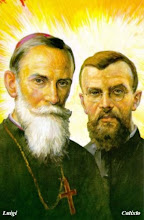
During the ceremony the Provincial recalled Don Bosco’s wish to send his spiritual sons to China and Don Rua eventually sending Fr Luigi Versiglia, who became a martyr saint for God and for China. Cardinal Zen Ze-Kiun spoke about the importance of the visit of the casket: “It is important to treasure these days that we can stay with Don Bosco, to pray for those who are in need especially abandoned young people. For Don Bosco`s confreres this is a chance for us to review our religious vocation and apostolic life.”
Then a Guard of Honour from Salesian Yip Hon Primary School and Salesian Yip Hon Millennium Primary School performed Giu’ Dai Colli to escort the Casket, while Cardinal Zen officiated at the ceremony.
On Friday 25 March the casket was welcomed at the Tang King Po Institute, in a ceremony at which the School Band and Choir performed. Also on this occasion Cardinal Zen Ze-Kiun and the Provincial both spoke. Referring to the relic of Don Bosco’s right hand said that Jesus used human’s hands to do his work and uses our heart to love others. Addressing the young people Fr Lam said that Don Bosco present among them through his relic was interested in them and would like to know about them and what their daily life was like so that he could lead them to Jesus.
Student representatives then expressed their wishes and prayed in front of the relic of Don Bosco with the intentions that temptations might be kept away from them, they might use their time well and spread the Gospel among their companions
The following day Saturday 26, in the church of Mary Help of Christians about 1500 young people gathered around the casket. With traditional dances, musical and theatrical performances they demonstrated the quality and breadth of their Salesian education and at the same time the characteristics of the Salesian Youth Movement: joy, cheerfulness, hard work, serving God enthusiastically, caring and serving others.
Among the young people present were 9 from Mongolia, accompanied by Fr Paul Leung, who with a video showed the Salesian mission in Mongolia.
Tuesday, August 31, 2010
Cardinal Zen hopeful situation in China will improve for Catholics
The Bishop Emeritus of Hong Kong, Cardinal Joseph Zen, said this week he hopes the situation for Catholics in China will improve despite the religious freedom difficulties that exist in the country. He added that the testimony of the faithful amidst widespread repression is fundamental for the future of the Catholic Church there.
According to L’Osservatore Romano, Cardinal Zen recently accompanied a group of nine Chinese Salesian sisters at Pope Benedict XVI’s general audience at Castel Gandolfo. Regarding the situation for Catholics in China he said, “It is important to follow the guidelines laid out by the Pope in this 2007 letter to Catholics in China,” which still has not been widely read due to government repression.
The future of the Church in China depends on the silent but efficacious testimony of Catholics in country, the cardinal continued.
Referring to the Salesian sisters, Cardinal Zen said, “The fact that they live amidst the people and are committed to ordinary tasks gives particular weight to their testimony.”
Saturday, January 10, 2015
Pope Francis: Only the Holy Spirit opens our hearts to love God
The Pope’s reflections came from the day's gospel reading that recounted how the apostles were terrified when they saw Jesus walking on water. And the reason for their terror, he explained, is that their hearts were hardened.
"Mirror" men and women and religious narcissists
Pope Francis said a person’s heart can be made of stone for many reasons, such as, for example, a painful experience in one’s life. But as he went on to point out, another reason for hardened hearts is because people are closed in on themselves.
“Creating a world within one self, all closed in. Closed within oneself, in one’s community or parish, but always closed in. And this closure can revolve around so many things. But let’s think about pride, self-sufficiency, thinking I am better than others, and vanity too, right? There are ‘mirror-men and women’ (who are wedded to their own image in the mirror), who are closed in on themselves and are constantly looking at themselves, right? These religious narcissists, right? But they have a hardened heart because they are closed in on themselves, they are not open. And they seek to defend themselves with these walls that they have created around themselves.”
Hardened hearts because of insecurity and fear
The Pope said these hardened hearts in people can also arise from a problem of insecurity, such as those who barricade themselves behind the laws and rules, as though inside a prison, to feel safer and follow these rules to the letter,
“When a heart becomes hardened, it’s not free and if it’s not free it’s because that person isn't capable of love, that was the fate of the Apostle John in the first Reading. A love that’s perfect banishes fear: in love there’s no fear, because fear is expecting a punishment and a person who's afraid doesn’t have a perfect love. He or she is not free. They are constantly afraid that something painful or sad will occur, that will cause their life to go badly or will endanger their eternal salvation… What an (over-active) imagination, because he or she can’t love. A person who isn't capable of loving is not free. And their heart was hardened because they hadn’t learnt how to love.”
The Spirit makes us free and docile not yoga or zen courses
Pope Francis concluded his homily by stressing that only the Holy Spirit can teach us how to love and free us from our hardened hearts.
“You can follow a thousand catechism courses, a thousand spirituality courses, a thousand yoga or zen courses and all these things. But none of this will be able to give you the freedom as a child (of God). Only the Holy Spirit can prompt your heart to say ‘Father.’ Only the Holy Spirit is capable of banishing, of breaking that hardness of heart and making it … soft? No, I don’t like that word, … ‘docile’. Docile towards the Lord. Docile when it comes to the freedom to love.”
Tuesday, November 10, 2009
Cardinal Zen on Becoming a Cardinal
Cardinal Zen - Becoming a Cardinal from Mike Massey on Vimeo.
Here is another bit from the interview with our Salesian Cardinal Joseph Zen on becoming a Cardinal!
Tuesday, May 24, 2016
Cardinal Zen on Mary, Help of Christians in China
Cardinal Zen - Mary Help of Christians from Mike Massey on Vimeo.
Here is another bit of the interview with Cardinal Zen from his visit with us!Also, here is more Our Lady and her presence to the people of China from this site:
Our Lady appears in China
In 1900, China reported three apparitions:
One in Beijing in which Our Lady was accompanied by St. Michael the archangel who, in turn, was surrounded by multitudes of angels.
A second apparition involved a weeping statue of Our Lady in the village of Santai during the Boxer Rebellion.
The third apparition occurred in Donglu.
Donglu is about 40 kilometres from Baoding in Hebei province, and it is one of the strongholds of the unofficial Catholic Church in China.
Witnesses recount that a beautiful lady, recognised as Mary, appeared in the skies. The Catholics implored Our Lady to save them from their enemies and their city from destruction. In thanksgiving for Our Lady’s protection over the city of Donglu during the Boxer Rebellion, a beautiful church was built in her honour. It was meant to serve as a constant reminder to the people of Mary’s loving and motherly protection. The pastor, at the time, secured a painting of the Dowager Empress Ci Xi dressed in imperial robes. He commissioned an artist to use it as the background for the image of Our Lady holding the Christ Child. The picture was hung in the Church of Donglu, which eventually became a famous place of pilgrimage.
The shrine at Donglu
People began coming to the shrine in Donglu in 1924, but the first official pilgrimage took place in 1929. By 1932, the location became such a popular pilgrimage site that Pope Pius XI approved it as an official Marian shrine.
Since 1929 tens of thousands of pilgrims have made their way up the hill to the shrine, especially in May.
The Miracle Of The Sun 23 May 1995
On 23 May 1995, pilgrims witnessed another phenomenon. Over 30,000 Catholics from the unofficial Church had gathered for Mass at the Donglu shrine. It was the vigil of the Feast of Our Lady, Mary Help of Christians, a favourite of Chinese Catholics. There were four bishops of the unofficial Church concelebrating the Mass and nearly 100 unofficial priests standing in the open field, all eager to honour Our Lady in a special way during her special month.
Suddenly, during the opening prayer and again during the consecration, the people observed the sun spinning from right to left. Light rays of various shades emanated from the sky. The people, mesmerised by the phenomenon, could look directly at it without blinking. Suddenly from the centre of the sun people saw what they later described as an apparition. Some beheld the Cross; others said they had seen the Holy Family. Still others had seen Our Lady holding the Infant Jesus while others claimed they had seen the Sacred Host. People, overwhelmed by the vision, suddenly became conscious of their sinfulness and began to cry out, “Holy Mother, forgive me my sins,” or “Holy Virgin Mary, have pity on us your children.” The phenomenon of the sun changing colours, approaching and then retreating while radiating various hues, lasted for about 20 minutes.
The government’s response
Needless to say, the government has not been terribly enthusiastic about having thousands upon thousands of people gather anywhere. This is all the more threatening when the gathering involves religion and people of the unofficial Church. The Public Security Bureau, the agency in charge of keeping watch over the unofficial Catholic community, periodically flexes its muscles to prevent anyone from going on pilgrimage to Donglu. In 1995, when tens of thousands of pilgrims flocked to Donglu for the Feast of Mary Help of Christians on May 24, the Public Security barred all pilgrims from joining anyone on the hill. The police forced people back into buses and trains without offering any explanation. Still, thousands successfully reached the area by finding alternative ways to get there. As many as 100,000 participated in the celebration.
Again in 1996, an official announcement forbade anyone from going to the Donglu shrine. This time two reasons were given for the prohibition: it was an illegal gathering and it was bad for social stability.
Teams of Public Security agents as large as 500 strong were dispatched to all the villages surrounding the Donglu area and to towns all over Hebei Province. As they travelled around, they tried to force the members of the unofficial community to join the Patriotic Association and to do away with unrecognised religious premises such as Donglu. Priests in the towns and villages were ordered not to leave their residences and were forbidden to preach from May 13 until further notice. Lay people were also forbidden to leave their villages. Parents were not allowed to take their children to church or to wear any religious objects.
Against all odds
It seems no amount of pressure can dull the enthusiam of Catholics intent on honouring Our Lady at the Donglu shrine. Every May, regardless of prohibitions, tens of thousands of pilgrims make their way up the steep hill, either in silence or reciting the rosary or singing hymns to praise one who is truly their mother and protector.
The shrine at Sheshan
In June 1989, Pope John Paul II prayed that the Virgin of Sheshan Help of Christians, would look kindly on “the beloved Chinese people.” This remark by Our Holy Father indicates the importance of this shrine as a symbol of Christian renewal in China. Sheshan, with its “nine peaks above the clouds” is situated about 35 kilometres from Shanghai city. Its forest of bamboo, its scenic winding paths and running brooks are a fitting location for communing with God and Our Lady. The mountain, according to legend, gets its name from a hermit named She who centuries ago, lived atop the mountain.
In 1866, the Church in Shanghai built a hexagonal pavilion and placed within it an altar and a statue of Our Lady. Five years later, the Jesuits built a church at the summit of the mountain and dedicated it to Our Lady Help of Christians, opening it in 1873.
In 1924, the bishops of China consecrated the nation to Our Lady and following the consecration they made a pilgrimage to Sheshan. Work on a basilica began in 1925 and was completed 10 years later. This church was the first basilica in all of the Far East and it became China’s favourite pilgrimage site.
During the Cultural Revolution the beautiful bronze statue of Our Lady at the pinnacle of the basilica disappeared and other religious symbols, including the altar and the stained glass window were all virtually destroyed. A replica of the bronze statue of Mary holding up the Christ Child was finally re-installed on top of the tower in the year 2000. Some 10,000 believers paid for it. Pilgrimages to the shrine resumed in 1979.
Every year since then, pilgrims by the thousands have flocked to Sheshan. In 1990, the first pilgrimage of the decade saw 30,000 Catholics coming to Sheshan for Our Lady’s feast. The elderly and the young made the long steep climb from the foothills of the mountain to the summit as a testimony of their love and devotion to Our Lady. One large group of pilgrims are the fisherfolk of Jiangnan who, from earliest times, sailed up the Yangtze, carefully steering their craft through the canals surrounding the foothills of the mountain.
Every year, they come, moor their boats and spend three days and nights at Sheshan to implore Our Lady’s help for the future and to thank her for favours received. But they are only a small group compared to the thousands from all over China who come to pay tribute to their heavenly mother in whom they place so much of their trust.
You can read more here.
Sunday, November 29, 2009
Salesian Cardinal Zen clarifies Pope's message to Chinese Catholics
Our Salesian Cardinal Zen is speaking out once again about the Church in China.
Friday, February 28, 2014
An Unusual Road to Monasticism
I. Spring, 2005
Tuesday, April 7, 2009
As in 2008, Pope focuses Good Friday meditations on persecuted Christians

Pope Benedict has chosen a Salesian to prepare the Good Friday meditations for him for the second year in a row! Last years meditations were prepared by Cardinal ZenZe-kiun, SDB of Hong Kong and this year they will be prepared by Archbishop Thomas Menamparampil, SDB of Guwahati, India. The following comes from the CNA site:
For the second year in a row, Pope Benedict XVI has asked that the meditations for the Good Friday Way of the Cross (Via Crucis) ceremony be focused on the plight of persecuted Christians around the world.
Last year's Via Crucis, written by the Archbishop of Hong Kong, Cardinal Joseph Zen Ze-kiun, featured the reflections that were relevant to the Church in China. Cardinal Zen called on the Church to remember the persecuted, as they experience "in their bodies the Passion of Jesus."
This Good Friday, Archbishop Thomas Menamparampil of Guwahati, India, will offer the meditations for the Via Crucis reflect on the question of evil in the world, on pain and on the various forms of suffering which are, he writes, a "symbol of the presence of the cross of Christ in our lives."
Archbishop Menamparampil will also mention the plight of persecuted Christians in India and the oppressed peoples of Sudan and the Congo. In these places, he says, we see a type of violence that "destroys ethnic and religious groups" and conflicts that are "fueled by economic interests."
The Way of the Cross will be presided over by Pope Benedict on the evening of Good Friday, April 10 at the Colosseum in Rome.
EWTN will feature coverage of all the major papal events during Holy Week as well as the papal nuncio to the U.S., Archbishop Pietro Sambi, celebrating the Solemn Mass of the Lord's Supper live from The Basilica of the National Shrine of the Immaculate Conception in Washington D.C.
Sunday, October 18, 2009
Weekend with Cardinal Joseph Zen, SDB
We had a wonderful weekend here in Orange with a special visitor; the Salesian Cardinal Joseph Zen of Hong Kong! The Cardinal spent 3 days with us and gave us a day of recollection at Don Bosco Prep in Ramsey. 100 Salesian Priests, Brothers, Sisters, and men and women in formation came together for the day. The Cardinal is an outspoken advocate for the Church in China and for the religious freedom all around the world. I will add some more pictures later. Eventually I will put up some really great talks and interview questions as well! God bless the Cardinal and his work in Hong Kong!
Here are some past posts on the Cardinal.